
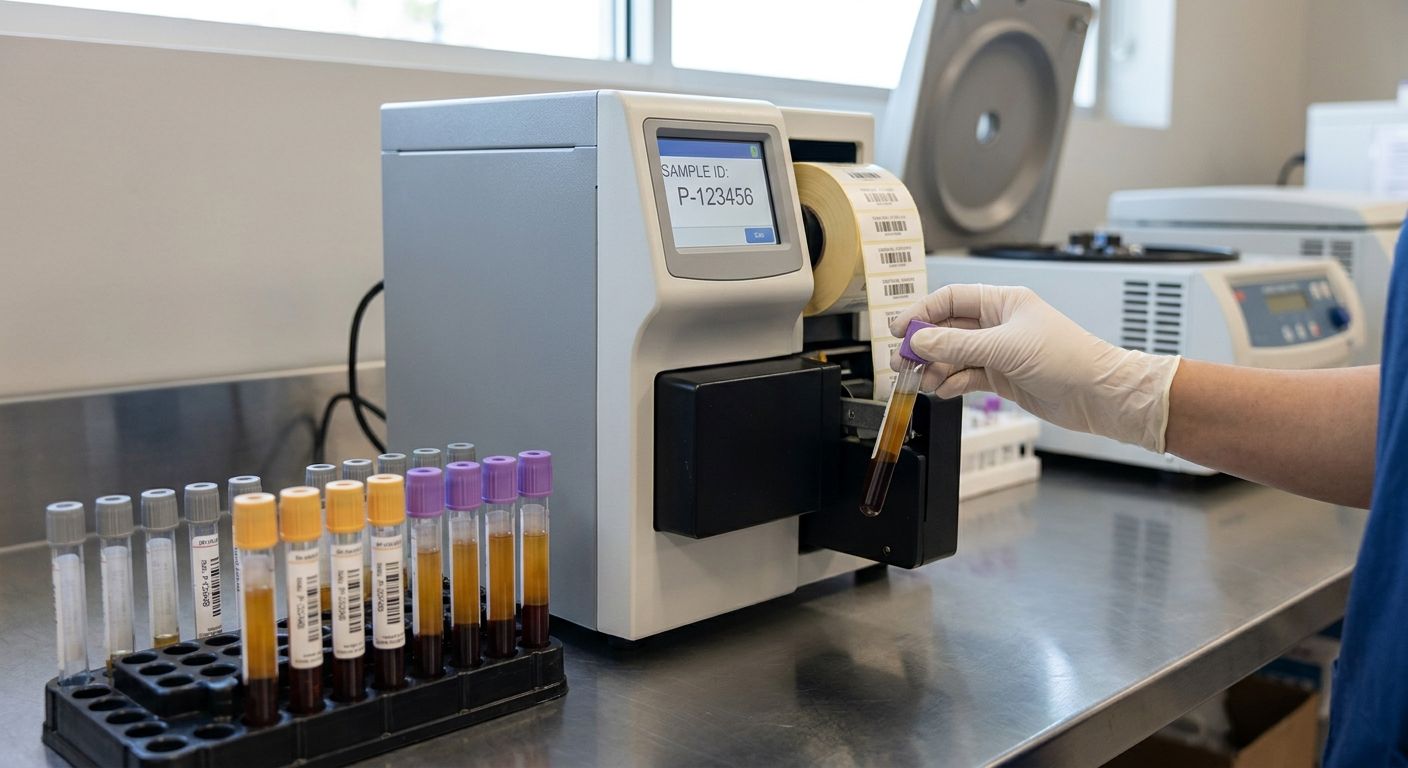
Plasma donation centers process hundreds of tubes a shift, and a mismatched label on a single specimen tube can mean a discarded donation or a chain-of-custody failure. This guide breaks down what a test tube labeler for plasma donation centers actually needs to do at draw-station speed, and which McAuley Labels printers hold up under daily centrifuge and cold-storage cycles in 2026.
- GoDEX RT700i wins for multi-bay draw stations needing standalone printing without a PC tether — Buy.
- GoDEX ZX430i at 300 DPI is the pick when barcode density outpaces 203 DPI resolution — Buy.
- GoDEX RT200i at 203 DPI covers single-bay centers on tight budgets — Consider.
- Direct thermal labels fail centrifuge and alcohol-wipe exposure faster than thermal transfer — skip direct thermal for tube labeling.
Why this matters
A misread barcode at a plasma center doesn't just slow down a shift — it breaks the link between donor, tube, and bag, and that's a compliance problem, not an inconvenience. Centers running FDA-regulated plasma collection need labels that survive centrifugation, cold chain storage, and repeated alcohol wipes without smearing.
The printer matters as much as the label stock. A label printer for test tubes in clinical labs built for occasional lab use isn't built for a center running three shifts and dozens of draw chairs. Plasma centers need throughput, duplicate label sets, and resolution that keeps small barcodes scannable at the bag-sealing station.
Who this is for
This guide is for lab managers and operations leads at plasma donation centers ordering a test tube labeler for plasma donation centers to replace handwritten labels or an aging printer that's falling behind draw volume. If your center processes fewer than 50 donations a day from a single station, your requirements differ from a multi-bay facility running networked printers — both get covered below.
What to look for in a test tube labeler for plasma donation centers
Print resolution matched to barcode density
Standard 203 DPI print handles most 1D barcodes and basic text fine, but plasma centers printing small 2D codes or dense linear barcodes on narrow tube labels need 300 DPI to keep bars distinguishable at scan distance. If your center's barcode format packs more than 20 characters into a half-inch label, 300 DPI stops guesswork at the scanner.
Direct thermal vs. thermal transfer durability
Direct thermal printing is cheaper per label but the print fades under heat, cold storage, and repeated alcohol wipes — all three are standard in plasma processing. Thermal transfer, which uses a ribbon to bond print to the label, holds up through centrifugation and freezer storage without the smearing that turns a barcode into a rejected sample.
Standalone throughput vs. networked draw stations
A single-bay center can run one standalone printer at the draw chair. A multi-bay center needs either networked printers or a standalone unit at every station — waiting on a shared printer across a room slows every donor cycle by minutes, and minutes add up across a full shift.
Duplicate label sets for chain of custody
Plasma tubes typically need matching labels on the tube, the collection bag, and sometimes a paper record — all printed in one pass with identical barcodes. A printer that can't queue duplicate sets forces manual re-entry, which is exactly where mismatches happen.
Software compatibility with your LIS
GoLabel-compatible GoDEX printers integrate with most label design workflows and can export from spreadsheet or database sources, which matters if your center pulls donor IDs from a laboratory information system rather than typing them by hand each draw.
Media cost per label at donation volume
A center running 200+ tubes a day burns through label stock and ribbon fast. Thermal transfer ribbon costs more per label than direct thermal, but the durability trade-off pays for itself the first time a direct thermal label fades before the sample reaches the lab.

Top picks for plasma donation centers
The safe pick: GoDEX RT700i This printer runs a 4-color display for on-the-fly label selection without a connected PC — useful when a draw station needs to switch between tube labels, bag labels, and record printouts mid-shift. Standalone operation at a single bay covers most independent plasma centers without networking overhead. Buy if you're running one or two draw stations and want a printer that doesn't depend on a workstation. Check the GoDEX RT700i thermal printer spec sheet against your tube label dimensions before ordering.
The resolution pick: GoDEX ZX430i At 300 DPI, this printer resolves dense barcodes that 203 DPI units blur at the edges — the difference matters when your tube labels carry both a linear barcode and a donor ID in small type. Centers with multi-bay setups printing high volumes benefit from the sharper print holding up through centrifuge cycles. Buy if your barcode format packs more data into a small label footprint. The GoDEX ZX430i 300 DPI printer is the resolution jump most centers underestimate needing until a scanner starts throwing errors.
The budget pick: GoDEX RT200i Standard 203 DPI covers basic barcode and text needs for centers running lower daily volume or simpler label formats. It won't match the ZX430i on dense barcode clarity, but for a single-bay center printing straightforward donor ID labels, the lower cost per unit makes sense. Consider this if your current volume stays under roughly 50 tubes a day and label formats are simple. The GoDEX RT200i 203 DPI printer is the entry point, not the ceiling — plan to upgrade resolution if barcode density grows.
What to avoid
- Direct thermal printers marketed as "lab ready." They print fine out of the box, but heat and alcohol exposure fade the print inside days — thermal transfer is the durable choice for tube labeling, not a nice-to-have.
- Consumer-grade desktop label makers. They look similar to industrial thermal printers online but lack the duty cycle for continuous shift use — expect jams and printhead failure well before 2026 ends if you push consumer hardware past its rated volume.
- Printers without duplicate-set queuing. If tube, bag, and record labels can't print together from one entry, someone is retyping IDs by hand, and that's where chain-of-custody errors start.
Verdict comparison
| Printer | Resolution | Best for | Standalone display | Verdict |
|---|---|---|---|---|
| GoDEX RT700i | 203/300 DPI options | Multi-bay flexibility | 4-color display | Buy |
| GoDEX ZX430i | 300 DPI | Dense barcode formats | Standard display | Buy |
| GoDEX RT200i | 203 DPI | Single-bay, low volume | Standard display | Consider |
Thermal transfer ribbon is a required consumable for any of these three, not an optional accessory — direct thermal media won't hold up through centrifuge and cold storage cycles.
FAQ
What's the best test tube labeler for plasma donation centers in 2026?
The GoDEX RT700i is the best overall pick for plasma donation centers in 2026 because it runs standalone with a 4-color display, avoiding a PC dependency at the draw station. Centers printing denser barcodes should step up to the 300 DPI GoDEX ZX430i instead.
Is 203 DPI or 300 DPI better for plasma tube labels?
300 DPI is better when tube labels pack small barcodes or dense text into a half-inch footprint. 203 DPI works fine for simple donor ID labels but starts blurring fine barcode elements as data density increases.
Should plasma centers use direct thermal or thermal transfer labels?
Thermal transfer is the better choice for plasma tube labeling because it resists fading under centrifugation, cold storage, and alcohol-wipe contact. Direct thermal is cheaper per label but fades faster under those exact conditions.
How much does a test tube labeler cost for a plasma center?
Industrial thermal printers suited to tube labeling generally run in the low-to-mid hundreds to low thousands of dollars depending on resolution and standalone features, plus ongoing ribbon and label media costs. Check current pricing on individual printer pages for exact figures.
Can one printer handle both tube labels and bag labels?
Yes, as long as the printer supports duplicate label set queuing so tube and bag labels print together with matching barcodes from one entry. Printers without that feature force manual re-entry, which raises mismatch risk.
Do plasma centers need networked or standalone printers?
Single-bay centers do fine with one standalone printer at the draw chair. Multi-bay centers running several draw stations at once typically need either networked printers or a standalone unit at every bay to avoid shared-printer bottlenecks.
What resolution do most plasma tube barcodes require?
Most tube barcode formats print cleanly at 203 DPI, but any format packing more than roughly 20 characters into a small label benefits from 300 DPI to keep bars distinguishable at the scanner.
One last thing
The detail most centers miss when shopping for a test tube labeler for plasma donation centers isn't the printer at all — it's the ribbon. A printer rated for thermal transfer without matching ribbon stock on hand defaults back to a blank or smeared print the moment the current roll runs out mid-shift. Stock ribbon ahead of donation volume spikes, not after.