
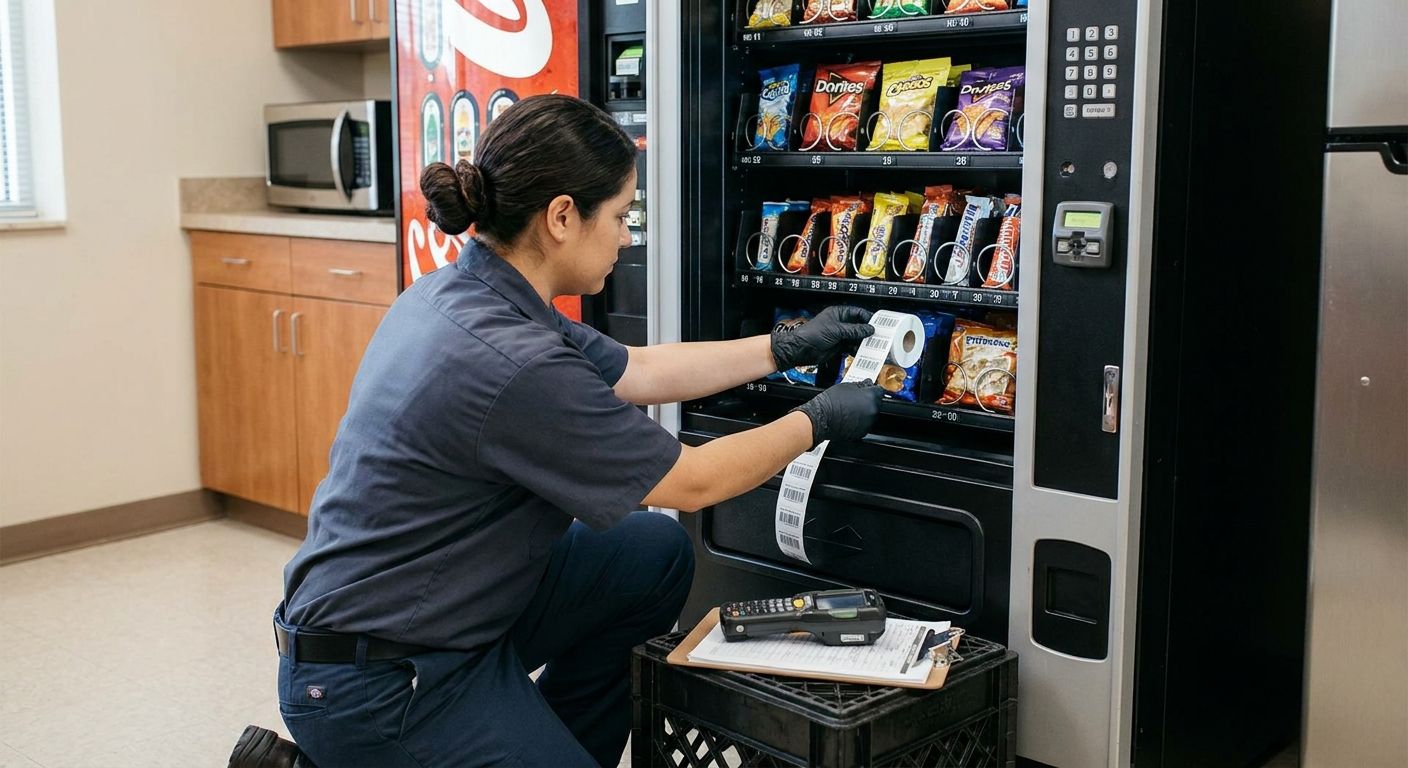
Vending machine restocking routes run on tight windows: drivers scan a shelf tag, refill the coil, and move to the next stop before the walk time eats the margin. The inventory label on that shelf bin or route tote either keeps the scan fast or slows down every stop on the list.
- Custom QR code inventory labels on metalized silver polyester scan through cold and condensation — buy for route totes.
- 3M heavy-duty barcode inventory labels hold up on steel vending racks handled daily — buy for high-turn SKUs.
- Standard paper labels smear inside coin-op machines and jam handheld scanners within weeks — skip them.
- A GoDEX RT200i printer running at 203 DPI covers in-house barcode runs without waiting on pre-printed rolls.
Why this matters
Vending route operators don't manage one stockroom — they manage a rolling one, spread across a van rack, a hand truck, and a dozen or more machine cabinets a day. A label that peels off a candy tote at stop three costs you a recount at stop four. Inventory labels for vending machine routes need to survive handling, temperature swings between the van and the machine interior, and repeated scans by a handheld device that's usually held at an angle, not flat under a warehouse scanner.
Most route operators inherit whatever labels came with their point-of-sale software, which usually means standard paper stock built for a stationary shelf, not a moving route. That mismatch shows up as failed scans, faded lot numbers, and drivers manually keying in SKUs — the exact thing barcode labeling was supposed to eliminate.
Who this is for
This guide is for independent vending operators and route drivers who restock multiple machines a day from a mobile inventory — coin-op snack and drink machines, micro-markets, and office pantry programs where SKU counts change stop to stop. If you're tracking inventory across a van, totes, and machine coils rather than a single warehouse floor, the label spec below applies to you.
What to look for in inventory labels for vending machine routes
Adhesive rated for cold surfaces and condensation
Vending machine interiors run cold near the coils, and totes ride in an unheated van cargo area for hours. A label adhesive that isn't rated for temperature swings lifts at the corner first, then peels off entirely by the second week — right when the barcode still needs to scan clean.
Scan reliability at an angle, in low light
Handheld scanners inside a vending cabinet rarely get a flat, well-lit read. QR codes and 2D barcodes on high-contrast stock — metalized silver or semi-gloss white — hold their read rate better than low-contrast paper prints when the driver is scanning one-handed with the machine door half open.
Small format sizing that fits shelf bins and totes
Vending shelf bins are narrow. A label sized for a warehouse rack shelf just doesn't fit a snack coil tray or a route tote lid. Compact label formats matter more here than in a standard stockroom.
Sequential numbering for route order
Routes restock in a fixed sequence — machine 1, machine 2, machine 3 — and numbered inventory labels let a driver match a physical bin to a route sheet without cross-referencing a spreadsheet mid-stop.
Material that survives daily handling
3M heavy-duty and metalized silver polyester stocks resist tearing, moisture, and the constant loading and unloading that a paper label was never built for. This is the difference between a label lasting a route season versus a single week.
Print speed that matches restock volume
If your SKU mix changes often, waiting on a pre-printed batch order slows down the whole route. In-house printing at 203 DPI or 300 DPI covers most barcode and QR needs without a reorder lag.
Top picks for vending route inventory labels
The scan-first pick. Custom QR code inventory labels on metalized silver polyester hold a clean scan through condensation and repeated handling, and the QR format lets a driver pull SKU history from a phone camera instead of a dedicated scanner. Buy if your route mix changes weekly and you need flexible scan-and-log workflow.
The durability pick. 3M heavy-duty barcode inventory labels are built for daily loading onto steel racks and van totes without the adhesive giving up. Buy for high-turn SKUs that get restocked multiple times a week and take the most physical handling.
The in-house printing pick. A GoDEX RT200i 203 DPI printer prints barcode and numbered inventory labels on demand, so a route manager isn't waiting on a reorder when a new vendor SKU shows up mid-season. Buy if you print more than a handful of labels a week in-house.
The steady-state pick. Semi-gloss white ID inventory labels cover routes with a stable SKU count and predictable restocking cadence — a clean, lower-cost option when durability demands are moderate. Consider if your route runs the same machines with the same product mix month to month.
What to avoid
- Standard copy-paper labels. They look fine on day one, then smear or tear inside a vending cabinet within a few weeks of handling — the barcode becomes unreadable long before the adhesive fails.
- Oversized barcode formats. A label sized for a warehouse shelf tag doesn't fit a vending coil tray or a route tote lid, and drivers end up folding or trimming labels on the fly, which distorts the barcode.
- Glossy stock without contrast testing. Some glossy finishes reflect glare under a vending cabinet's interior light, which drops scan rates exactly where a driver needs a fast, one-pass read.


Verdict comparison
| Pick | Material | Best For | Verdict |
|---|---|---|---|
| Custom QR Code Inventory Labels | Metalized silver polyester | Weekly-changing SKU mix | Buy |
| 3M Heavy-Duty Barcode Inventory Labels | 3M industrial polyester | High-turn, daily-handled SKUs | Buy |
| GoDEX RT200i (203 DPI) | Thermal print engine | In-house label printing | Buy |
| Semi-Gloss White ID Labels | Semi-gloss white polyester | Stable, low-change routes | Consider |
| Standard paper labels | Uncoated paper | Nothing on a route | Skip |
If a label can't survive a cold coil and a five-minute restock without peeling, it doesn't belong on a vending route in 2026.
FAQ
What's the best inventory label material for vending machine routes?
Metalized silver polyester and 3M heavy-duty stock hold up best on vending routes in 2026 because they resist the cold, condensation, and daily handling that break down standard paper labels within weeks.
Are QR codes or barcodes better for vending route inventory?
QR codes work better for routes with frequently changing SKUs since a phone camera can scan them without a dedicated reader, while barcodes suit stable, high-volume SKUs scanned with a handheld device.
Do I need a dedicated printer for vending route labels?
You need an in-house printer only if you print more than a handful of labels a week; a 203 DPI printer like the GoDEX RT200i covers standard barcode and numbered label runs without reorder delays.
How much do heavy-duty inventory labels cost for a vending route?
3M heavy-duty numbered barcode labels run higher per roll than standard semi-gloss stock because of the industrial adhesive and polyester face film, but they outlast paper labels many times over on a handled route.
Why do standard paper labels fail on vending machines?
Standard paper labels absorb condensation from cold vending coils and tear from repeated handling, which smears barcodes and drops scan rates within a few weeks of route use.
Can I use numbered labels to match a restock route sequence?
Yes, sequential numbering on inventory labels lets a driver match a physical bin or tote to a route sheet without cross-checking a separate spreadsheet at each stop.
What DPI resolution is enough for vending route barcode labels?
203 DPI covers most barcode and QR code label needs for vending routes; 300 DPI is worth the upgrade only if you're printing small text or dense 2D codes that need finer detail.
One last thing
The detail most route operators miss isn't the label material — it's contrast. A high-contrast metalized silver or semi-gloss white label scans faster under the dim, angled light inside a vending cabinet than a glossy clear label ever will, even when both use the same barcode symbology. Test scan speed under actual cabinet lighting before locking in a full route order for 2026.