
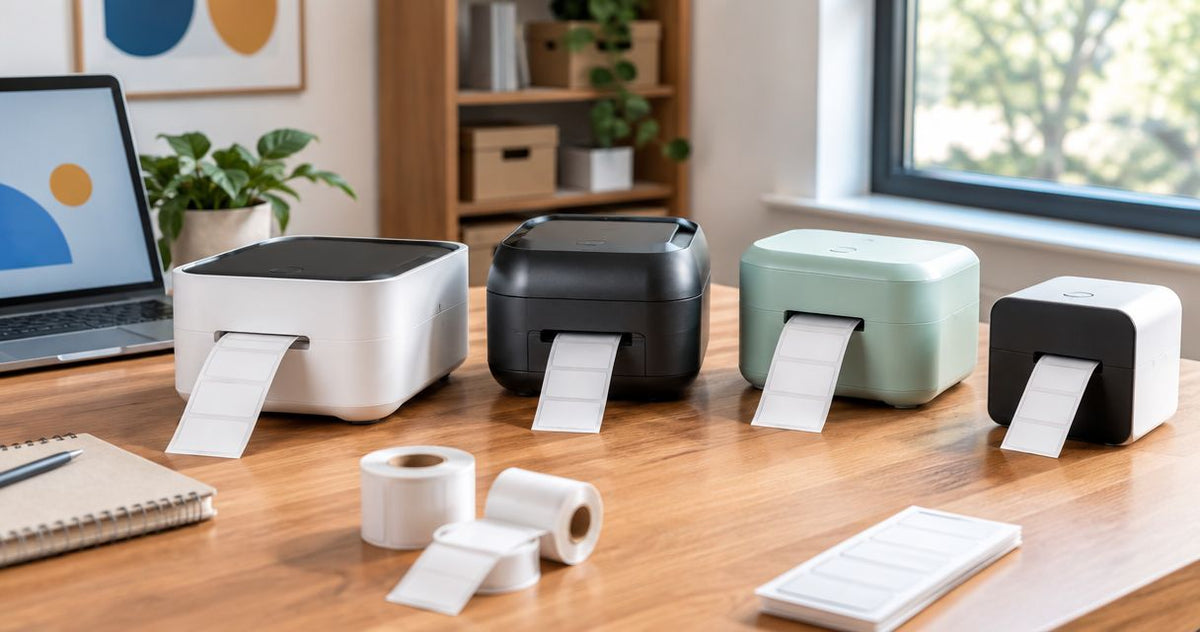
Munbyn is a practical choice when you mainly need direct-thermal shipping labels without ink or ribbon. It stops being a complete answer when the job calls for thermal-transfer asset labels, finer print, or oil change stickers. The best Munbyn label printer alternative in 2026 is the GoDEX RT700i+ from McAuley Labels for businesses that need both direct thermal and thermal transfer; choose the GoDEX ZX430i+ for 300 dpi asset labels.
- The best Munbyn label printer alternative in 2026 is McAuley Labels’ GoDEX RT700i+ for businesses using both thermal print methods.
- Choose the GoDEX ZX430i+ when small text or dense asset-label barcodes make 300 dpi the deciding specification.
- Choose the oil change sticker printer system when service reminders, not shipping labels, are the daily job.
- Keep a Munbyn direct-thermal printer if it already handles your shipping-label work and you do not need another print method.
Why this matters
A shipping label, an equipment ID label, and a windshield service reminder do different jobs. Start with what the label must carry and where it will be used; then choose the printer and label stock together. A higher-resolution printer cannot fix stock that is wrong for the surface, and a specialized sticker system adds little to a shipping-only desk.
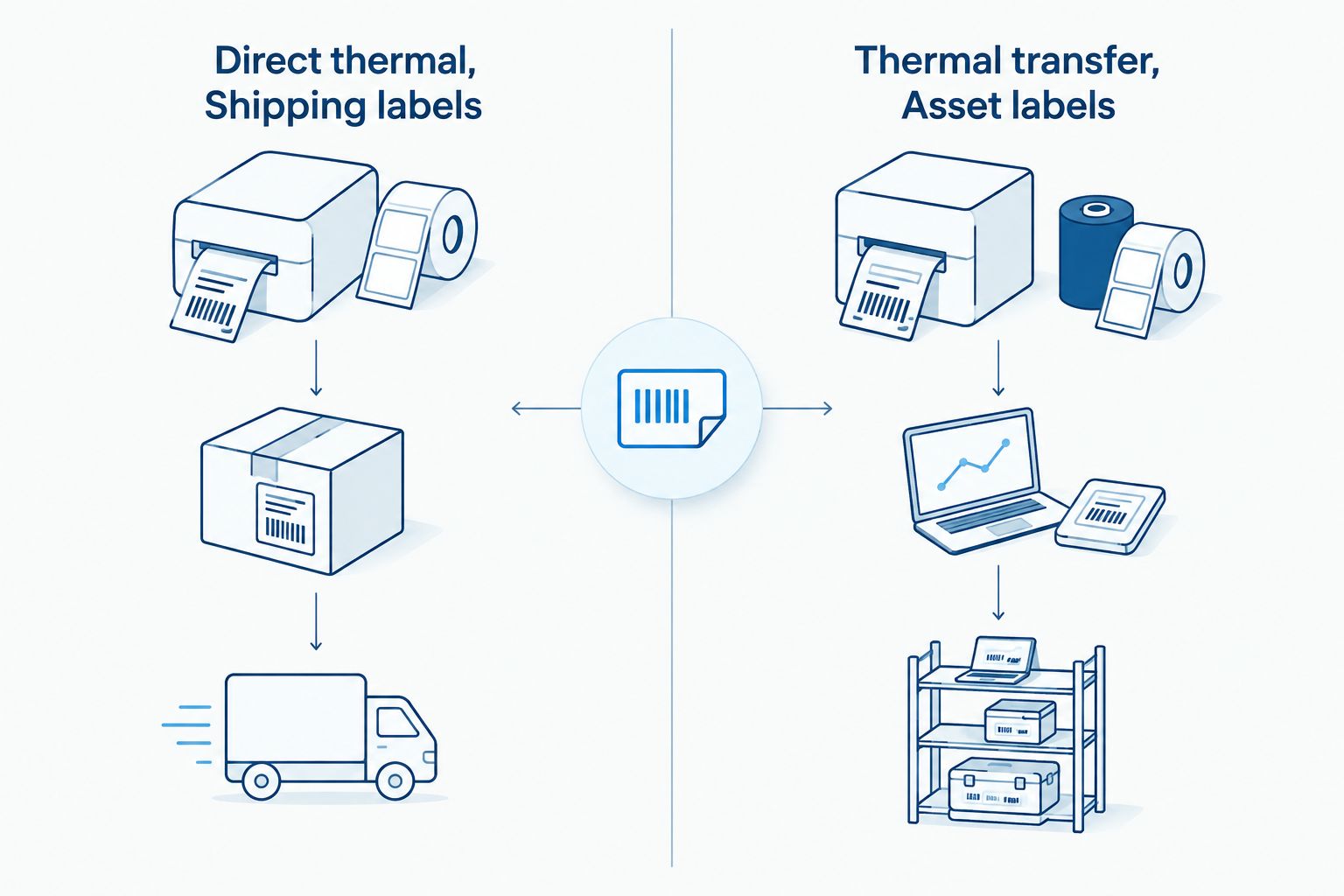
The key distinction in this 2026 comparison is direct thermal versus thermal transfer. Direct thermal prints on heat-sensitive stock without a ribbon. Thermal transfer uses a ribbon to put an image on compatible stock, including polyester labels. Neither method is automatically the right choice for every business: match the method to the label material and working conditions before comparing models.
- Shipping labels: Start with direct thermal if the label stock and your workflow call for it.
- Asset labels: Check the intended material, barcode size, print resolution, and how the tag will be used.
- Service reminders: Check the sticker format and what staff need to enter at the point of printing.
Munbyn alternatives at a glance
This table compares a Munbyn direct-thermal shipping setup with three specific alternatives sold by McAuley Labels. Munbyn sells more than one printer, so confirm your exact model’s specifications rather than treating the brand as a single machine.
| Printer or system | Best for | Standout feature | How it differs from a Munbyn direct-thermal shipping setup |
|---|---|---|---|
| Munbyn direct-thermal shipping printer | Businesses satisfied with their current shipping-label workflow | Ribbon-free direct-thermal printing | The benchmark: no change is needed if its label format meets the job |
| GoDEX RT700i+ thermal printer | Businesses printing both direct-thermal and thermal-transfer labels | Dual thermal operation; 203 dpi and a 4-inch format | Adds a thermal-transfer route for compatible label stock |
| GoDEX ZX430i+ thermal printer | Teams printing fine text or dense codes on asset labels | Dual thermal operation at 300 dpi | Adds thermal transfer and a stated 300 dpi resolution |
| Oil change sticker printer system | Auto service counters printing reminder stickers | Standalone keyboard, ribbon, and 1,000 custom labels in the supplied system | Built around service reminders rather than a general shipping-label task |
Best for everyday business-label flexibility: GoDEX RT700i+. For a narrower use case, the other rows can be the better purchase. The comparison is about fit, not a claim that every Munbyn model has the same limitations.
1. GoDEX RT700i+: best for mixed thermal-label work
The GoDEX RT700i+ is the strongest general-purpose Munbyn alternative here because it supports both direct thermal and thermal transfer. McAuley Labels lists it as a 4-inch, 203 dpi printer with a color display. That gives you a way to consider compatible thermal-transfer stock without abandoning direct-thermal work.
Where the GoDEX RT700i+ shines
- Two print methods: You can choose between direct-thermal and thermal-transfer workflows instead of selecting a separate printer solely to change methods.
- Defined print format: The listed 4-inch format gives you a concrete specification to check against your label design.
- Business-label use: It is a more relevant starting point than a shipping-only purchase when asset or inventory labels are part of the brief.
Where the GoDEX RT700i+ falls short
- 203 dpi is not 300 dpi: If your smallest text or densest code needs more detail, compare it with the ZX430i+ and test your actual artwork.
- Thermal transfer adds supplies: That route requires compatible ribbon and label stock, so it is more involved than ribbon-free direct thermal.
- It is not a finished service-reminder setup: An auto shop looking for the supplied sticker-and-keyboard package should assess the dedicated system instead.
| Decision point | GoDEX RT700i+ | Munbyn direct-thermal shipping setup |
|---|---|---|
| Print method | Direct thermal and thermal transfer | Direct thermal |
| Resolution in this comparison | Listed at 203 dpi | Check the exact Munbyn model |
| Main reason to choose it | One printer for either supported method | Keep an existing shipping-label workflow |
| Additional supplies | Ribbon for thermal-transfer work | No ribbon for direct-thermal work |
Best for: A business that needs one printer for direct-thermal jobs and compatible thermal-transfer labels. Verdict: Buy when the second print method solves a real labeling requirement; otherwise, keep the working Munbyn setup.
2. GoDEX ZX430i+: best for detailed asset labels
The GoDEX ZX430i+ moves the decision from general flexibility to print detail. Its listed specifications include 300 dpi, dual thermal printing, a 4-inch format, and USB, serial, and Ethernet connections. For an asset-label design with small characters or a compact barcode, those are useful specifications to compare against the actual label artwork.
Where the GoDEX ZX430i+ shines
- 300 dpi output: It offers a stated resolution above the RT700i+’s 203 dpi; that matters when testing fine print on the same label design.
- Two print methods: Thermal-transfer capability lets you evaluate compatible polyester stock rather than limiting the decision to direct-thermal labels.
- Listed connections: USB, serial, and Ethernet provide clear requirements to check against the workstation or network where you intend to print.
Where the GoDEX ZX430i+ falls short
- Extra resolution is not always useful: A large, simple shipping label does not justify a printer change on resolution alone.
- Label durability is a separate decision: Printer resolution does not establish how a tag will adhere to equipment or respond to its environment. Check stock and adhesive separately.
- Setup requires a closer look: Confirm the design software, connection, ribbon, and label stock you intend to use before replacing a working shipping printer.
| Decision point | GoDEX ZX430i+ | Munbyn direct-thermal shipping setup |
|---|---|---|
| Print method | Direct thermal and thermal transfer | Direct thermal |
| Stated resolution | 300 dpi | Check the exact Munbyn model |
| Label priority | Test fine text and compact codes | Continue the current shipping-label task |
| Connection requirements | USB, serial, and Ethernet listed | Check the exact Munbyn model |
Best for: Equipment-label buyers who need to test 300 dpi print detail and thermal-transfer stock. Verdict: Buy for that defined requirement; hold if your current labels already scan and read as needed.
The printer is only part of an asset-tag decision. If a tag goes on equipment, specify the surface, the code or text it must carry, and the stock you intend to use before committing to the print workflow. A sharper image on unsuitable stock does not solve an adhesion problem.
3. Oil change sticker printer system: best for service reminders
An oil change sticker is not a shipping label with different wording. It is a service-counter output with its own format and entry workflow. McAuley Labels lists an oil change sticker printer system supplied with a standalone keyboard, ribbon, and 1,000 custom labels; that package makes more sense to evaluate than a general shipping printer when reminders are the primary job.
Where the oil change sticker printer system shines
- Task-specific package: The listed components put the printer, ribbon, labels, and keyboard in one specified system.
- Counter workflow: The standalone keyboard gives a service team a stated input method to assess against how it enters reminder details.
- Defined starting stock: The supplied 1,000 custom labels make it clear what label type the system is centered on.
Where the oil change sticker printer system falls short
- Narrow purpose: It is not the default pick for a warehouse shipping desk or a general asset-label project.
- You still need to check the sticker brief: Confirm the information, artwork, and application your shop needs rather than assuming any supplied label fits it.
| Decision point | Oil change sticker printer system | Munbyn direct-thermal shipping setup |
|---|---|---|
| Primary task | Oil change reminders | Shipping labels |
| Included input method | Standalone keyboard | Check the exact Munbyn setup |
| Supplied materials | Ribbon and 1,000 custom labels listed | Check the existing label supply |
Best for: Auto service teams replacing a shipping-label workaround with a dedicated reminder-sticker workflow. Verdict: Buy for that task; skip for shipping-only work.
Choose by the label you need to produce
Before replacing a Munbyn printer in 2026, write down the label job. A model comparison becomes useful only after the output is defined: a shipping label, an equipment tag, and a windshield reminder do not share the same buying criteria.
- Keep the current job separate from the new one. If Munbyn prints your shipping labels, identify the additional label it cannot produce to your requirements. Do not replace a working shipping station to solve an unrelated asset-tag need.
- Specify the material and surface. A polyester equipment label, a heat-sensitive shipping label, and a windshield sticker call for different checks. Decide what will be printed and where it will be applied.
- Test the smallest critical detail. Use the actual text or barcode design when comparing 203 dpi with 300 dpi. A resolution specification is meaningful only alongside the label you intend to print.
- Check the complete workflow. Account for the printer, compatible stock, ribbon if thermal transfer is selected, input method, and the connection your team needs.
The practical 2026 shortlist is short: RT700i+ for a mixed thermal workflow, ZX430i+ when 300 dpi is a requirement, and the oil change sticker system for service reminders. If none addresses a problem your current printer has, a switch adds equipment without fixing the job.
Why people switch from Munbyn
A reason to switch is a new labeling requirement, not the brand name on the existing printer. The alternatives above address three specific briefs: adding thermal-transfer printing, testing finer 300 dpi output, or moving service reminders into a dedicated sticker workflow. Those are measurable requirements you can put into a label specification.
For example, an equipment team can define its asset-tag material and print design, then compare that brief with the ZX430i+’s stated 300 dpi and dual thermal operation. An auto shop can compare its reminder process with the included keyboard and label supply in the oil change system. Neither decision requires an unsupported claim that Munbyn printers fail at a task across every model.
When staying with Munbyn is the right call
Keep your Munbyn direct-thermal printer in 2026 if it prints the labels you need, at the size and quality your workflow requires. Ribbon-free printing is a genuine advantage when direct-thermal stock fits the job. Changing printers solely because another model offers thermal transfer or 300 dpi makes no sense unless you will use that capability.
If the problem is a crooked, faded, or unreadable label, check the label stock, artwork, and printer setup before treating it as a replacement decision. If the problem is that the job now requires a different print method or a dedicated service-reminder process, compare the alternatives against that requirement.
FAQ
What is the best Munbyn label printer alternative in 2026?
The GoDEX RT700i+ from McAuley Labels is the best choice here for a business that needs both direct-thermal and thermal-transfer printing. If your only job is direct-thermal shipping labels, keeping a working Munbyn printer is the better decision.
Is the GoDEX RT700i+ better than a Munbyn printer for shipping labels?
Not automatically. The GoDEX RT700i+ adds thermal-transfer capability, but that is not a benefit if your Munbyn setup already meets your direct-thermal shipping-label needs.
Which Munbyn alternative is best for asset labels?
The GoDEX ZX430i+ is the best fit in this shortlist when you need to test 300 dpi detail and compatible thermal-transfer stock. Check the asset label’s surface, material, and artwork as well as the printer.
Do I need 300 dpi instead of 203 dpi?
Choose 300 dpi when your actual label design needs finer printed detail than you can get at 203 dpi. Test the smallest text or barcode you intend to use rather than choosing by resolution alone.
Can a shipping-label printer replace an oil change sticker system?
A shipping-label setup is not a like-for-like substitute for the listed oil change sticker printer system. The dedicated system is supplied with a standalone keyboard, ribbon, and custom labels for the service-reminder task.
Does thermal transfer printing require a ribbon?
Yes, thermal transfer uses a ribbon with compatible label stock. Direct thermal prints on heat-sensitive stock without a ribbon, so the correct choice depends on the label job.
Should I replace a working Munbyn printer in 2026?
No, not if it already produces the labels your business needs. Replace or supplement it when a defined requirement—such as thermal-transfer stock, finer print, or service-reminder stickers—calls for a different setup.
One last thing
The best replacement test is your own label, not a list of printer features. Take the smallest text, the densest code, the intended stock, and the surface it must stick to. In 2026, that brief tells you whether to keep Munbyn, move to a dual thermal GoDEX printer, or buy a purpose-built reminder system.