
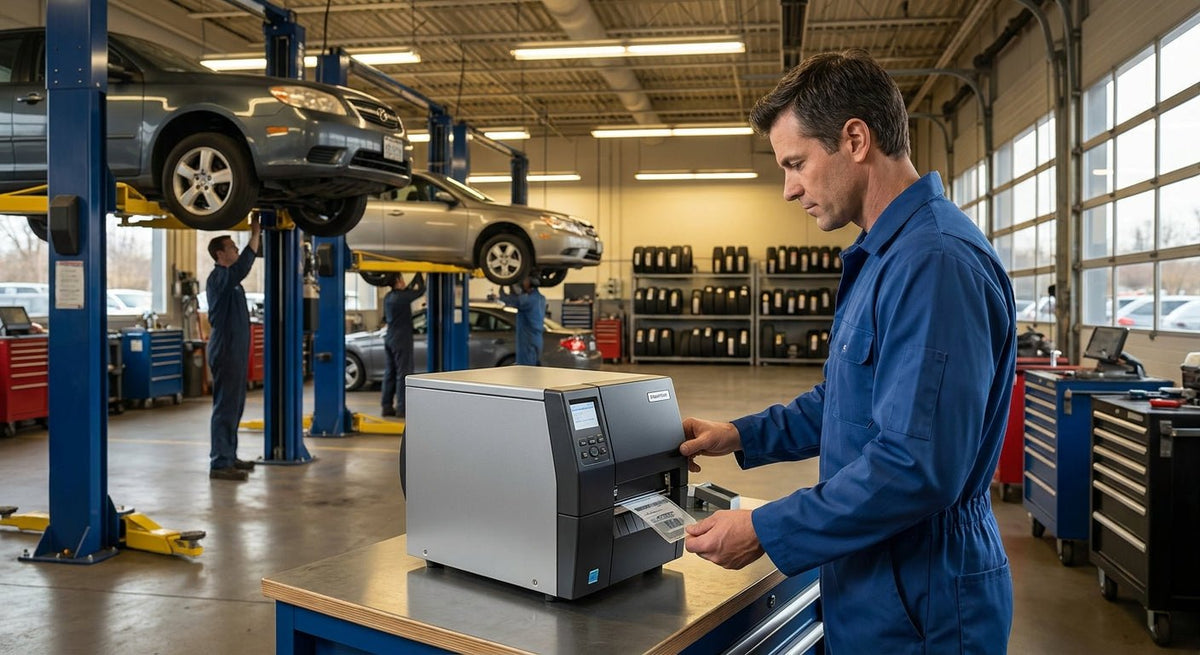
A multi-bay service shop lives and dies by throughput. When your techs are burning time hand-writing dates, hunting for a Sharpie, or waiting on a pre-printed sticker roll that ran out at 11 a.m. on a Tuesday, that cost shows up in cars per day — not in a line item anyone tracks. The right oil change sticker printer for service shops eliminates that friction at the bay level, not the back office.
TL;DR: Multi-bay shops in 2026 need a dedicated oil change sticker printer that prints on demand, runs without a PC tethered to it, and produces legible text at 203 DPI or higher. McAuley Labels' oil change sticker printer system is the direct answer — it ships preloaded with custom labels, includes a standalone keyboard, and requires no software installation. If your shop runs 3 or more bays, this setup pays for itself in sticker waste and technician time within the first month.
Why This Matters for Multi-Bay Shops in 2026
Single-bay independent shops can get away with a lot. A pre-printed pad, a pen, done. Multi-bay shops — especially those running 4 to 8 bays on a busy Saturday — need a system that scales to volume without adding a dedicated operator. In 2026, customer expectations around service documentation have also shifted: a smudged, hand-filled sticker is increasingly a trust signal in the wrong direction. A clean, branded, thermally printed sticker with the correct mileage, date, and your shop name takes 4 seconds and costs under $0.10 per unit when you print in house.
Who This Is For
This guide is written for the owner or service manager of a shop running 3 or more bays — quick lube, full-service, transmission specialty, or tire-plus-oil operations. You're doing at least 20 to 50 oil changes per day. You may have tried pre-printed rolls from a national supplier and found yourself either over-ordering to get a price break or running out mid-week. You want a printer on the counter that any tech can use in under 10 seconds, with no IT support required.
What to Look for in an Oil Change Sticker Printer for Service Shops
Standalone Operation — No PC Required
In a shop environment, tying a printer to a computer creates a single point of failure. If the PC locks up, updates, or gets used for something else, sticker production stops. A standalone printer with a built-in keyboard or keypad lets any tech enter the mileage and date directly on the unit. For multi-bay operations in 2026, this is the non-negotiable starting point.
Print Speed at Volume
At 50 oil changes per day across 6 bays, you need a printer that outputs a label in under 5 seconds per unit. Direct thermal and thermal transfer mechanisms at 203 DPI handle this comfortably. Slower mechanisms, or printers designed for occasional-use office environments, create a bottleneck at the exact moment bays are turning over.
Custom Branding on Every Label
A sticker with your shop name, logo, phone number, and next-service interval is a marketing touchpoint sitting on a customer's windshield for 3,000 to 5,000 miles. Generic or blank-field stickers waste that placement. The printer system you choose should support preloaded custom label designs — not require you to design and load templates every time you reorder stock.
Label Durability in a Shop Environment
Oil, heat, UV, and humidity are constants in any service bay. Labels that smear, peel, or fade within 30 days fail the customer at the worst moment — when they're trying to remember when their next service is due. Thermal transfer printing onto semi-gloss or polyester stock holds up in windshield conditions without lamination.
Ribbon and Supply Availability
A printer that requires proprietary, hard-to-source consumables becomes a liability the moment supply chains tighten. Verify that replacement ribbons and label stock are available with short lead times from the printer's supplier. McAuley Labels stocks compatible supplies for all Godex-platform printers and ships from the US.
Total Cost Per Label
Pre-printed rolls from a national supplier typically run $0.25 to $0.40 per label when you account for minimum order quantities, overstock waste, and expedited reorder fees. An in-house thermal system running custom labels drops that to $0.08 to $0.12 per label at volume, with no minimum order for reprints.
Top Picks for Multi-Bay Service Shops
The Purpose-Built Shop System
The direct answer. McAuley Labels' oil change sticker printer system ships as a complete kit: Godex thermal printer, preloaded ribbon, and 1,000 custom-printed labels with your shop's logo, name, and service fields. The standalone keyboard means zero PC dependency. Print speed is under 4 seconds per label. This is the only option on this list that arrives ready to use on day one, with your branding already on the stock.
Verdict: Buy — for any multi-bay shop doing 20+ oil changes per day in 2026.
The 300 DPI Upgrade
For shops that want sharper QR codes or smaller text. The Godex RT230i at 300 DPI produces noticeably crisper output than a 203 DPI baseline unit. If your stickers include a QR code linking to a service record or review page — an increasingly common practice in 2026 — 300 DPI is the minimum resolution for reliable scan rates on a 1-inch code. Works with standard thermal transfer ribbon stock.
Verdict: Buy — if QR codes or fine-detail logos are part of your sticker design.
The Entry-Level Thermal for Lower Volume
The budget starter. The Godex RT200 at 200 DPI covers shops doing 10 to 20 oil changes per day that want to move off pre-printed pads without a large upfront investment. Print quality is adequate for date, mileage, and text fields. Not recommended if your sticker design includes a logo with fine detail.
Verdict: Consider — for lower-volume shops or as a backup unit for a second bay cluster.
The Mobile Option for Drive-Through or Lot Work
The wildcard. The Godex MX30i mobile printer is battery-powered and belt-clip portable. For shops with a drive-through lane or lot-based intake where techs walk to the vehicle rather than bringing it to a bay, this removes the walk back to a counter printer. Output is 203 DPI. Battery life covers a full shift at moderate volume.
Verdict: Consider — as a complement to a counter unit, not a replacement.
What to Avoid
- Inkjet or laser printers repurposed for label stock. These cannot handle the label roll format reliably, smear in oil-adjacent environments, and require ribbon or ink cartridge changes at the worst times. Thermal mechanism printers are the correct hardware class for shop use.
- Pre-printed static-date sticker pads as a primary system. Once your shop customization changes — phone number update, new owner, rebrand — you are stuck with obsolete stock. An in-house printer reprints the current version on demand.
- Printers with no US-based supply chain for consumables. A 3-week lead time on ribbon stock shuts down your in-house printing. Confirm domestic availability before purchasing any printer system.
Comparison: Key Criteria Across the Top Picks
| Printer | DPI | Standalone | Best For | Verdict |
|---|---|---|---|---|
| Oil Change Sticker Printer System | 203 | Yes, with keyboard | Multi-bay shops, day-one ready | Buy |
| Godex RT230i | 300 | Yes | QR codes, fine-detail logos | Buy |
| Godex RT200 | 203 | Yes | Lower-volume shops | Consider |
| Godex MX30i | 203 | Yes (battery) | Mobile/drive-through lanes | Consider |
FAQ
What's the best oil change sticker printer for service shops with multiple bays? The McAuley Labels oil change sticker printer system is the top pick for 2026. It ships with a standalone keyboard, preloaded custom labels, and ribbon — no PC or software setup required. It handles the throughput demands of 3-to-8-bay shops without creating a bottleneck.
Can I use a regular label printer for oil change stickers? Technically yes, but general-purpose label printers are not designed for the label roll sizes, adhesive types, or windshield-grade stock used in automotive service. A printer spec'd for oil change sticker production runs the correct media without feed errors or adhesion problems.
How much does it cost to print oil change stickers in house? At volume, in-house thermal printing runs $0.08 to $0.12 per label including ribbon and stock costs. Pre-printed rolls from external suppliers typically cost $0.25 to $0.40 per label when minimum order waste is factored in.
Do I need a computer connected to an oil change sticker printer? Not if you buy the right unit. Printers with standalone keyboards — like the system McAuley Labels offers — let techs enter date, mileage, and service type directly on the printer. No PC, no network dependency.
What DPI do I need for an oil change sticker printer? 203 DPI is adequate for text-only stickers with date and mileage fields. If your design includes a QR code or a logo with fine detail, step up to 300 DPI for reliable scan rates and clean output.
How many stickers per roll does a shop typically use? A shop doing 30 oil changes per day burns through 900 stickers per month. Most thermal label rolls for automotive stickers come in 500-count or 1,000-count configurations. Order cadence depends on your volume, but 1,000-count rolls reduce changeover frequency on busy days.
Is static cling or adhesive better for windshield oil change stickers? Adhesive stickers stay put and don't shift when windows are opened or closed. Static cling is removable without residue but can fall in hot or humid conditions. Most multi-bay shops default to adhesive for permanence. For a direct comparison, see static cling vs adhesive oil change stickers.
Can I get my shop logo printed on the stickers from McAuley Labels? Yes. McAuley Labels prints custom stickers with your logo, shop name, phone number, and service fields. Orders are manufactured in the US. See the oil change stickers with custom logo page for specifications and order minimums.
One Last Thing
The sticker on a customer's windshield outlasts the service visit by 3 to 6 months and puts your shop name in front of the driver every time they sit behind the wheel. Shops that print branded stickers in house — rather than using generic pre-filled pads — report that customers more consistently return to the same shop for the follow-up service, because the name and number are already visible. That retention effect is worth more than the per-label cost savings alone.