
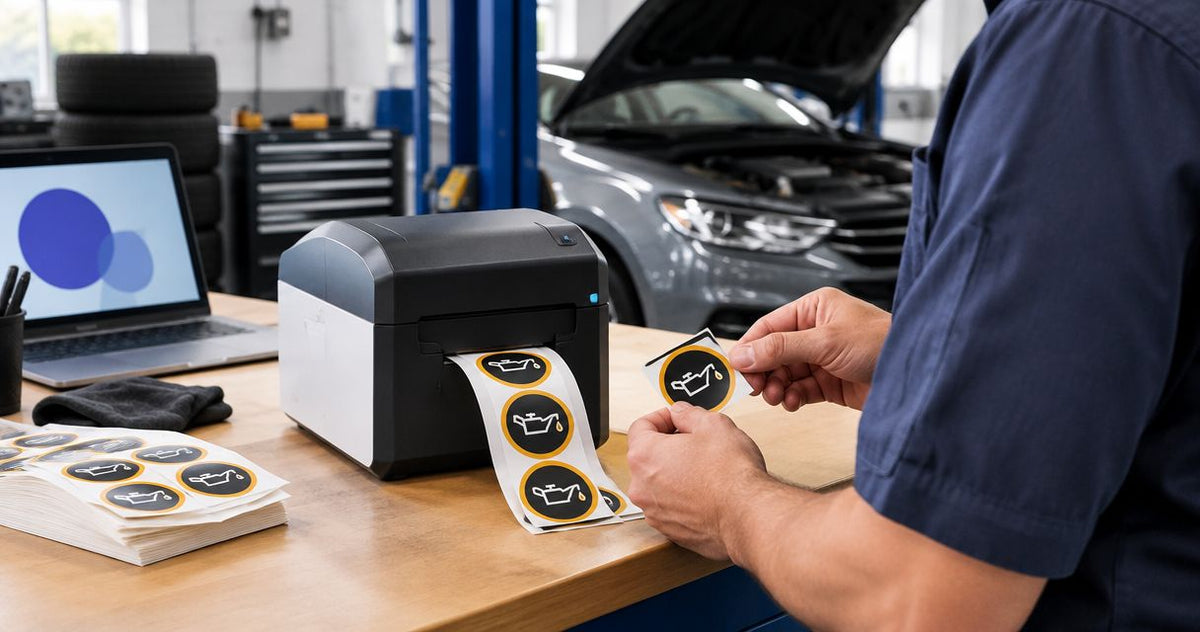
Shops shopping on oil change sticker printer price alone usually end up with a printer that can't hold a crisp QR code or can't keep pace with a full service lane. This guide ranks five thermal printers built for oil change stickers, scored on print resolution, throughput, and the kind of shop each one actually fits in 2026.
- GoDEX RT700i+ is the best overall oil change sticker printer for single-bay quick lube shops in 2026.
- GoDEX RT200i is the pick for multi-bay shops that need to print stickers fast between vehicles.
- GoDEX ZX430i+ prints 300 DPI QR codes that scan cleanly on windshield glass every time.
- The oil change sticker printer system bundles a printer with stickers so a new shop can start printing the same week.
- GoDEX G530 covers shops that also print thermal-transfer labels for parts and inventory on the same machine.
Why this matters
An oil change sticker isn't just a reminder — it's the last thing that leaves the vehicle after service, and a blurry barcode or a QR code that won't scan makes the shop look sloppy. Resolution and durability matter more than the sticker price tag. Shops that outgrow a basic desktop printer within a year usually bought on price instead of on volume and use case, which is why the oil change sticker printer system exists as a starting point that pairs a printer with stock designed for windshield application.
Best overall: GoDEX RT700i+. Best for high-volume multi-bay shops: GoDEX RT200i. Best for QR-code windshield stickers: GoDEX ZX430i+. Best all-in-one starting point: the oil change sticker printer system. Best for shops that also print asset or inventory labels: GoDEX G530.
What makes the best oil change sticker printer
- Print resolution — 203 DPI handles text and basic barcodes; 300 DPI is the floor for QR codes that need to scan reliably on curved windshield glass.
- Direct thermal vs. thermal transfer — direct thermal skips ribbon costs for standard paper stickers; dual/2-in-1 models switch between both.
- Throughput — how fast the printer produces a sticker between one vehicle leaving the bay and the next pulling in.
- Display and setup — a color touchscreen cuts training time for front-desk staff who aren't printer technicians.
- Connectivity — USB, serial, and Ethernet options determine whether the printer sits standalone or ties into shop management software.
- Warranty and support — GoDEX printers in this lineup carry a 3-year warranty, which matters for equipment that runs daily.
At a glance
| Printer | Best for | Standout feature | Key limitation |
|---|---|---|---|
| Oil change sticker printer system | New shops starting from zero | Printer paired with oil change sticker stock | Less flexible than buying components separately |
| GoDEX RT700i+ | Single-bay quick lube shops | 203 DPI with color display for easy setup | Not built for high-detail QR codes |
| GoDEX G530 | Shops printing labels beyond oil changes | 300 DPI dual thermal, 2-in-1 | No color display, menu-driven setup |
| GoDEX ZX430i+ | QR-code windshield stickers | 300 DPI with color display | Higher-resolution glass work needs care with placement |
| GoDEX RT200i | Multi-bay, high-volume shops | 203 DPI built for standard sticker throughput | 203 DPI ceiling limits fine QR detail |
1. Oil Change Sticker Printer System: best for shops starting from scratch
The oil change sticker printer system pairs a thermal printer with oil change sticker stock so a new shop or a shop switching from handwritten stickers can start printing without sourcing hardware and labels from two different places.
Oil change sticker printer system pros:
- Removes the guesswork of matching printer to label stock
- One order instead of separate hardware and consumables purchases
- A practical entry point for a shop's first thermal printer
Oil change sticker printer system cons:
- Less control over resolution and connectivity than picking a standalone printer
- Not the fit for a shop that already owns compatible hardware
Best for: a shop replacing handwritten oil change reminders for the first time. Verdict: Buy.
2. GoDEX RT700i+: best oil change sticker printer for single-bay quick lube shops
The GoDEX RT700i+ is a 4-inch, 203 DPI dual thermal printer with a color display, built for shops that print one sticker at a time between service appointments rather than in batches.
GoDEX RT700i+ pros:
- Color display simplifies setup for front-desk staff
- 203 DPI is enough for standard oil change sticker text and basic barcodes
- 3-year warranty standard on GoDEX printers
GoDEX RT700i+ cons:
- 203 DPI isn't the resolution to reach for if the sticker carries a dense QR code
- Not designed for high-volume, continuous batch printing
Best for: single-bay or independent shops printing standard oil change stickers. Verdict: Buy.
3. GoDEX G530: best for shops printing more than just oil change stickers
The GoDEX G530 printer is a 4-inch, 300 DPI dual thermal printer that switches between direct thermal and thermal transfer, which matters for a shop that also labels parts bins, tools, or inventory on the same machine used for oil change stickers.
GoDEX G530 pros:
- 300 DPI clears the bar for QR codes, not just text
- Dual thermal capability covers ribbon-based labels for durability-sensitive tags
- 3-year warranty standard
GoDEX G530 cons:
- No color touchscreen, so setup leans on menu navigation
- Overkill for a shop that only ever prints one sticker type
Best for: multi-purpose shops labeling parts, inventory, and vehicles from one printer. Verdict: Buy.
4. GoDEX ZX430i+: best for QR-code oil change stickers on windshield glass
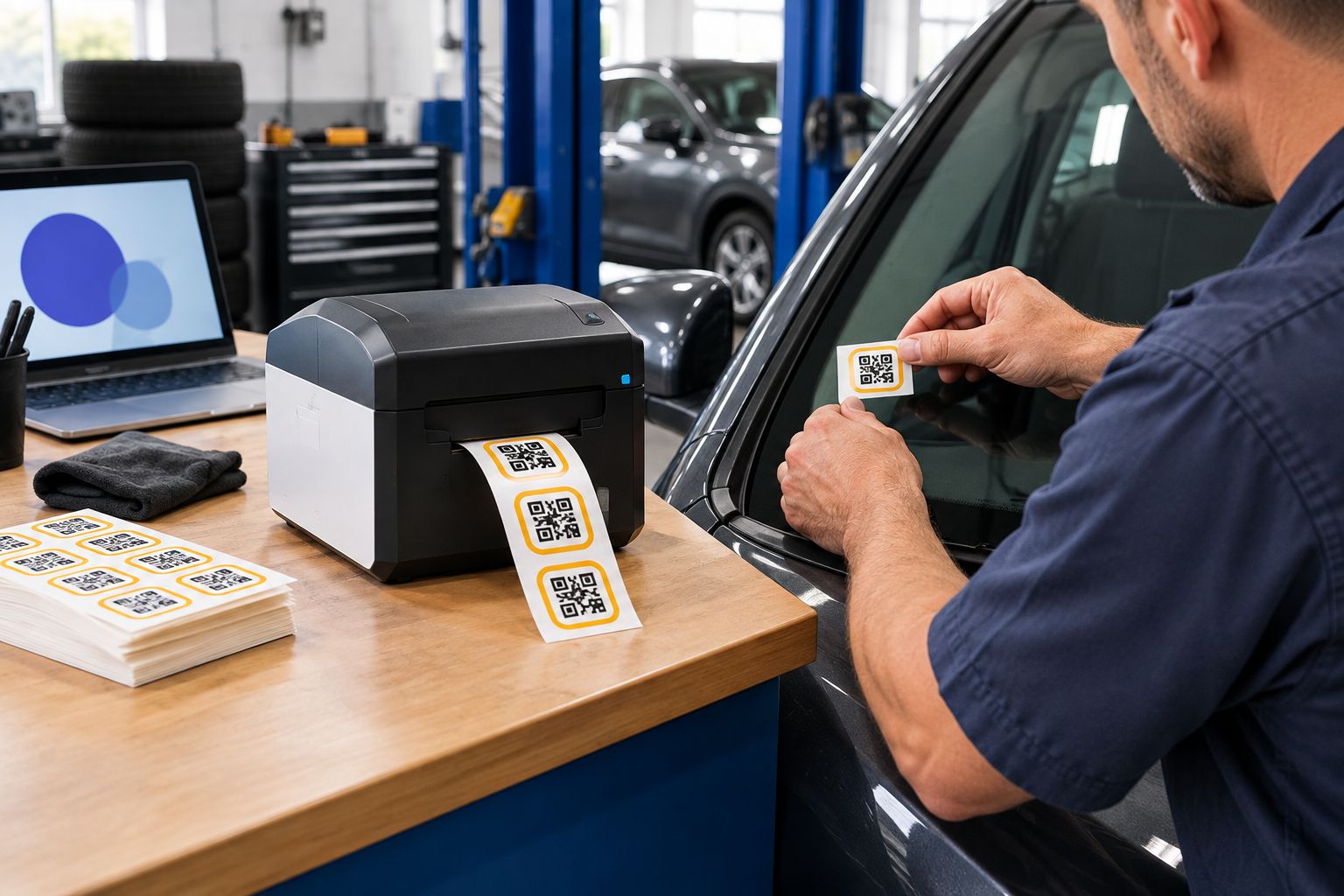
The GoDEX ZX430i+ printer runs at 300 DPI with a color display, and it's the printer to reach for when the oil change sticker carries a QR code linking to a digital service record instead of just printed mileage and date.
GoDEX ZX430i+ pros:
- 300 DPI produces QR codes that scan cleanly on the first try
- Color display speeds up staff training
- 3-year warranty standard
GoDEX ZX430i+ cons:
- No benefit over a 203 DPI printer if the shop never uses QR codes
- Higher resolution means more attention to label alignment during setup
Best for: shops running QR-code service tracking through oil change stickers. Verdict: Buy.
5. GoDEX RT200i: best for multi-bay, high-volume shops
The GoDEX RT200i is a 203 DPI thermal printer built for shops running multiple bays where the printer needs to keep pace with vehicles moving through faster than a single-bay counter can manage.
GoDEX RT200i pros:
- 203 DPI is sufficient for standard oil change sticker content at volume
- Fits shops standardizing on one printer model across bays
GoDEX RT200i cons:
- Same resolution ceiling as entry-level models — not built for dense QR codes
- Best suited to shops that already know their volume needs, not a first-time buyer
Best for: multi-bay quick lube or fleet service centers with steady daily volume. Verdict: Buy.


How we ranked these
Each printer was scored against the six criteria above: resolution, thermal type, throughput, display, connectivity, and warranty. Items were slotted into a use case where they win outright rather than stacked into one leaderboard — a 203 DPI printer isn't worse than a 300 DPI printer, it's just wrong for QR codes.
“A 203 DPI printer is fine for standard oil change stickers, but it will never print a QR code that scans reliably.”
Which oil change sticker printer should you choose?
For most shops asking about oil change sticker printer price and features together, GoDEX RT700i+ is the default pick — 203 DPI covers standard stickers, the color display cuts training time, and it fits a single-bay shop's pace. Move up to GoDEX ZX430i+ or GoDEX G530 the moment QR codes or non-automotive labels enter the picture. Multi-bay shops printing at volume should default to GoDEX RT200i. Shops with no printer yet and no time to research components should start with the oil change sticker printer system.
FAQ
What resolution does an oil change sticker printer need?
203 DPI is enough for standard text and basic barcodes on oil change stickers. QR codes need at least 300 DPI to scan reliably on windshield glass in 2026.
Is GoDEX RT700i+ better than GoDEX RT200i?
GoDEX RT700i+ and GoDEX RT200i both print at 203 DPI, but RT700i+ suits single-bay shops with its color display while RT200i is built for multi-bay shops printing at higher daily volume.
Do I need a thermal transfer printer for oil change stickers?
No. Direct thermal covers standard oil change stickers without ribbon costs. Thermal transfer models like the GoDEX G530 only matter if the same printer also handles labels that need ribbon-based durability.
What is the oil change sticker printer price range in 2026?
Pricing varies by resolution and features — entry-level 203 DPI desktop models sit at the low end, 300 DPI color-display models cost more, and bundled systems price the printer and stickers together. Check current pricing on each product page before ordering.
Can I print QR codes on oil change stickers?
Yes, with a 300 DPI printer like the GoDEX ZX430i+. QR codes printed at 203 DPI often fail to scan because the fine detail gets lost.
How long does a GoDEX oil change sticker printer last?
GoDEX printers in this lineup carry a 3-year warranty, and daily use in a service bay is within normal operating conditions for these models.
What's the best oil change sticker printer for a new shop?
The oil change sticker printer system is the fastest way to start printing, since it pairs a printer with sticker stock in one order instead of sourcing each separately.
One last thing
The resolution decision matters more than almost anything else on this list: a shop that starts with 203 DPI and later adds QR-code service tracking will need to replace the printer, not just the labels. Buy for where the shop is headed in 2026, not just where it is today.