
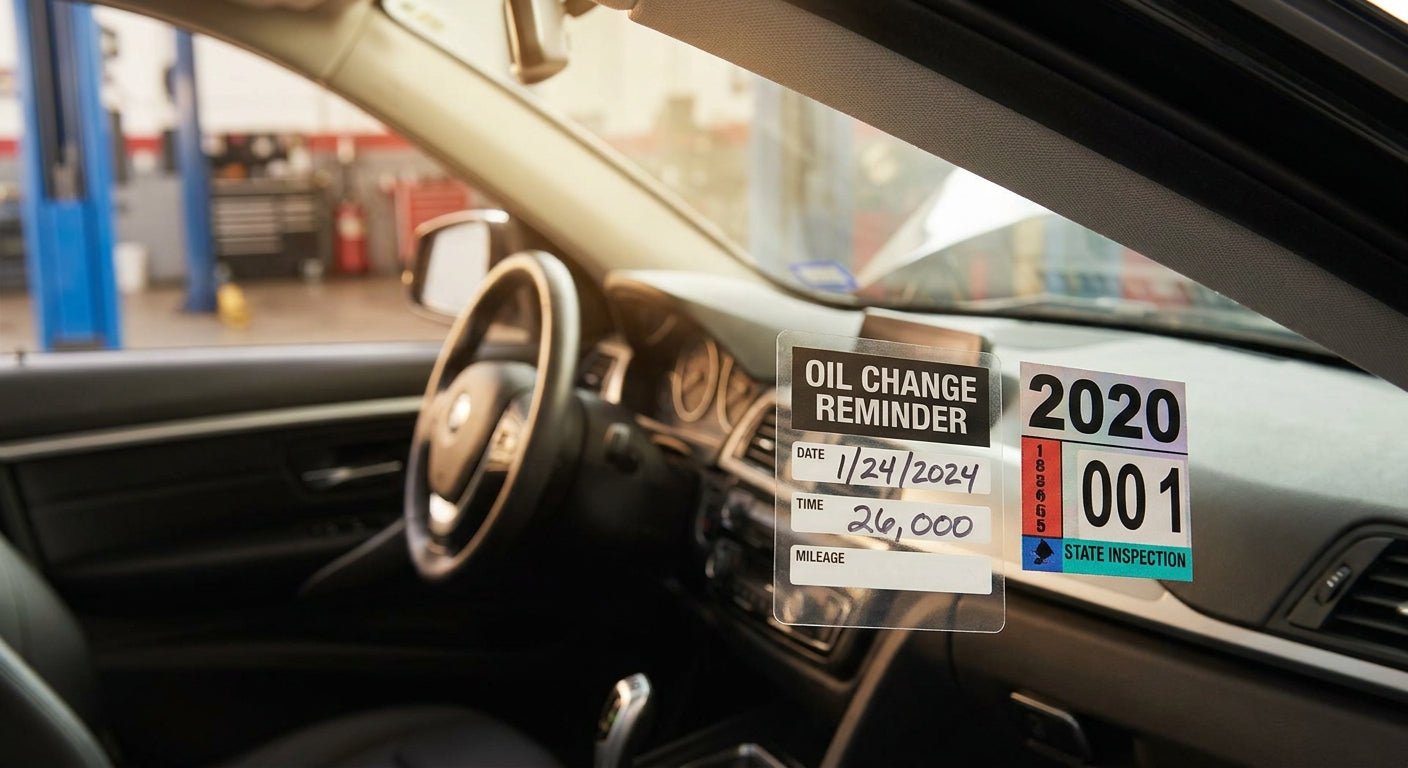
State inspection deadlines don't wait for a shop's schedule, and a windshield reminder that fades or peels before the next service date puts a customer out of compliance and your shop out of a repeat visit. This guide breaks down what oil change stickers for state inspection reminders need to survive a full service interval, which McAuley Labels formats hold up, and which shortcuts cost you callbacks.
TL;DR
McAuley Labels' custom text and custom logo oil change stickers are the safe pick for state inspection reminders in 2026, holding printed data through 3,000-5,000 mile intervals without fading. For shops that need to prove compliance dates digitally, the windshield QR code stickers add scannable service history on top of the printed reminder. Skip static cling stickers for any state with strict inspection-reminder statutes — they detach in cold climates and leave no adhesive residue proof of service. Verdict: Buy adhesive thermal stickers, skip static cling for compliance-driven states.
Why This Matters
Most states don't mandate a specific reminder sticker format, but insurers, fleet managers, and dealership service departments increasingly treat the windshield sticker as the paper trail for service compliance. A sticker that smears in a car wash or peels off in a Minnesota winter doesn't just look bad — it erases the evidence that the service happened on schedule.
Shops running high volume in 2026 are also under more pressure from customers who photograph their windshield sticker to dispute inspection timing. A blurry date field or a logo that rubs off after two weeks turns a $30 add-on into a customer service problem. The fix isn't complicated: pick the right adhesive, the right print method, and the right data fields, and the sticker does its job for the full service interval.
Who This Is For
This guide is for quick lube operators, independent auto repair shops, dealership service lanes, and fleet maintenance managers who print or order oil change stickers as part of their state inspection reminder process. If you're stocking stickers for a single-bay shop or running a printer system across five locations, the criteria below apply the same way — durability and legibility matter more than sticker count.
What to Look for in Oil Change Stickers for State Inspection Reminders
Adhesive that survives windshield conditions
A windshield sees temperature swings from below freezing to 140°F behind glass in direct sun, and cheap adhesive fails at both extremes. Look for stickers rated for automotive glass application, not general-purpose paper labels repurposed for windshields. If a sticker lifts at the corners within a month, the mileage and date fields go with it.
Print permanence under thermal printing
Direct thermal printing is fast and doesn't need ribbon, but the print itself is heat-sensitive and can fade under prolonged sun exposure or a warm dashboard. For inspection reminders that need to stay legible for 3 to 6 months, confirm the sticker stock is rated for that exposure window, not just short-term readability.
Custom fields that match your compliance needs
A reminder sticker needs mileage, date, and shop identification at minimum — some states and fleet contracts also want a technician ID or service code. Oil change stickers with custom text let you print exactly the fields your compliance process requires instead of working around a fixed template.
Logo placement for brand accountability
A sticker with your shop's name and logo does double duty: it reminds the customer of the service date and tells anyone who looks at that windshield exactly who performed the work. This matters more in states where inspection stations cross-check service records against the sticker on file.
QR code capability for digital service records
A printed sticker can fade or get scraped off with an ice scraper, but a QR code linked to a digital service record survives even if the sticker doesn't. Shops fielding disputes over service timing increasingly print both — the paper reminder and a scannable backup.
Batch printing speed for high-volume bays
A multi-bay shop or quick lube chain running 40+ cars a day can't wait on a slow print cycle between vehicles. The right printer setup matters as much as the sticker stock — a standalone system that prints in under 3 seconds per label keeps the line moving.
Top Picks for 2026
Custom text oil change stickers — the reliable basic. McAuley Labels' custom text oil change stickers print mileage, date, and shop info with no logo overhead, which keeps per-unit cost down for shops ordering in bulk. The adhesive is rated for windshield application and holds through a typical 5,000-mile interval without peeling. Verdict: Buy for shops that need a straightforward compliance record without branding requirements.
Custom logo oil change stickers — the brand builder. Custom logo oil change stickers add your shop's identity to every windshield that leaves the bay, which matters for dealerships and franchise locations tracking brand consistency across service lanes. The printed logo holds up alongside the mileage and date fields through standard thermal print settings. Verdict: Buy for any shop where the sticker also functions as a repeat-visit reminder.
Windshield QR code stickers — the compliance tracker. The QR code windshield stickers with custom logo pair a scannable code with printed text, so even if the sticker fades, the linked service record doesn't. This is the pick for fleet managers and multi-location shops fielding inspection disputes in 2026, where a scan settles the question faster than a phone call to the shop. Verdict: Buy for fleets and multi-bay operations tracking service history digitally.
Oil change sticker printer system — the in-house solution. The oil change sticker printer system puts printing on-site instead of ordering pre-printed batches, which matters for shops that change mileage intervals or branding often. A standalone system prints one label at a time as the car leaves the bay, which keeps the mileage field accurate to the minute instead of estimated at order time. Verdict: Consider for shops printing more than 200 stickers a month — the upfront cost pays back fast at that volume, but low-volume shops are better off ordering pre-printed batches.
Generic pre-printed reminder pads — the false economy. Blank reminder pads sold at auto parts stores use ballpoint pen for the date and mileage fields, which smears within days of windshield exposure. Verdict: Skip — the per-unit cost looks lower, but illegible fields defeat the entire purpose of a compliance reminder.
What to Avoid
- Static cling stickers in cold-climate states. They look identical to adhesive stickers on the shelf, but static cling loses grip below freezing and falls off the glass entirely — a documented problem in Northern states from November through March.
- Paper labels not rated for windshield use. General office label stock lacks the UV and moisture resistance a windshield sticker needs, and print fades to unreadable within 60 days of direct sun exposure.
- Handwritten fields on any surface. Even with a durable sticker, handwritten mileage and dates are the first thing questioned in a compliance dispute — printed fields carry more weight.
Verdict Comparison Table
| Product | Adhesive Type | Custom Fields | QR Code | Best For | Verdict |
|---|---|---|---|---|---|
| Custom text stickers | Windshield adhesive | Text only | No | Straightforward compliance records | Buy |
| Custom logo stickers | Windshield adhesive | Text + logo | No | Brand-focused shops, dealerships | Buy |
| QR code windshield stickers | Windshield adhesive | Text + logo | Yes | Fleets, multi-location shops | Buy |
| Sticker printer system | N/A (hardware) | Configurable | Configurable | High-volume in-house printing | Consider |
| Static cling stickers | Cling only | Text | No | Warm-climate, low-volume shops only | Skip (cold climates) |
FAQ
What are the best oil change stickers for state inspection reminders in 2026? Adhesive windshield stickers with printed mileage and date fields, like McAuley Labels' custom text and custom logo formats, hold up best because they resist fading and peeling through a full 3,000-5,000 mile service interval.
Is a QR code oil change sticker better than a printed-only sticker? A QR code sticker adds a digital backup to the printed reminder, which matters if the physical sticker fades or gets scraped — but for shops without a linked service record system, a printed-only sticker does the job at lower cost.
How much does a custom oil change sticker printer system cost to run? Cost depends on print volume and label stock choice, and shops printing over 200 stickers a month typically see the fastest payback versus ordering pre-printed batches — check current pricing directly for an exact quote.
Do static cling stickers work for state inspection reminders? Static cling stickers work in warm, stable climates but lose adhesion below freezing, which makes them a risky choice for shops in Northern states running inspections through winter.
Can I put my shop's logo on an oil change sticker? Yes — custom logo oil change stickers print your shop's branding alongside the mileage and date fields, which reinforces both the compliance record and the reminder to return for the next service.
What information should an oil change reminder sticker include? At minimum, mileage, service date, and shop identification; fleets and multi-location shops often add a QR code or technician ID for additional service record tracking.
How long does an oil change sticker need to last? A sticker needs to stay legible through the full service interval, typically 3,000 to 5,000 miles or 3 to 6 months, which rules out labels not rated for windshield UV and temperature exposure.
Are thermal-printed oil change stickers durable enough for windshields? Thermal-printed stickers on windshield-rated adhesive hold up through standard service intervals in 2026, provided the stock is rated for sun and temperature exposure rather than general office use.
One Last Thing
The detail most shops miss isn't the sticker — it's the printer settings behind it. A thermal printhead running at the wrong darkness setting produces a sticker that reads fine on day one and fades to gray by week three, which looks identical to a bad adhesive problem but has nothing to do with the sticker stock itself. Check darkness calibration before blaming the label.