
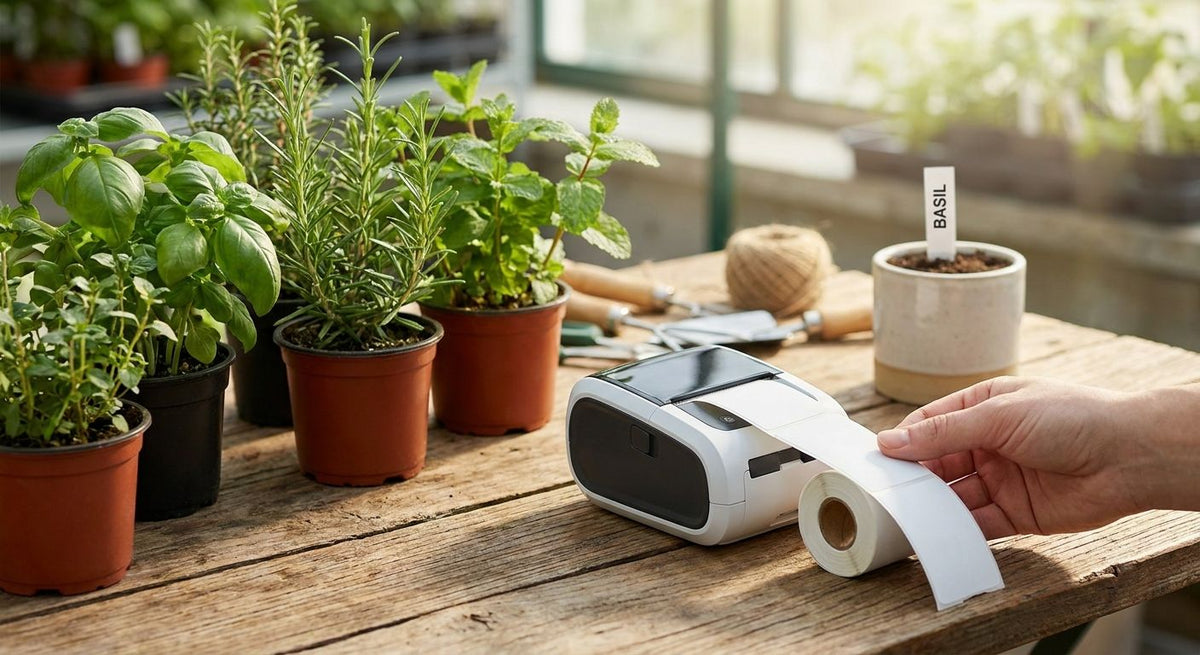
Herb and kitchen garden label printer needs come down to one thing: small, legible tags that survive water, soil, and sun without falling apart between planting and harvest. A plant label printer for herb garden use is a thermal printer built to run small-format, weather-resistant tags for potted basil, raised bed rows, and windowsill herb jars, with the goal of keeping every variety identified from seedling to snip. Unlike a commercial nursery running thousands of tags a week, herb and kitchen gardeners print in small batches, reprint often as they rotate crops, and need labels that survive a kitchen sink rinse just as well as a garden hose.
- The 203 DPI compact plant label printer from McAuley Labels is the right-sized pick for herb and kitchen garden tags in 2026.
- Direct thermal works fine for indoor pots; outdoor raised beds need thermal transfer with polyester stock to survive rain and UV.
- 203 DPI is enough for plant names and dates; go to 300 DPI only if you're printing small QR codes or logos on the tag.
- Handwritten stakes and masking tape fail within one growing season — a thermal printer pays for itself in the first replant.
Why plant label printer choice matters for herb and kitchen gardens
Herb seedlings look nearly identical at four weeks — basil, oregano, and thyme are all a mess of green leaves until they mature. Mislabeled trays mean pulling the wrong herb at harvest, or worse, tossing a plant because nobody remembers what it was. A kitchen gardener running six or eight varieties in small pots needs a label that's still readable in 2026 after three months of watering, not just legible on the day it's printed.
The failure mode for this segment isn't print volume, it's print durability at small scale. A nursery producing 5,000 tags a month can justify an industrial printer. A home herb grower or small kitchen garden operator needs something that sits on a counter, prints on demand, and doesn't need a computer science degree to reload.
Build a labeling system for your herb garden
Match the label material to where the plant lives
Indoor windowsill herbs and outdoor raised beds have opposite failure points — moisture from below versus rain and UV from above.
- Indoor pots on a counter or windowsill: direct thermal paper labels handle occasional splash fine
- Outdoor raised beds and garden stakes: use polyester or vinyl stock rated for weather, not paper
- Greenhouse or high-humidity setups: treat them like outdoor — paper curls and the ink smears
- Hydroponic or frequently misted setups: avoid uncoated paper entirely
The waterproof plant label printer buying guide breaks down which stock survives sprinkler exposure versus hand-watering only — worth checking before you commit to a material for an outdoor bed.
Size the label to the stake or pot
A plant tag doesn't need to be big to be readable — it needs the right proportions for the surface.
- Small pot inserts: 1 in x 2 in tags fit standard 4-inch herb pots without covering foliage
- Garden stakes: 2 in x 3 in gives room for common name, variety, and plant date
- Jar or seed-start labels: narrow strips under an inch wide work for taped-on IDs
- Row markers for raised beds: wider format if you're printing planting dates alongside the variety name
Pick the resolution that matches what you're printing
Most herb tags are plain text — a common name, a variety, maybe a planting date. That doesn't need high resolution.
- Plain text tags (herb name, date): 203 DPI prints crisp, readable characters at small sizes
- Small QR codes linking to care instructions: 300 DPI keeps the code scannable at under an inch
- Logo-branded tags for a hobby seed business: 300 DPI holds fine detail better than 203 DPI
- Barcode-style variety tracking for a small nursery operation: 300 DPI reduces scan errors
For straight text tags — which covers most herb and kitchen garden use — a 203 DPI compact plant label printer is the sensible starting point rather than paying for resolution you won't use.
Choose a printer sized for a kitchen counter or potting bench
A desktop-class thermal printer is the right footprint here, not an industrial floor unit built for warehouse throughput.
- Confirm the printer takes narrow label widths — most industrial units default to 4-inch stock, oversized for a 1-inch pot tag
- Look for a compact chassis that fits a counter or bench without eating your workspace
- USB connection is enough for home use; skip network setup unless you're managing labels across multiple growing sites
- A color display on the printer itself saves trips back to a computer mid-batch
The GoDEX RT700i+ thermal printer prints at 203 DPI with a color display and fits a compact footprint, which covers the resolution and size needs of herb and kitchen garden labeling without stepping up to an industrial unit.
Print a full season's batch before you plant
Reprinting mid-season because you ran out of tags interrupts a planting day. Batch printing solves that.
- Print the full season's variety list in one run before the first seed goes in the ground
- Keep 10-15% extra for stakes lost to weather or replanting
- Store spare labels away from direct sun — thermal print can fade with prolonged UV exposure even before it's applied
- Label rolls by variety group if you're running more than a dozen herb types
Add a QR code if you track care details digitally
A QR code on a plant tag can link to a care sheet, harvest log, or planting date record instead of cramming that data onto the physical tag.
- Keep the code small — 300 DPI resolution keeps it scannable even under an inch wide
- Link to a simple note, not a full website — phones scanning outdoors need a fast load
- Skip this step entirely if you're managing under a dozen plants; it adds setup time without real payoff at that scale


Comparing label options for herb and kitchen gardens
| Option | Best for | Key limitation |
|---|---|---|
| Handwritten wood or plastic stakes | One-off small beds, zero setup | Fades and smears within one growing season |
| Permanent marker on masking tape | Quick indoor pot labels | Curls and peels with regular watering |
| Inkjet-printed paper tags | Batch printing on an existing home printer | Ink runs the moment it gets wet |
| Direct thermal desktop printer | Compact kitchen-counter herb labeling | No ribbon means labels can fade under direct UV over months |
| Thermal transfer printer + polyester stock | Outdoor raised beds, multi-season reuse | Needs ribbon and a slightly bigger footprint |
Verdict: for indoor kitchen herb pots, a direct thermal desktop printer is the simplest fit; for outdoor raised beds that see rain and full sun, thermal transfer with polyester stock is the only option that holds up past one season.
“If you can't read a plant tag from three feet away after a month outside, the label material failed before the printer ever mattered.”
Common mistakes herb and kitchen gardeners make
- Using paper labels outdoors. Paper curls and the print smears the first time it gets rained on — fine for a windowsill pot, wrong for a raised bed.
- Printing text too small for the stake size. A 6-point font on a 2-inch stake reads fine at the printer and disappears from three feet away in the garden.
- Skipping the batch print. Printing one tag at a time as you plant means running out mid-row and improvising with a marker for the last few plants.
- Storing spare labels in direct sun. Thermal print can fade before the label is even applied if the roll sits on a sunny windowsill for weeks.
- Mixing seed packet labels with mature plant tags. A label meant for a seed tray rarely has room for the variety, planting date, and care notes a full-grown herb bed needs.
FAQ
What's the best plant label printer for a herb garden in 2026?
A compact 203 DPI thermal printer like the GoDEX RT700i+ covers herb and kitchen garden labeling in 2026 — enough resolution for plant names and dates without paying for industrial features you won't use.
Is direct thermal or thermal transfer better for plant tags?
Direct thermal is fine for indoor pots that only see occasional splash. Thermal transfer with polyester stock is the better call for outdoor raised beds exposed to rain and sun.
Do I need 300 DPI for herb plant labels?
No — 203 DPI prints herb names, varieties, and dates clearly at small sizes. Reserve 300 DPI for tags carrying a small QR code or logo.
How long do printed plant labels last outdoors?
Paper labels fade and curl within a single growing season outdoors. Polyester stock printed with thermal transfer holds up across multiple seasons of watering and sun exposure.
Can I print plant labels at home without a dedicated label printer?
Yes, with a permanent marker on plastic stakes or an inkjet-printed paper tag for indoor use, but both fade or run faster than a thermal-printed label does.
What size should a herb pot label be?
A 1 in x 2 in tag fits standard 4-inch herb pots without covering foliage. Garden stakes generally need 2 in x 3 in for a variety name plus a planting date.
Are QR codes worth adding to herb plant tags?
Only if you're tracking care details or harvest logs digitally for more than a dozen plants. For a small windowsill herb setup, a plain text tag is faster to manage.
One last thing
The detail most kitchen gardeners miss: the ribbon matters as much as the printer. A wax/resin ribbon rated at 2.25 in x 243 ft holds up to daily watering and handling far better than a bare direct thermal print left exposed to sun on a stake — if you're labeling outdoor beds in 2026, budget for the ribbon, not just the printer.