
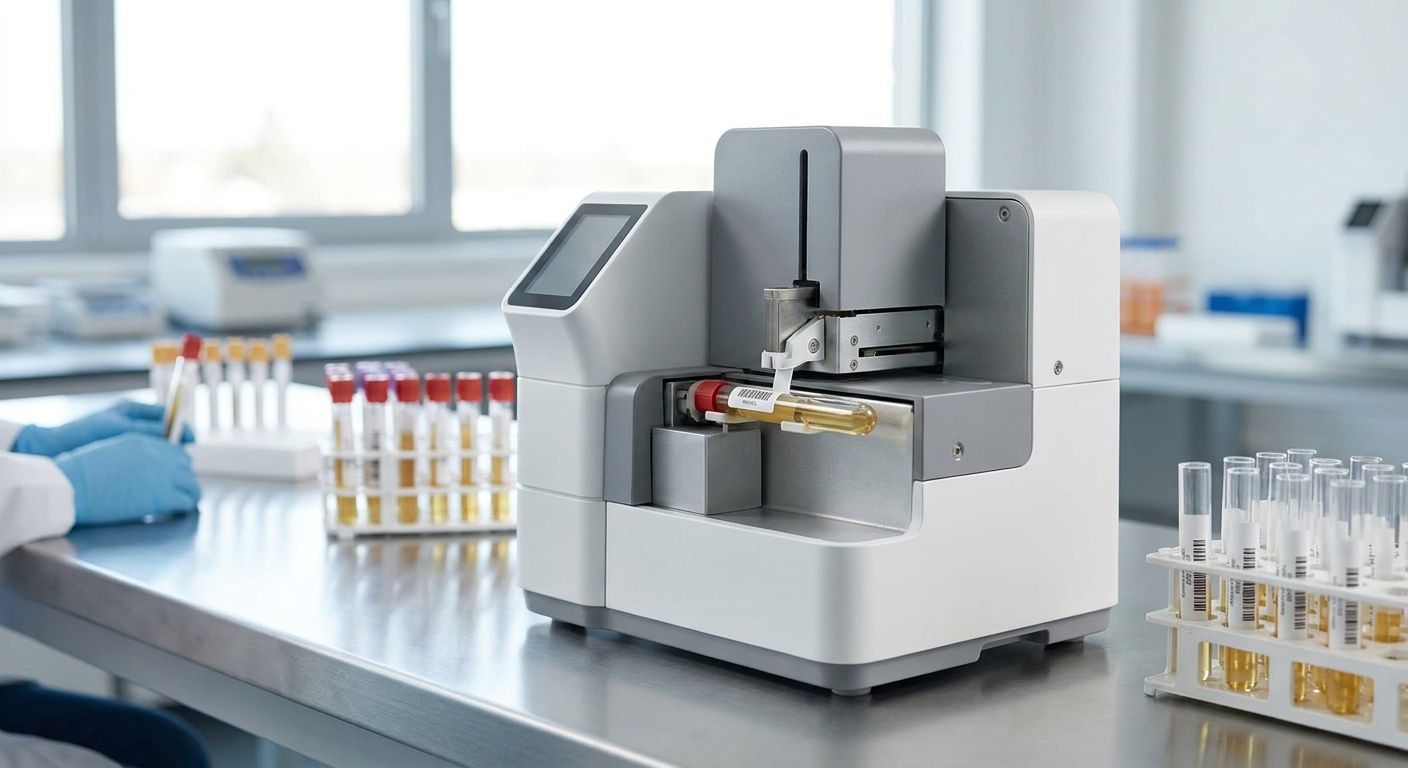
A test tube labeler for toxicology and drug testing labs has to survive centrifuges, sub-zero storage, and a chain-of-custody audit trail — not just print a legible barcode. This guide breaks down what separates a lab-grade labeler from a repurposed shipping printer, and names the specific machines and consumables that hold up under 2026 lab conditions.
- The McAuley Labels Test Tube Labeler for Labs runs $3,055.50 and is the direct-buy pick for automated specimen labeling — Buy.
- GoDEX ZX430i at 300 DPI is the safe choice for small-format barcode and QR text on toxicology tubes — Buy.
- GoDEX RT700i with its color touchscreen handles mixed drug-screen batch runs — Consider.
- Skip 203 DPI printers for chain-of-custody archives; fine barcode text blurs at scanner range.
- Thermal transfer ribbon protects labels through freezer storage and chemical exposure that direct thermal alone can't survive.
Why this matters
A mislabeled specimen tube in a toxicology lab isn't a shipping delay — it's a chain-of-custody failure that can invalidate a drug test result outright. Courts and employers reject results when the chain-of-custody labeling trail has gaps, and gaps usually start at the printer, not the courier.
Most labs default to whatever barcode printer sits in the shipping department. That's a mistake in 2026, when drug testing volume keeps climbing and audit standards keep tightening. A test tube labeler for toxicology labs needs to be evaluated on its own criteria, separate from general warehouse label printers.
Who this is for
This guide is for toxicology lab managers, drug testing facility operators, forensic evidence handlers, and clinical lab techs who label specimen tubes daily and need those labels to survive freezer storage, centrifuge spin, and a legal chain-of-custody review months or years later. If your lab processes more than a few dozen tubes a day, or if any of those tubes end up in litigation, the printer choice matters more than the price tag.
What to look for in a test tube labeler for toxicology labs
Chain-of-custody barcode integrity
Toxicology results get challenged in court, and the first thing an attorney checks is whether the specimen barcode is unique, scannable, and unaltered. Sequential or randomized barcode numbering with no duplicate risk matters more here than in almost any other labeling use case.
Print resolution for small-format text
A standard test tube gives you maybe half an inch of usable label width. At 203 DPI, small text and dense barcodes blur enough to fail a handheld scanner from three feet away. At 300 DPI, the same barcode reads clean on the first pass — a real difference when a tech is scanning 200 tubes in a shift.
Adhesive and stock durability
Toxicology samples often sit in a -20°C freezer for months before a retest or appeal. Labels need adhesive that doesn't lift in cold storage and print that doesn't smear when handled with gloved, sometimes damp, hands during centrifuge loading.
Ribbon vs. direct thermal
Direct thermal print fades under heat and light exposure over time — fine for a same-day shipping label, risky for a specimen that needs to stay legible for a retention period measured in months. Thermal transfer ribbon locks the print into the label stock and resists the fade that direct-thermal-only setups suffer.
Batch throughput
Drug testing labs run batches, not one-offs. A labeler that requires manual reload or slow single-tube cycles turns a 30-minute batch into a two-hour bottleneck. Standalone and automated labelers built for lab workflows cut that time down without adding labeling errors.
Software and format compatibility
A labeler that only accepts one barcode format or can't pull data from a spreadsheet or LIS export creates manual re-entry — and manual re-entry is where chain-of-custody errors actually happen. Look for printers that support common barcode symbologies and standard label design software.
Top picks for toxicology and drug testing labs
The dedicated pick: Test Tube Labeler for Labs — This is a purpose-built automated tube labeling machine priced at $3,055.50, designed specifically for laboratory specimen workflows rather than general shipping or retail labeling. For a toxicology lab running consistent daily batches, a dedicated machine removes the manual alignment errors that come with hand-feeding tubes through a general-purpose printer. Buy if you're labeling more than a few dozen tubes a day and want a single-purpose workflow.
The flexible pick: GoDEX RT700i — This GoDEX RT700i thermal printer features a color touchscreen display for on-unit label editing, which matters when a lab tech needs to adjust a specimen ID format mid-batch without walking back to a workstation. It's a solid fit for labs that also print general lab labels alongside specimen tubes. Consider it if your labeling needs go beyond test tubes into general specimen and inventory labeling.
The small-format precision pick: GoDEX ZX430i — Running at GoDEX ZX430i 300 DPI printer resolution, this is built for the exact problem toxicology labs run into: tiny barcodes on curved, narrow tube surfaces that still need to scan clean. Buy for any lab where micro-text legibility on small tubes is a daily requirement.
The consumable that decides everything: Thermal Transfer Ribbon — Printer choice gets all the attention, but thermal transfer ribbon is what actually determines whether a specimen label survives a freezer, a chemical spill, or a year on a shelf pending appeal. Pairing any of the printers above with ribbon-based print instead of direct-thermal-only stock is the difference between a label that lasts and one that fades. Buy as a standing consumable order, not a one-time add-on.
What to avoid
- 203 DPI printers for archived chain-of-custody samples. The GoDEX RT200i 203 DPI printer is fine for shipping labels but the resolution is too coarse for the small, dense barcodes toxicology tubes require — you'll get scan failures at the exact moment you need a clean read.
- Direct-thermal-only stock for long-term retention. It looks identical to thermal transfer stock at the point of print, but direct thermal labels fade under freezer condensation and light exposure over a 6-12 month retention window. Fine for a sample that gets discarded in a week, wrong for anything that might get pulled for a retest.
- Generic office label printers. They're not built for the tube diameter, curvature, or adhesive stress that specimen tubes create, and most lack the barcode symbology support a chain-of-custody system needs.
Verdict comparison
| Pick | Best for | Resolution / Detail | Verdict |
|---|---|---|---|
| Test Tube Labeler for Labs | High-volume automated batches | $3,055.50 dedicated machine | Buy |
| GoDEX RT700i | Mixed specimen and inventory labeling | Color touchscreen display | Consider |
| GoDEX ZX430i | Micro-text barcode precision | 300 DPI | Buy |
| Thermal Transfer Ribbon | Long-term label durability | Ribbon-based, resists fade | Buy |
| Generic 203 DPI printer | Basic non-archival labeling only | 203 DPI | Skip |
FAQ
What's the best test tube labeler for toxicology labs in 2026?
The McAuley Labels Test Tube Labeler for Labs at $3,055.50 is built specifically for automated specimen tube labeling, which makes it the strongest fit for labs running consistent daily batches. Printer-based setups like the GoDEX ZX430i at 300 DPI work well for lower-volume or mixed labeling needs.
Is 300 DPI necessary for specimen tube labels?
Yes, for toxicology and chain-of-custody work, 300 DPI keeps small barcodes and micro-text legible at scanner range. 203 DPI printers are fine for shipping labels but blur dense specimen barcodes on narrow tube surfaces.
Should drug testing labs use direct thermal or thermal transfer labels?
Thermal transfer ribbon is the safer choice for specimen tubes that go into freezer storage or extended retention, since direct thermal print fades under cold condensation and light exposure over months. Direct thermal is acceptable only for same-day or short-term labels.
How much does a dedicated test tube labeler cost?
A purpose-built automated test tube labeler runs around $3,055.50 as of 2026, compared to a few hundred dollars for a standard desktop thermal printer. The premium buys automated alignment and batch handling that reduces manual labeling errors.
Can a general barcode printer work for toxicology specimen labeling?
A general barcode printer can technically print a label, but it usually lacks the resolution and stock compatibility needed for small tube surfaces and chain-of-custody durability. Labs handling drug testing or forensic samples should use a printer rated for lab specimen work, not warehouse shipping labels.
What barcode format works best for chain-of-custody specimen labels?
Sequential or randomized 1D and 2D barcodes with no duplicate risk are standard for chain-of-custody tracking, since uniqueness is what courts and auditors check first. The printer needs to support the symbology your lab's tracking system requires without manual re-entry.
How often should toxicology labs replace label printer ribbon?
Ribbon should be treated as a standing consumable order rather than a one-time purchase, since running low mid-batch risks inconsistent print density on active specimen labels. Most labs order in bulk on a recurring schedule tied to their monthly tube volume.
Do test tube labels need to survive freezer storage?
Yes, toxicology and drug testing specimens are frequently held in -20°C freezer storage pending retest or appeal, so label adhesive and print need to survive that environment without lifting or fading. Thermal transfer stock with cold-rated adhesive is the standard fix.
One last thing
The detail that trips up most labs isn't the printer — it's assuming direct thermal print will hold up the same way thermal transfer does. It won't, and the failure shows up months later when a sample gets pulled for retest and the barcode has already faded past a clean scan.