Water testing and environmental labs live or die on sample chain of custody, and a smeared or peeling test tube label breaks that chain faster than a bad calibration curve. This guide ranks the label printers and labeling systems that hold up against centrifuges, ice baths, and reagent splashes in 2026.
- GoDEX ZX430i is the best test tube labeler for water testing labs needing 300 DPI barcode clarity on narrow tubes — buy it.
- GoDEX RT730i wins for high-volume municipal and commercial labs running 500+ samples a day.
- Skip direct thermal-only setups for any sample headed to cold storage, solvent exposure, or long-term retention.
- Resin thermal transfer ribbon is mandatory for labels that touch water, ice, or preservatives, not an upgrade.
Why this matters
A water testing lab prints hundreds of tube labels a week for grab samples, composite jugs, and QA blanks, and every one of those labels needs to survive a trip through ice, a centrifuge, and sometimes a -20°C freezer before anyone reads the barcode again. Get the printer or ribbon wrong and you lose sample ID legibility right when a regulator asks for chain-of-custody proof.
The label printer for laboratory test tubes question gets asked across clinical, research, and environmental labs, but water testing has its own wrinkle: samples sit in coolers with ice packs for hours before they even reach the bench, and labels need to stay adhered and readable through that condensation. Direct thermal labels that look fine on day one can fade to gray within a month in a freezer, which is a real problem for labs holding retained samples for regulatory audits.
McAuley Labels builds thermal printers and a dedicated test tube labeler around exactly this kind of durability problem, and the picks below reflect what actually holds up in bench conditions rather than what looks good in a spec sheet.
How this list was ranked
Each pick is scored against three things that matter specifically for water testing workflows: print resolution against small-diameter tube barcodes, ribbon or label durability against moisture and cold storage, and throughput against typical daily sample volume. Rankings are based on aggregated manufacturer specification data and known thermal printing behavior in cold and wet environments as of 2026, not a single lab's internal test. Anything that fails on durability gets marked down even if it wins on price.
The ranked list
1. GoDEX ZX430i — the precision pick
The GoDEX ZX430i prints at 300 DPI, which is the resolution floor for a barcode that stays scannable on a 12mm or 15mm tube. Lower resolution stretches the same barcode data across less space and the bars blur into each other on narrow labels.
It runs thermal transfer, so it's built to pair with resin ribbon rather than relying on heat-sensitive coating alone. For a water testing lab printing sample ID labels daily in 2026, that's the difference between a barcode that scans clean six weeks later and one that's already faded. Verdict: Buy for any lab printing narrow-tube barcodes daily.
2. GoDEX RT730i — the high-volume workhorse
The GoDEX RT730i is built for labs that aren't printing a few dozen labels a day but a few hundred — municipal water authorities, contract environmental labs, and multi-site testing operations. It's a thermal transfer unit designed for sustained daily runs rather than occasional batches.
The tradeoff is footprint and price against a smaller desktop unit, but for a lab that processes stormwater samples after every rain event, that capacity matters more than desk space. Verdict: Buy if your lab runs more than 200 tube labels a day.
3. GoDEX RT200i — the budget entry
The GoDEX RT200i prints at 203 DPI, which is fine for barcode-only labels with no small text, but it's the wrong call if your label carries a sample ID, date, and analyst initials in a font small enough to fit a test tube. Cheaper up front, but you'll find yourself squinting at labels within a month.
It still handles basic tube labeling for labs running lower volume or simpler barcode-only workflows. Verdict: Consider only if your labels are barcode-only with no small print.
4. GoDEX GE330 — the compact bench option
The GoDEX GE330 is a smaller thermal transfer desktop printer, a fit for a bench that doesn't have room for a full industrial unit but still needs resin-ribbon durability instead of direct thermal fade. It's a step down in throughput from the RT730i but keeps the same durability logic.
Good for a satellite lab or a QA station that only prints a rack or two of tube labels per shift. Verdict: Consider for low-volume bench setups.
5. McAuley Labels Test Tube Labeler for Labs — the purpose-built pick
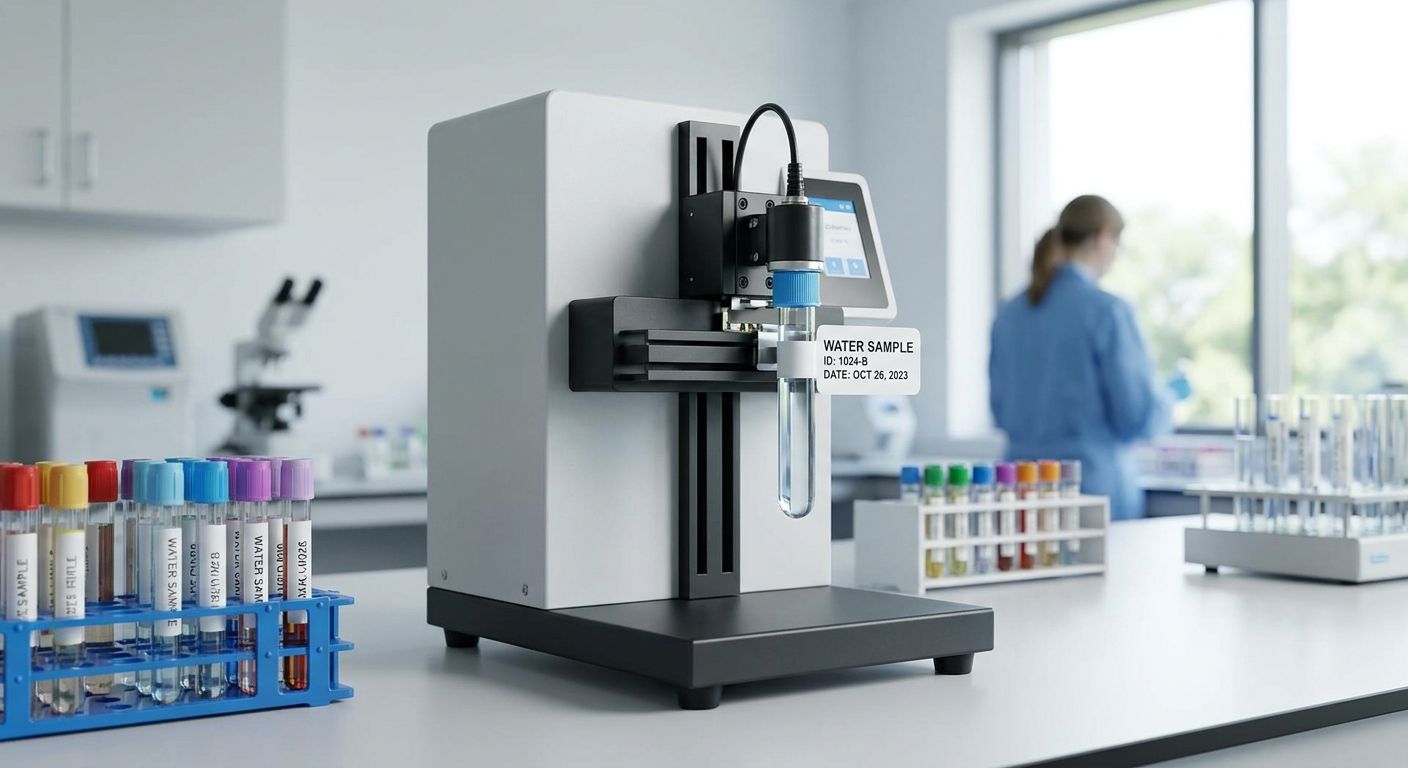
McAuley Labels also sells a dedicated test tube labeler built specifically around laboratory tube workflows, priced at $3,055.50 in 2026. Rather than adapting a general-purpose desktop printer, it's designed around the tube-labeling motion itself — feeding, wrapping, and applying to round stock without a manual print-and-apply step.
For labs doing high volumes of tube labeling as their primary print job rather than one task among several, a purpose-built unit removes a manual step that a general thermal printer still requires. Verdict: Buy if tube labeling is your primary daily print task, not a side job.
6. Resin thermal transfer ribbon — the consumable that decides everything
None of the printers above matter if the wrong ribbon feeds through them. Thermal transfer ribbon in resin formulation is what actually gives water testing labels their chemical and moisture resistance — wax and wax-resin blends smear when they contact solvents or sit wet for hours in a cooler.
Buying the printer without the right ribbon is the single most common mistake labs make when they set up tube labeling from scratch. Verdict: Buy resin ribbon specifically, skip wax and wax-resin for anything touching water or reagents.
Comparison table
| Model | Resolution | Ribbon type | Best for | Verdict |
|---|---|---|---|---|
| GoDEX ZX430i | 300 DPI | Thermal transfer | Small-tube barcodes with text | Buy |
| GoDEX RT730i | 300 DPI | Thermal transfer | 200+ labels/day | Buy |
| GoDEX RT200i | 203 DPI | Thermal transfer | Barcode-only, low volume | Consider |
| GoDEX GE330 | 203 DPI | Thermal transfer | Compact bench setups | Consider |
| Dedicated Test Tube Labeler | N/A | Built-in feed | High-volume tube-only workflow | Buy |
| Resin ribbon | N/A | Resin | Any moisture/chemical exposure | Buy |
Where to buy
Buy the printer and its ribbon together from the same source so the ribbon width and formulation are confirmed compatible before your first print run. A mismatched ribbon width wastes stock and jams the printhead.
Request a small sample roll before ordering bulk labels, especially if your lab is testing a new label stock against a specific reagent or cold-storage condition. If your lab needs a nonstandard label size or a custom sample-ID layout, a custom quote gets you exact specs instead of forcing a standard template.
FAQ
What is the best test tube labeler for water testing labs in 2026?
The GoDEX ZX430i is the best test tube labeler for water testing labs in 2026 because its 300 DPI resolution keeps barcodes and small text legible on narrow tube diameters. High-volume labs running 200+ samples a day should size up to the GoDEX RT730i instead.
Is direct thermal or thermal transfer better for water sample tubes?
Thermal transfer with resin ribbon is better for water sample tubes because it resists smearing from moisture, ice, and chemical exposure. Direct thermal labels fade under heat and UV and are a poor fit for samples held in cold storage for weeks.
What DPI do I need for test tube barcode labels?
300 DPI is the practical minimum for barcodes on tubes smaller than 15mm in diameter. 203 DPI works only for larger labels with barcode data and no small text alongside it.
How much does a lab test tube labeling printer cost?
Desktop thermal transfer printers built for lab tube labeling run in the low hundreds to low thousands of dollars depending on speed and duty cycle, while a dedicated purpose-built labeler lists around $3,055.50 in 2026. Ribbon and label stock are recurring costs on top of the printer.
Can I use wax ribbon for water testing sample labels?
Wax ribbon is not recommended for water testing sample labels because it smears when it contacts moisture or solvents. Resin ribbon is the correct choice for any label that will touch water, ice, or reagents.
Do test tube labels survive freezer storage?
Labels printed with resin thermal transfer ribbon on the right adhesive stock survive freezer storage down to standard lab freezer temperatures without smearing. Direct thermal labels typically fade faster under prolonged cold storage.
How many labels can a GoDEX RT730i print per day?
The GoDEX RT730i is built for sustained daily runs in the hundreds of labels, which is why it's the pick for municipal and multi-site water testing operations rather than a single bench lab.
What size tube labels do water testing labs typically use?
Water testing labs typically use narrow labels sized for 12mm to 15mm diameter tubes and jugs, which is exactly the size range where 300 DPI resolution outperforms 203 DPI for barcode legibility.
One last thing
The detail most labs skip when setting up tube labeling: wax-resin ribbon looks identical to full resin ribbon on the spool, but only full resin holds up against long-term cold storage and solvent splashes. Check the ribbon formulation label before you order, not just the printer spec sheet — the printer is only half the durability equation.