
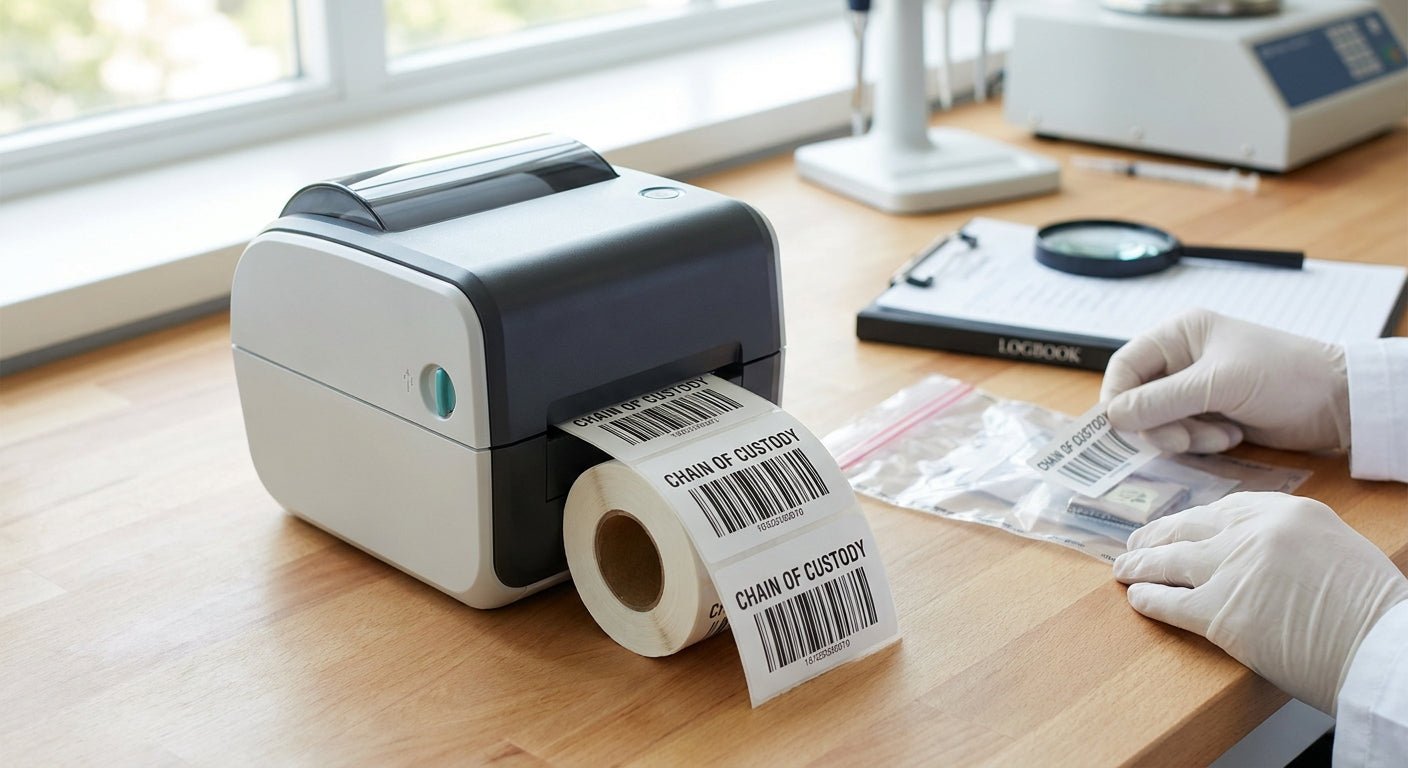
Chain of custody evidence labels have one job: survive scrutiny in court and in a freezer, sometimes both. This guide ranks the label printers and label stock combinations that hold up under that pressure in 2026.
- The GoDEX ZX430i+ at 300 DPI is the best label printer for chain of custody labels in 2026 for barcode clarity — Buy.
- 3M Heavy-Duty barcode stock resists solvent wipe-downs and freezer condensation better than standard paper labels.
- 203 DPI printers work for large property tags but blur small barcodes below 1 inch — Skip for evidence work.
- Sequential numbering and tamper-evident stock matter more than brand name for defensibility in an audit.
Why this matters
An evidence label that smudges, peels, or scans wrong doesn't just look bad — it breaks the chain of custody a prosecutor or auditor needs to trust. Property rooms, forensic labs, and evidence intake desks run labels through freezers, solvent wipes, and years of shelf storage before anyone reads them again.
The printer and the label stock have to match that timeline. A 203 DPI desktop printer that's fine for shipping labels can turn a 1-inch barcode into a smear the scanner rejects on the third pass. That's a re-tag, a broken seal, and a documentation gap nobody wants to explain in 2026.
“If a barcode scanner needs three passes to read an evidence tag, the label already failed the chain of custody.”
How this list was ranked
Each printer here is scored on print resolution, tamper-evident label compatibility, and duty cycle — the three things that decide whether a label survives intake, storage, and courtroom review. Resolution data comes from published GoDEX spec sheets current as of 2026. Label stock entries are ranked on adhesive class and material resistance to moisture and abrasion, since evidence rooms rarely control temperature the way a warehouse does.
Price and warranty terms reflect current McAuley Labels listings. Nothing here is a lab test claim — it's a spec-and-durability comparison built for buyers who need to justify the purchase to a records supervisor.
The ranked list
1. GoDEX ZX430i+ — the standard-issue pick
This 4-inch printer runs at 300 DPI, which is the resolution floor for barcodes under 1 inch wide — the size most evidence tags use to fit on small bags and vials. It has a color display for quick status checks during a shift and ships with a 3-year warranty in 2026.
At $945, it's priced for a department that prints hundreds of evidence tags a month, not a handful. Pair it with 3M Heavy-Duty label stock and it becomes a repeatable, auditable labeling station. Buy — this is the default recommendation for chain of custody labels at any property room printing more than a few dozen tags a week.
2. GoDEX RT700i — the multi-format evidence desk pick
The RT700i runs a 4-color display and handles mixed label widths, which matters when one desk prints vial labels, bag tags, and box seals in the same shift. It's built for higher-volume label rotation than a basic desktop unit.
Departments running one shared printer across intake, storage, and lab handoff get more use out of the larger interface than out of a single-purpose desktop model. Buy if one GoDEX printer needs to cover more than one label format in the same evidence workflow.
3. 3M Heavy-Duty barcode label stock — the label that survives the freezer
The printer only matters if the label stock holds up after it leaves the printer. 3M Heavy-Duty barcode stock resists condensation, solvent wipe-downs, and years of cold storage better than standard paper labels — the three conditions most property rooms actually create.
This is the stock to run under any 300 DPI printer on this list. Buy — 3M heavy-duty barcode inventory labels are the label half of the equation, and skipping this for cheap paper stock undoes the printer's resolution advantage.
4. GoDEX RT200i — the property-room budget printer
Running at 203 DPI, the RT200i handles large property tags — furniture, electronics, bulky items — where the barcode has room to be an inch or more wide. It's not the printer for small vial or bag labels.
Departments tagging large items only, with barcodes that stay above 1 inch, get acceptable results here without paying for 300 DPI resolution they don't need. Consider it as a second station for oversized property, not as the primary evidence printer.
5. GoDEX G530 — the shared network station
The G530 is built to sit on a network and serve multiple intake desks rather than one dedicated station. That's useful in a facility where evidence comes in at several points but gets logged into one system.
It trades some of the touchscreen convenience of the RT700i for network reliability across a bigger footprint. Consider for multi-desk intake, Skip if one printer per station is the actual workflow.
6. Wax/resin thermal transfer ribbon — the consumable most departments get wrong
A 2.25-inch by 243-foot wax/resin ribbon is what actually puts the barcode on the label — direct thermal alone fades under UV and heat over a multi-year storage period, which is a problem when evidence sits for years pending trial. Wax/resin resists that fade.
At roughly $9 per roll, it's the cheapest line item on this list and the easiest one to overlook until a label comes back unreadable in court. Buy as a standing consumable, not a one-time purchase.
7. Metalized silver QR code asset tags — for chain-of-custody equipment, not case evidence
These heavy-duty metalized tags are built for durable equipment tracking — cameras, kits, storage containers — rather than for the case-item labels themselves. They're worth stocking separately for the hardware side of an evidence operation.
Consider for tagging the equipment and containers that move evidence, Skip for the case-item labels themselves — use the barcode stock above for that.


Comparison table
| Pick | Resolution | Best for | Verdict |
|---|---|---|---|
| GoDEX ZX430i+ | 300 DPI | Small barcode evidence tags | Buy |
| GoDEX RT700i | 4-color display | Mixed-format evidence desk | Buy |
| 3M Heavy-Duty barcode stock | N/A (label) | Freezer/solvent-exposed labels | Buy |
| GoDEX RT200i | 203 DPI | Large property tags only | Consider |
| GoDEX G530 | 203 DPI class | Shared multi-desk network | Consider |
What to avoid
Don't buy a 203 DPI printer for anything smaller than a 1-inch barcode — the resolution math doesn't hold, and a rescan on a chain-of-custody item is a documentation problem, not just an annoyance. Standard paper label stock looks identical to heavy-duty stock on a shelf but fails in weeks under freezer condensation or repeated solvent wipes, which is exactly the environment most evidence rooms create.
Generic ribbon bought off a marketplace listing without a stated wax/resin composition is a gamble — direct thermal-only prints fade under UV and heat over the multi-year hold periods common in pending cases.
Where to buy
Buy the printer and the label stock from the same source so warranty and ribbon compatibility aren't a guessing game later. Confirm the label material — 3M Heavy-Duty versus standard paper — before ordering in bulk; the two look the same on a screen and behave very differently after six months in storage.
Stock at least one spare ribbon roll per printer on-site. A ribbon that runs out mid-batch during intake is the single most common reason evidence tags get delayed past a shift change.
FAQ
What's the best label printer for chain of custody labels in 2026?
The GoDEX ZX430i+ is the best label printer for chain of custody labels in 2026 at 300 DPI, which is the resolution floor for barcodes under 1 inch wide. It pairs with 3M Heavy-Duty label stock for freezer and solvent resistance.
Is 300 DPI enough for evidence barcode labels?
Yes, 300 DPI is the standard resolution for evidence barcodes under 1 inch wide in 2026. Below that resolution, small barcodes blur and scanners need multiple passes to read them.
Can a 203 DPI printer handle evidence labels?
A 203 DPI printer works for large property tags with barcodes over 1 inch wide, but it struggles with small vial or bag labels. Use 203 DPI for oversized items only, not case-item barcodes.
Do evidence labels need to be tamper-evident?
Tamper-evident stock adds a visible layer of protection when a label is removed or altered, which strengthens documentation during an audit. Not every evidence workflow requires it, but property rooms handling case items typically use it.
What label material holds up best in an evidence freezer?
3M Heavy-Duty barcode stock resists condensation and solvent wipe-downs better than standard paper labels. Standard paper stock degrades within weeks under repeated freezer cycling.
How much does a chain of custody label printer cost?
A 300 DPI printer suited to evidence labeling runs around $945 in 2026, with ribbon costing roughly $9 per 243-foot roll. Larger multi-format printers cost more depending on display and connectivity features.
Is GoDEX or Zebra better for evidence rooms?
Both brands make 300 DPI printers suited to small barcode work; the deciding factor is usually ribbon and label compatibility with existing stock. Match resolution and label material first, then compare brand-specific service terms.
How do you print sequential numbers for evidence tags?
Sequential numbering is set in the label design software before printing, incrementing a serial field automatically across a batch. This keeps every evidence tag unique without manual entry errors.
One last thing
The detail most departments miss isn't the printer at all — it's the ribbon composition. A direct thermal-only label looks identical to a wax/resin thermal transfer print on day one, but fades under UV and heat over a multi-year hold period, which is exactly how long some cases sit before trial. If a label has to survive years, not months, wax/resin ribbon is non-negotiable in 2026.