
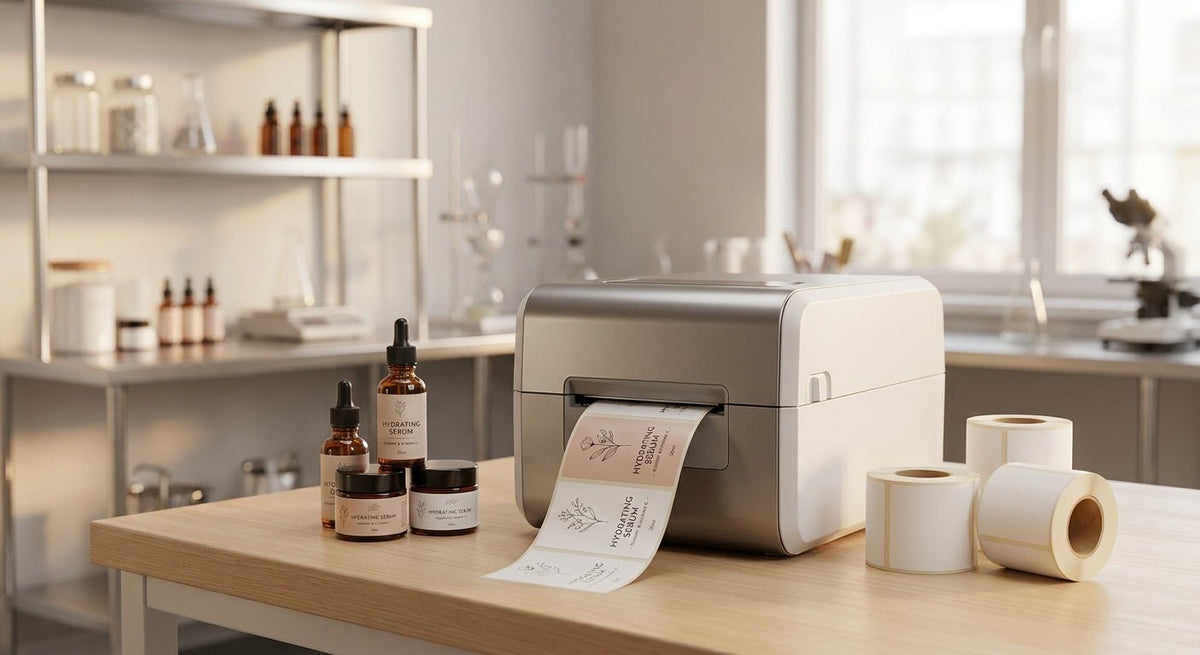
Cosmetics manufacturers printing ingredient lists, lot codes, and regulatory compliance data need a thermal label printer that handles fine print at scale — this guide identifies the right specs and top printer picks for that exact use case in 2026.
TL;DR: For thermal label printer for cosmetics manufacturing in 2026, the Godex RT230i (300 DPI) is the standard pick for ingredient-dense labels on bottles and tubes, the Godex RT863i (600 DPI) is the right call when fine print and small font sizes are non-negotiable, and the Godex EZ2350i covers mid-volume operations that need a color display for faster operator setup. Skip direct thermal entirely — cosmetic labels need ribbon-based thermal transfer to survive moisture, oils, and the shelf life of the product itself.
Who This Is For
This guide is written for cosmetics manufacturing operations that print labels in-house: contract manufacturers running multiple SKUs, indie beauty brands scaling past hand-application, and private-label producers who need lot-code traceability and FDA-compliant ingredient panels on every unit. If you're printing 200–5,000 labels per day on containers ranging from 0.5 oz lip balm pots to 16 oz pump bottles, every spec decision below applies directly to your workflow.
What to Look for in a Thermal Label Printer for Cosmetics Manufacturing
Print Resolution: 300 DPI Minimum, 600 DPI for Small Labels
Cosmetic labels regularly carry 8-point font ingredient lists and 2D barcodes (QR or DataMatrix) for traceability. At 203 DPI, fine text smears and barcodes fail scan tests. 300 DPI produces clean, scannable output on labels as small as 1" x 1.5". On containers under 1 oz — lip gloss, sample sachets, eye cream — move to 600 DPI to keep ingredient text legible at legal-minimum type sizes. The Godex RT863i thermal printer at 600 DPI is the only option in this catalog at that resolution.
Thermal Transfer, Not Direct Thermal
Direct thermal labels fade when exposed to heat, UV light, and moisture — all three of which cosmetic products generate or encounter during storage and use. Thermal transfer printing uses a wax or resin ribbon to bond ink permanently to the label substrate. Resin ribbons on polyester labels survive water, oils, isopropyl alcohol wipe-downs, and 18-month shelf exposure without smearing. Direct thermal has no place on a finished cosmetic product label.
Label Material Compatibility: Polyester and Glossy Stocks
Cosmetics labels go on glass, HDPE, and aluminum — curved surfaces with tight label diameters. Glossy white polyester is the standard substrate: it handles moisture barriers, adheres to curved surfaces, and holds color-ribbon printing cleanly. Your printer needs to accommodate roll media with a 1" core minimum and support label widths from 1" to 4". Verify the printer's minimum label width before ordering — some industrial units bottom out at 1.5" and cannot handle small pot labels.
Print Speed vs. Accuracy Trade-off
At 4 inches per second (ips), thermal transfer printers produce clean output on polyester. Push past 6 ips on fine-detail cosmetic labels and you introduce ribbon slip artifacts on ingredient text. For high-volume runs (1,000+ labels per shift), pair a 4–5 ips print speed with a label rewinder rather than chasing faster print speeds that compromise readability.
Connectivity and Software Integration
Cosmetics manufacturers running batch production need USB + Ethernet as a minimum. Wi-Fi connectivity matters if the printer is on a filling line away from a fixed workstation. Godex printers ship with GoLabel software, which handles variable-data fields (lot codes, batch numbers, expiry dates) and supports ZPL/EPL command sets for integration with ERP or inventory systems. A printer without stable Ethernet and variable-data software support creates a bottleneck every time a batch number changes.
Durability and Duty Cycle
A cosmetics production line is not an office. Humidity from emulsification equipment, airborne powder from loose cosmetics, and cleaning-cycle moisture all stress printer mechanisms. Look for a rated duty cycle of at least 4" of media per day at sustained production pace. Industrial-grade units like the Godex RT-series carry metal frames and sealed paper paths that tolerate production-floor conditions; desktop-class units with plastic housings will fail faster under those conditions.
Top Picks
The Standard Production Pick: Godex RT230i — 300 DPI
The safe pick for most cosmetics lines. The Godex RT230i at 300 DPI prints at up to 5 ips on labels up to 4.25" wide. At 300 DPI, ingredient panels in 8-point type print cleanly, and GS1-128 barcodes pass scanner verification without adjustment. The RT230i runs USB, serial, and Ethernet natively — no add-on cards needed for network integration. It handles glossy white polyester stock without feed issues, which covers the majority of cosmetic label substrates.
Verdict: Buy for standard bottle, tube, and jar labels from 1.5" wide and up.
The Fine-Print Pick: Godex RT863i — 600 DPI
The wildcard for small-format and high-detail labels. The Godex RT863i at 600 DPI doubles the dot density of a standard 300 DPI unit. On a 1" x 1.5" lip balm label, 600 DPI is the difference between readable and compliant ingredient text and text that requires a magnifying glass. This printer also produces DataMatrix codes small enough for unit-dose packaging. Print speed is lower at 600 DPI — plan for 3 ips on fine-detail runs — but output quality on small labels justifies the throughput cost.
Verdict: Buy if your SKU mix includes containers under 2 oz or labels narrower than 2".
The Mid-Volume Operator Pick: Godex EZ2350i — 300 DPI with Color Display
The pick for operations with multiple operators. The Godex EZ2350i with color display at 300 DPI adds a full-color touchscreen that reduces operator setup errors on batch changeovers. When production staff switch between 12 active SKUs in a shift, a color UI for label template selection cuts mislabeling risk. Print quality matches the RT230i; the premium is in operator experience, not output spec.
Verdict: Buy for operations running 5+ SKUs per shift with rotating staff.
The High-Volume Industrial Pick: Godex ZX430i — 300 DPI
The pick for contract manufacturers at sustained high volume. The Godex ZX430i at 300 DPI is built for continuous-run production: large ribbon capacity, metal frame construction, and a duty cycle suited to multi-shift operations. At 300 DPI and 6 ips, it moves volume without sacrificing print quality on standard cosmetic label stocks. Industrial build quality means it tolerates the humidity and powder environments of a cosmetics plant better than desktop-class units.
Verdict: Buy for contract manufacturing operations running 2,000+ labels per day.
The Bottle Applicator Option: Godex AG1000F — 203 DPI
The specialized pick for round-bottle application. The Godex AG1000F bottle applicator at 203 DPI combines printing and label application in one unit, built specifically for cylindrical containers. At 203 DPI it is not suitable for fine ingredient text — use it for secondary labels (lot codes, barcodes, date labels) on bottles where a separate primary label already carries ingredient data. If your line applies 500+ round-bottle secondary labels per shift, this eliminates a manual application step entirely.
Verdict: Consider for secondary-label application on round containers; Skip as a primary cosmetic label printer.
What to Avoid
- Direct thermal printers on finished product labels. No ribbon means no durability. A direct thermal label on a moisturizer will fade within weeks of shelf exposure. The article on direct thermal vs. thermal transfer covers this in full — the short answer is thermal transfer only for cosmetics.
- 203 DPI printers for primary cosmetic labels. 203 DPI cannot render FDA-required ingredient lists in compliant type sizes on labels under 3" wide. It is a shipping-label resolution, not a product-label resolution.
- Desktop plastic-housing units for production floors. Units like the Godex DT-series are designed for office or light-commercial use. Cosmetics production environments — humidity, powder, cleaning agents — will damage unsealed plastic-frame mechanisms within months of continuous use.
Verdict Comparison Table
| Printer | DPI | Best For | Verdict |
|---|---|---|---|
| Godex RT230i | 300 | Standard bottle/jar/tube labels | Buy |
| Godex RT863i | 600 | Small-format, fine-text labels | Buy |
| Godex EZ2350i | 300 | Multi-SKU, multi-operator lines | Buy |
| Godex ZX430i | 300 | High-volume contract manufacturing | Buy |
| Godex AG1000F | 203 | Round-bottle secondary labels only | Consider |
FAQ
What's the best thermal label printer for cosmetics manufacturing in 2026? The Godex RT230i at 300 DPI covers most cosmetics manufacturing needs: clean ingredient text, GS1-compliant barcodes, and Ethernet connectivity for batch-variable printing. Move to the RT863i at 600 DPI when label size drops below 2" wide.
Is direct thermal or thermal transfer better for cosmetic labels? Thermal transfer is the only viable option for cosmetic product labels. Direct thermal output fades under moisture, UV, and the oils present in most cosmetic products. Thermal transfer with a resin ribbon on polyester stock lasts the full shelf life of the product.
What DPI do I need for FDA ingredient list compliance on cosmetic labels? 300 DPI handles 8-point type on labels 2" wide and larger. For labels under 2" — lip balm, sample sizes, eye cream pots — 600 DPI is required to keep ingredient text legible at FDA-minimum type sizes.
Can I use a thermal label printer for lot code and expiry date printing on cosmetics? Yes. Thermal transfer printers with GoLabel software or ZPL support handle variable-data fields (lot codes, batch numbers, best-by dates) as auto-incrementing or database-linked fields. No manual re-keying between batches.
How much does a thermal label printer for cosmetics manufacturing cost? Entry-level 300 DPI thermal transfer units (Godex RT200i, RT230i) start below $300. Industrial units with color displays and high-duty cycles (EZ2350i, ZX430i) run $400–$700. The RT863i at 600 DPI sits in the $500–$600 range. Ribbon and label stock are the ongoing consumable cost.
What label material should I use for cosmetic product labels? Glossy white polyester with a permanent adhesive is the standard for most cosmetic containers. It survives moisture, oil contact, and refrigerated storage. For labels on glass or aluminum, verify the adhesive spec matches the surface energy of the container material.
Can one printer handle both primary product labels and shipping labels? A 4" thermal transfer printer like the RT230i or ZX430i prints both 4" x 6" shipping labels and 2" x 3" product labels from the same unit by swapping label rolls. The limiting factor is ribbon width — verify the installed ribbon covers your widest label format.
What software do Godex printers use for cosmetics label design? Godex printers ship with GoLabel, which supports text fields, barcodes, QR codes, and variable-data sequences. For operations already running an ERP or inventory system, Godex printers accept ZPL and EPL command sets for direct integration without GoLabel as an intermediary.
One Last Thing
The most common mislabeling error in cosmetics manufacturing is not a printer problem — it is a template management problem. A printer that outputs 300 DPI clean text still produces the wrong label if the operator loads last batch's template. Godex's GoLabel software supports password-protected template libraries and operator-level access restrictions. Lock down template selection to supervisors, and the printer hardware becomes the least likely point of failure in your labeling process.