
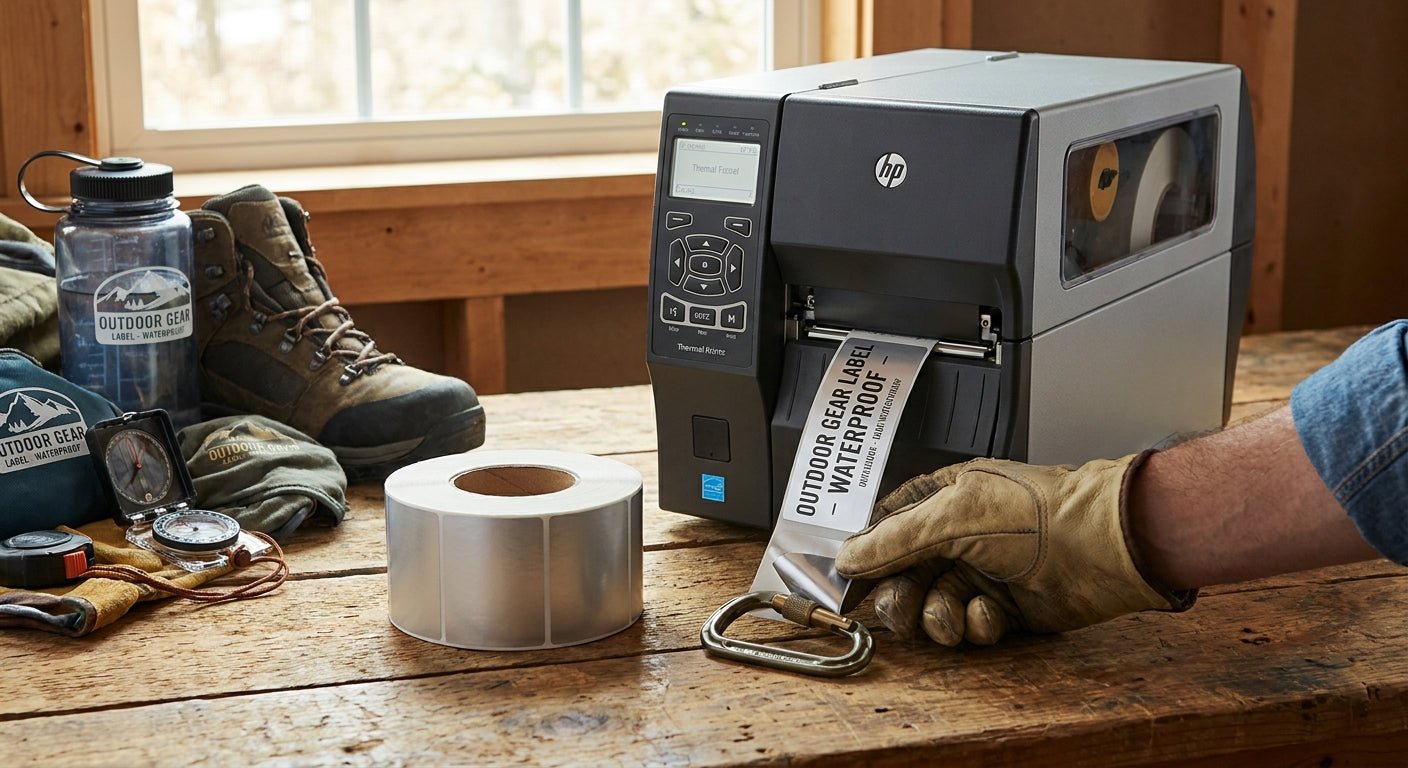
Outdoor equipment sits in rain, road salt, and full sun for years at a stretch, and a thermal transfer printer paired with the right ribbon and label stock is the only combination that actually survives that environment.
This guide breaks down what to look for in a thermal transfer printer for outdoor equipment labels and which models hold up once the tags leave the shop and go to the yard.
TL;DR
A thermal transfer printer for outdoor equipment labels needs 300 DPI resolution or better, wax-resin or full-resin ribbon, and a metal or reinforced chassis — direct thermal alone fades within months once it's outside. The GoDEX GE330 is the Buy for fleets and rental yards running metalized silver or 3M heavy-duty tags on generators, trailers, and mowers. The GoDEX RT863i is the Buy for shops that need 600 DPI resolution for small serialized barcodes on compact parts. Skip anything marketed as "waterproof" that's actually a direct thermal engine — it won't hold up through a 2026 summer on asphalt.
Why this matters
Direct thermal printers burn an image into heat-sensitive paper. That image is exposed to the same sun and heat that degrades the paper itself, so labels go blank in 3 to 6 months outdoors — sometimes faster on black equipment that runs hot in direct sun.
Thermal transfer works differently: the printer melts a resin or wax-resin ribbon onto the label surface, bonding pigment into a polyester or vinyl substrate instead of relying on a heat-reactive coating. That's why every asset tag rated for outdoor duty pairs a thermal transfer printer with a resin-compatible ribbon and a synthetic label stock, not paper.
Get this wrong and you're re-tagging trailers, mowers, and rental units every season. Get it right in 2026 and the same tag survives multiple winters.
Who this is for
This guide is for facilities managers, equipment rental yards, construction fleets, and landscaping or utility companies tagging generators, compressors, trailers, and mowers that live outside year-round. If your assets sit in a climate-controlled office or warehouse, a heavy-duty asset tag setup built for outdoor equipment is more printer than you need — a direct thermal desktop unit will do fine indoors.
If your inventory is exposed to weather, road grime, or repeated washdowns, keep reading.
What to look for in a thermal transfer printer for outdoor equipment labels
Print resolution: 203 vs 300 vs 600 DPI
Resolution determines whether a barcode scans reliably after the label has been rained on and handled for a year. A 203 DPI engine is fine for large ID tags with big text, but small serialized barcodes on compact parts need 300 DPI minimum to stay crisp. Shops printing tiny QR codes or dense 2D codes should go to 600 DPI so the code doesn't smear into an unreadable block after repeated exposure.
Ribbon chemistry: wax, wax-resin, or resin
Wax ribbon is cheap and fine for indoor paper labels, but it scratches off metalized silver or polyester stock within weeks outdoors. Wax-resin is the practical minimum for outdoor equipment tags — it bonds well to synthetic film and resists smearing from oil, grease, and light abrasion. Full resin is the step up for tags that get direct chemical exposure, like labels near hydraulic fluid or diesel. A thermal transfer ribbon matched to your label stock matters more than the printer brand — the wrong ribbon on the right printer still fails outdoors.
Label material: metalized silver vs 3M heavy-duty polyester
Metalized silver polyester holds up against UV and moisture better than plain white polyester and gives barcode scanners a high-contrast surface to read against. 3M heavy-duty adhesive backing is what keeps the tag stuck to a textured or curved metal surface through temperature swings — a standard adhesive lets corners lift within a season. Match the label chemistry to the ribbon chemistry; mixing wax ribbon with metalized stock is the single most common outdoor-tag failure.
Printer chassis and duty cycle
A plastic desktop printer built for retail price tags isn't built for a shop floor or an outdoor tagging station where it gets bumped, dusted, and run daily. Look for a metal frame and a print speed rated for continuous runs of 100+ labels, not just single-label jobs. Duty cycle matters more than sticker price if you're tagging an entire fleet at once.
Sensor type for continuous vs die-cut outdoor tags
Outdoor asset tags come in die-cut rolls with gaps between labels or continuous stock with black registration marks. A printer with both gap and black-mark sensing gives you flexibility to switch stock without buying a new machine. This matters more than it sounds — the wrong sensor setting causes skipped or doubled labels mid-run.
Connectivity and standalone printing in the field
If tags get printed at a yard or job site instead of a central office, a printer with a keypad or standalone mode saves a laptop trip every time. USB and Ethernet cover most shop setups; standalone models matter more for mobile crews tagging equipment on delivery.
Top picks for outdoor equipment labels
GoDEX GE330 — the workhorse
This 4-inch, 203 DPI thermal transfer printer is built for daily tagging runs on metalized silver and 3M heavy-duty stock, which covers most outdoor equipment tagging jobs without overspending on resolution you don't need. Print speed and a metal chassis mean it handles continuous fleet-tagging sessions rather than one label at a time. Buy if you're tagging generators, trailers, mowers, or rental units and don't need sub-millimeter barcode detail. See the GoDEX GE330 thermal transfer printer.
GoDEX RT863i — the high-resolution pick
At 600 DPI, this is the printer for small serialized barcodes, dense QR codes, or compact parts where a 203 DPI code would smear into noise after a season outdoors. The resolution jump costs more per unit but pays off on tags smaller than 1 inch square. Buy if your outdoor assets include small tools, sensors, or parts that need a scannable code in a tight footprint. Check the GoDEX RT863i 600 DPI thermal printer.
GoDEX RT730i — the compact desktop option
This model fits a smaller footprint for shops that don't need a full industrial chassis but still want thermal transfer capability for weatherproof tags. It handles moderate volume well but isn't built for all-day continuous runs the way the GE330 is. Consider it if you're tagging under 50 units a week and space at the tagging station is tight.
GoDEX ZX420i — the one to skip for outdoor duty
This printer is a capable indoor unit at 203 DPI, but it's positioned for retail and general-purpose labeling rather than heavy-duty outdoor tagging cycles, and the chassis isn't rated for the same duty cycle as the GE330 or RT863i. Skip it for equipment yards; it's a better fit for indoor retail or office labeling where volume and abrasion resistance matter less.
What to avoid
- Direct thermal printers marketed as "outdoor durable." No direct thermal label holds an image past a few months of UV exposure, regardless of what the printer spec sheet claims about the paper coating.
- Wax ribbon on metalized or polyester stock. It looks fine on day one and scratches off within weeks of handling — always match resin or wax-resin ribbon to synthetic label material.
- Paper labels with a laminate marketed as "waterproof." Lamination helps against splashes but doesn't stop UV fade the way a true polyester substrate does; it's a stopgap, not a fix.
Verdict comparison
| Model | Resolution | Ribbon type | Best for | Verdict |
|---|---|---|---|---|
| GoDEX GE330 | 203 DPI | Wax-resin | Fleet and yard tagging | Buy |
| GoDEX RT863i | 600 DPI | Resin | Small serialized barcodes | Buy |
| GoDEX RT730i | 203 DPI | Wax-resin | Low-volume desktop use | Consider |
| GoDEX ZX420i | 203 DPI | Wax | Indoor retail labeling | Skip for outdoor |
FAQ
Is a thermal transfer printer better than direct thermal for outdoor equipment labels? Yes — thermal transfer bonds resin or wax-resin ink into the label surface, while direct thermal relies on a heat-sensitive coating that fades from UV and heat within months outdoors.
What DPI do I need for outdoor asset tags? 203 DPI is enough for large ID tags with readable text, but 300 DPI or higher is safer for barcodes smaller than 1.5 inches, and 600 DPI is worth it for dense QR codes on compact parts.
Does wax-resin ribbon really matter that much? Yes — wax ribbon scratches and smears off metalized or polyester label stock within weeks of outdoor handling, while wax-resin bonds and holds through repeated exposure and abrasion.
Can I use the same printer for both outdoor equipment tags and indoor inventory labels? A thermal transfer printer like the GoDEX GE330 handles both — the difference is ribbon and label stock, not the printer itself, so one machine can cover both jobs if you swap consumables.
How long do thermal transfer outdoor labels last compared to direct thermal? Thermal transfer labels on metalized or 3M heavy-duty stock commonly last multiple years outdoors, while direct thermal labels fade to unreadable within a single season in full sun.
What's the difference between metalized silver and 3M heavy-duty polyester for outdoor tags? Metalized silver gives better barcode contrast and a reflective, professional look for asset ID; 3M heavy-duty polyester with reinforced adhesive is built to hold on curved or textured metal surfaces through temperature swings.
Do I need a standalone printer for field tagging? Only if crews tag equipment on-site rather than at a central shop — a keypad or standalone mode saves carrying a laptop, but most yards tag in batches at one station and don't need it.
What's the most common mistake when buying a printer for outdoor labels? Pairing the wrong ribbon with the label stock — wax ribbon on synthetic material is the single biggest cause of tags failing within weeks instead of years.
One last thing
The printer gets most of the attention, but the ribbon-to-label match decides whether a tag survives one winter or five. A 2026-spec GoDEX GE330 running the correct wax-resin ribbon on 3M heavy-duty stock will outlast a pricier 600 DPI printer running mismatched wax ribbon on the wrong material — buy the pairing, not just the machine.