
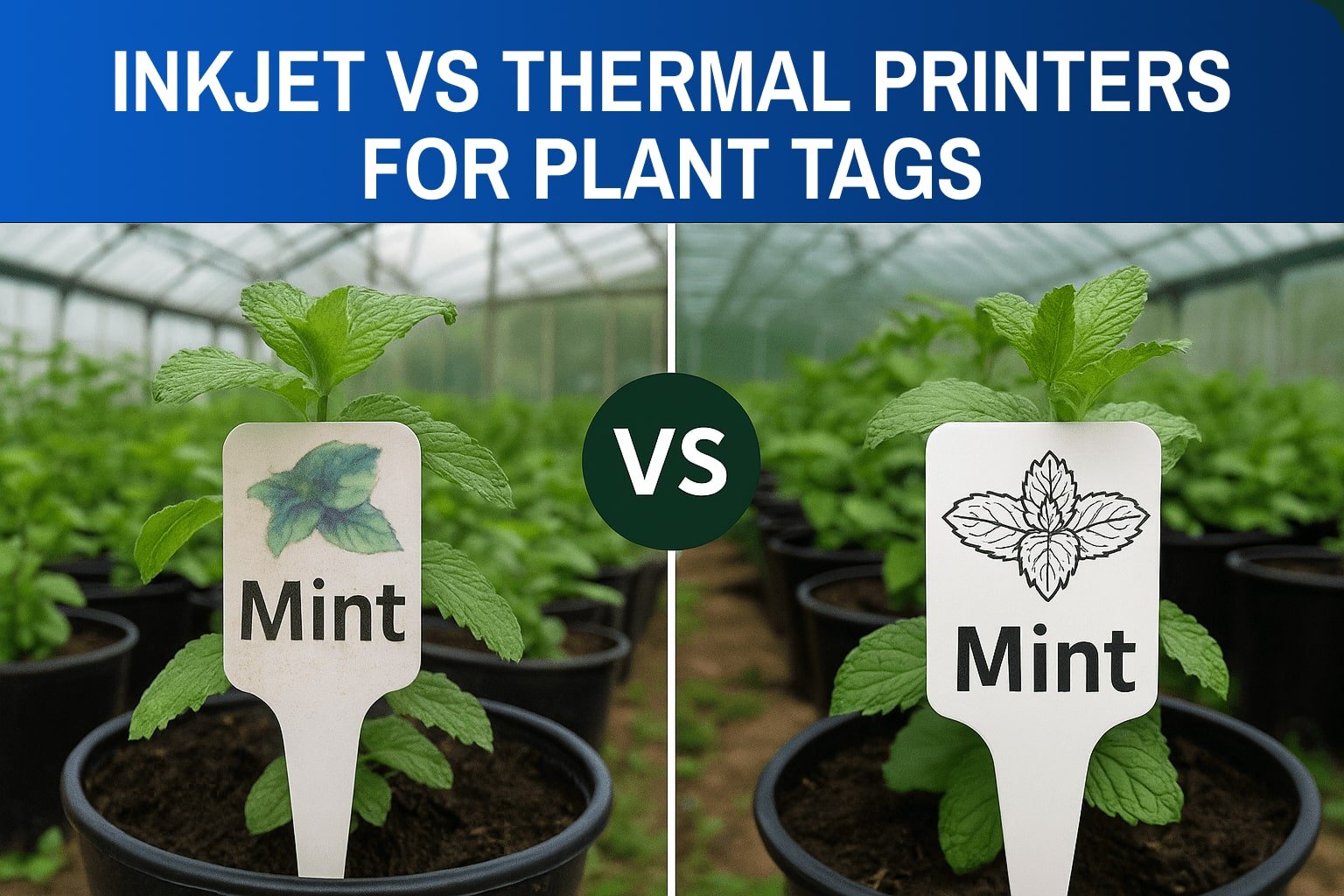
When you’re running a greenhouse, nursery, or garden center, labeling plants isn’t just about organization. It’s about durability, readability, and branding. From sunlight to irrigation, plant labels face extreme conditions daily. The type of printer you use can determine whether your tags last a full season or fade in a week.
So which one performs better, inkjet or thermal printers?
Let’s break down the differences so you can choose the right setup for your horticulture labeling needs.
🖋️ Inkjet Printers for Plant Tags: The Familiar but Fragile Option
Inkjet printers are affordable, easy to find, and great for printing photos or paper documents. However, when it comes to plant labels or nursery tags, they have serious limitations:
-
Ink runs when wet, even with “water-resistant” paper.
-
Exposure to UV light causes fading within weeks.
-
Standard printers struggle with synthetic materials such as polyester or polypropylene.
-
They use expensive ink cartridges that need frequent replacement.
You can print temporary labels for indoor plants or short-term use, but they won’t survive long in a humid greenhouse or outdoor nursery.
Best suited for: Small-scale growers, indoor gardeners, and short-term plant ID tags.
♨️ Thermal Printers: The Professional Choice for Nurseries
Thermal printers, especially thermal transfer models, are designed for industrial durability. Instead of spraying ink, they use heat and resin ribbons to bond the print directly into the label material.
That process makes the labels:
-
Waterproof and UV-resistant
-
Smudge-proof and scratch-resistant
-
Able to handle synthetic tag materials (polyester, polypropylene, or vinyl)
-
Cost-efficient for high-volume printing
Thermal transfer printing is the industry standard for horticultural labeling because it keeps plant tags legible in extreme conditions: rain, sunlight, fertilizers, and temperature swings.
Best suited for: Nurseries, greenhouses, farms, botanical gardens, and landscape suppliers.
🧾 Quick Comparison Table
| Feature | Inkjet Printer | Thermal Transfer Printer |
|---|---|---|
| Print durability | Fades in sun, smudges in water | UV-resistant and waterproof |
| Material compatibility | Paper only | Polyester, polypropylene, vinyl |
| Outdoor performance | Short-term | Long-term, weatherproof |
| Maintenance | Frequent cartridge replacements | Low maintenance, long ribbon life |
| Speed | Moderate | Fast, batch-ready |
| Cost per label | Higher over time | Lower over time |
| Ideal use | Indoor plants, office tags | Nurseries, farms, greenhouses |
🌱 Why Nurseries Choose GoDEX Thermal Printers
GoDEX printers combine industrial durability with user-friendly controls, perfect for plant professionals who need consistent, weatherproof labels.

Here’s how each model fits the horticulture workflow:
-
RT700i+ – 203 DPI for everyday nursery labels and loop tags.
-
ZX420i+ – 300 DPI precision for horticulture signage and brand printing.
-
HD830i+ – 8-inch wide format for large tags, tree labels, and outdoor signage.
All support resin ribbon printing for permanent, fade-proof results and are ENERGY STAR® certified for efficient operation.
🧴 Pro Tip: Combine with Synthetic Tags
To get the most from your thermal printer, pair it with:
-
Polyester (PET) for UV-resistant, long-term tags.
-
Polypropylene (BOPP) for flexible waterproof labels.
-
Vinyl for heavy-duty outdoor tags or tree wraps.
These materials keep text, barcodes, and branding crisp and readable for years.
✅ Final Takeaway
If you need professional, durable, and waterproof labels, thermal printers outperform inkjet printers in every critical category.
While inkjets may be fine for quick office tasks, thermal transfer printers like the GoDEX RT700i+, ZX420i+, and HD830i+ are purpose-built for horticultural environments.
They print faster, last longer, and help you maintain a consistent, professional look across your nursery or greenhouse.