
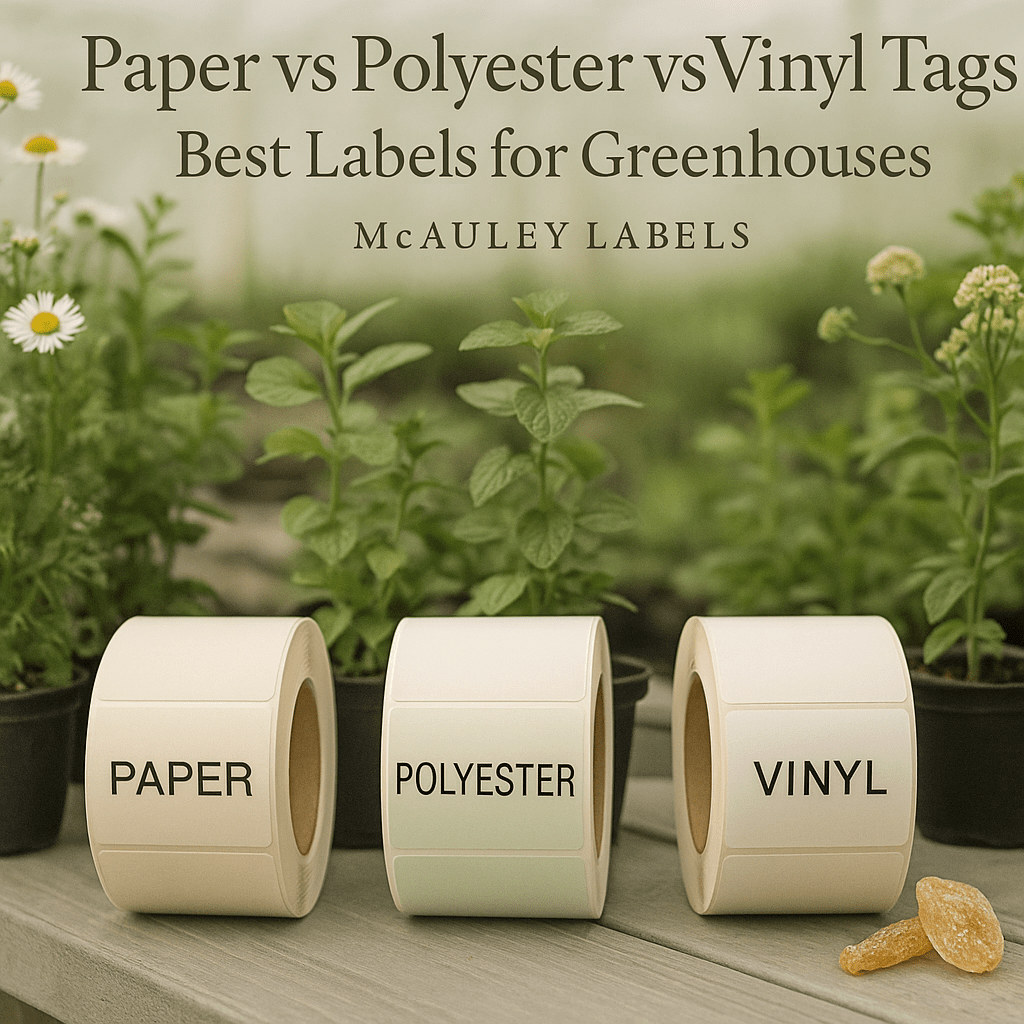
When labeling plants, not all tags are created equal.
From humid greenhouses to open-air nurseries, the material you choose for your plant tags determines whether your labels last a few weeks or several seasons.
In this guide, we’ll break down the three most common types of label materials, paper, polyester, and vinyl - so you can choose the one that fits your environment, printer, and durability needs.
🪴 1. Paper Labels – Affordable, But Temporary
Paper labels are the most economical choice and ideal for short-term or indoor use. They’re easy to print and cut, but they degrade quickly when exposed to moisture, heat, or UV light.
Pros:
-
Low-cost option for internal labeling or retail pricing
-
Compatible with most printers
-
Good print contrast and readability
Cons:
-
Not waterproof
-
Fades quickly in sunlight
-
Tears or peels in humidity
Best For:
Retail environments, seed trays, or temporary labeling in climate-controlled conditions.
🌦️ 2. Polyester (PET) Labels – The Greenhouse Workhorse
Polyester labels balance durability, print quality, and weather resistance, making them the most popular choice for professional growers and nurseries.
They can endure daily watering, fertilizer exposure, and even direct sunlight for extended periods. When printed with a thermal transfer printer and resin ribbon, polyester tags remain sharp, waterproof, and UV-resistant.
Pros:
-
Waterproof and chemical-resistant
-
UV-stable, perfect for outdoor exposure
-
Excellent adhesion on plastic, metal, or stake tags
-
Compatible with GoDEX ZX420i+ and RT700i+ thermal transfer printers
Cons:
-
Slightly higher cost than paper
-
Requires ribbon-based (thermal transfer) printing
Best For:
Greenhouses, nurseries, farms, and horticulture businesses need long-lasting identification tags.
☀️ 3. Vinyl (PVC) Labels – For Extreme Outdoor Durability
Vinyl labels are the most durable material available for plant tags, used in tree farms, landscaping, and harsh outdoor environments.
These thick, flexible labels resist UV exposure, water, and temperature swings better than any other type. They’re also perfect for loop tags and stake labels, maintaining flexibility without cracking over time.
Pros:
-
Exceptional UV and weather resistance
-
Ideal for long-term plant identification
-
Works well with outdoor-safe inks and resin ribbons
-
Tear-resistant and flexible
Cons:
-
More expensive than paper or polyester
-
Best results require high-quality thermal transfer printers like HD830i+
Best For:
Tree tags, landscape labeling, and botanical gardens where longevity is critical.
🔍 Material Comparison Chart
| Feature | Paper | Polyester (PET) | Vinyl (PVC) |
|---|---|---|---|
| Durability | ★☆☆☆☆ | ★★★★☆ | ★★★★★ |
| Water Resistance | ✗ | ✓ | ✓✓✓ |
| UV Resistance | ✗ | ✓ | ✓✓✓ |
| Cost Efficiency | ✓✓✓✓ | ✓✓ | ✓ |
| Print Method | Direct Thermal / Inkjet | Thermal Transfer | Thermal Transfer |
| Best Printer Match | Desktop | GoDEX RT700i+, ZX420i+ | GoDEX HD830i+ |
🌱 Which Material Is Best for Greenhouse Labels?
If you print frequently and need a balance of quality and cost, polyester is the go-to choice.
For large farms, tree nurseries, or labels that must survive seasons of sunlight and rain — choose vinyl.
Paper labels remain a good choice only for indoor, temporary, or low-cost needs.
Pro Tip: For best results, print your labels using a resin ribbon. This ensures fade-proof, scratch-resistant text that stays legible even after repeated watering.
💡 Example Use Case:

A greenhouse using GoDEX ZX420i+ with polyester labels and resin ribbons achieved over 18 months of outdoor readability, no fading, no smudging, no peeling.