
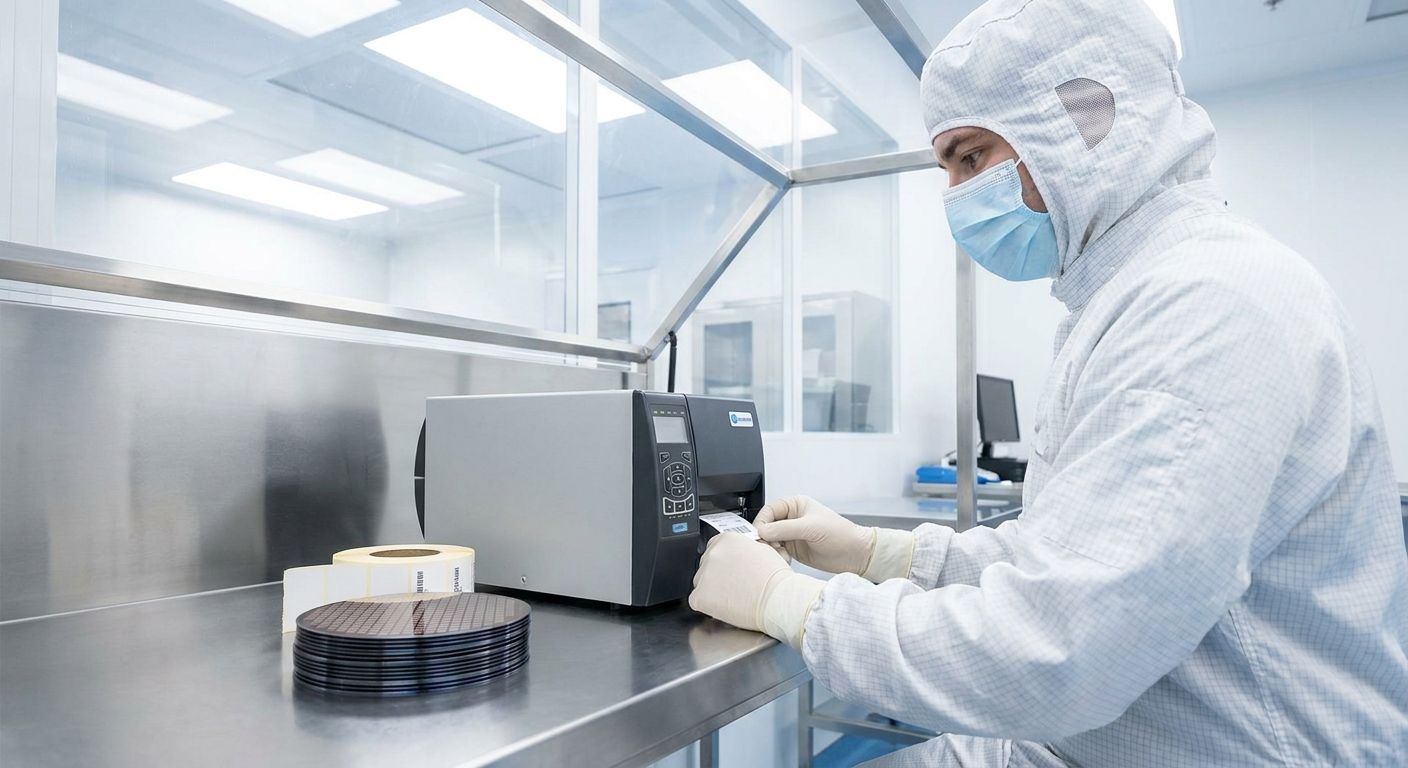
Semiconductor fabs and cleanroom operations track thousands of tools, carts, and fixtures that never leave a gowned environment — which means the label has to survive isopropyl alcohol wipe-downs, static-sensitive surfaces, and particle-count audits without becoming the contamination source itself. This guide covers what an asset tag printer for cleanroom facilities actually needs to hold up in 2026, and which McAuley Labels products meet that bar.
- Heavy Duty Silver Barcode Asset Tags resist IPA and hydrogen peroxide wipe-downs common in Class 100 cleanrooms — Buy.
- GoDEX ZX430i+ prints 300 DPI barcodes fine enough for wafer-lot and tool-ID labels at $945 — Buy.
- Metallized Silver ID Label tags handle static-sensitive tool housings without adding particulate risk — Buy.
- Skip standard paper labels in cleanroom or fab settings; adhesive outgassing and fiber shed disqualify them fast.
- 3M Heavy Duty barcode inventory labels are worth the upgrade for tools cycling through autoclave or chemical baths — Consider.
Why this matters
A mislabeled tool in a semiconductor fab isn't a minor inconvenience — it's a calibration record gap, a maintenance log with a hole in it, or a contamination event nobody can trace back to source. Cleanroom asset tags get scanned dozens of times a shift by gloved hands under low light, so the barcode has to stay sharp long after the label has been wiped down a hundred times. Facilities running ISO Class 5 through Class 8 environments in 2026 are standardizing on metalized polyester and heavy-duty silver stock specifically because standard paper and vinyl labels shed fiber and degrade under repeated solvent contact.
Who this is for
This guide is built for facilities managers, metrology techs, and EHS coordinators at semiconductor fabs, wafer processing plants, and cleanroom-classified labs who need to barcode tools, gowning equipment, HVAC components, and fixed assets without introducing outgassing risk or particulate contamination. If your current asset tags are peeling after a chemical wipe-down or your barcodes are unreadable after six months of gloved handling, the fix usually starts with the label stock, not the scanner.
McAuley Labels' Heavy Duty Silver Barcode Asset Tags are built around exactly this brief — metalized polyester face stock rated for equipment that gets cleaned constantly and never leaves a controlled environment.
What to look for in an asset tag printer for cleanroom facilities
Static-dissipative or low-charge label materials
Standard adhesive-backed labels can generate a static charge when peeled from the liner, which is a real problem next to ESD-sensitive wafer handling equipment. Metalized polyester tags dissipate charge more evenly than paper stock and don't flake fiber onto a gowned surface.
Chemical and cleaning-agent resistance
Cleanroom protocols call for repeated IPA, hydrogen peroxide, or quaternary ammonium wipe-downs, and a label that clouds or lifts after a dozen cleanings is a compliance liability, not just a cosmetic one. Heavy-duty silver and 3M-backed stock are formulated to survive solvent contact that would delaminate a standard label in weeks.
Barcode resolution for small, dense labels
Tool IDs, wafer-lot numbers, and calibration codes often need to fit on a 1-inch by 2-inch tag with room for a human-readable line underneath. A 203 DPI printer starts to lose barcode integrity at that size — 300 DPI is the practical floor, and 600 DPI gives you margin for QR codes carrying more data per scan.
Adhesive rated for the surface, not just the label
Stainless steel, powder-coated housings, and anodized aluminum all take adhesive differently, and a tag that holds on a flat metal panel can lift within days on a curved or textured tool surface. Guidance on matching label stock to stainless steel equipment covers the adhesive and surface-prep differences that matter most in a fab environment.
Sequential or QR-coded serialization
Fabs tracking hundreds of tools by asset number need labels pre-serialized or printed in sequence at the point of application, not hand-numbered after the fact. Sequential barcode or QR numbering removes the duplicate-ID errors that show up in manual tagging systems.
Low particle generation during printing and application
Thermal transfer printing with a clean ribbon path generates far less debris than inkjet or laser printing, which matters when the printer itself sits inside or near a controlled environment. A dedicated thermal transfer unit with a sealed ribbon cartridge keeps particulate output down during high-volume tagging runs.


Top picks for cleanroom and semiconductor asset tagging
Heavy Duty Silver Barcode Asset Tags — the safe pick. Metalized polyester construction, rated for outdoor and industrial durability, and already referenced above for its wipe-down resistance. Facilities running weekly IPA sanitation cycles report the barcode staying scannable well past the point standard vinyl tags would have clouded over. Buy for general tool and fixture tagging across the fab floor.
Metallized Silver ID Label — the ESD-aware pick. This is the tag to reach for on static-sensitive tool housings and metal enclosures near wafer handling stations, where a low-charge surface matters more than raw adhesive strength. It carries the same metalized face stock as the barcode version but in an ID-label format for equipment that needs a readable asset number at a glance. Buy for ESD-adjacent tool tagging.
GoDEX ZX430i+ Thermal Printer, 300 DPI — the workhorse printer. At $945, it prints 300 DPI barcodes sharp enough for a 1-inch tool tag with a 20-digit alphanumeric string underneath, and the color display makes ribbon and stock swaps fast for a facilities team running multiple label sizes. It handles the daily print volume of a mid-size fab tagging program without the cost of a 600 DPI unit most cleanroom labels don't require. Buy if your smallest label is 1 inch square or larger.
Custom Barcode Inventory Labels, 3M Heavy Duty — the adhesive upgrade. For tools that cycle through autoclave cleaning or get exposed to solvent baths more aggressive than a standard wipe-down, the 3M-backed adhesive holds where standard heavy-duty stock starts to lift at the corners after repeated thermal cycling. It costs more per label than the standard silver tag, so reserve it for the subset of assets that actually see that exposure. Consider for high-chemical-exposure equipment only.
GoDEX RT863i+ Thermal Printer, 600 DPI — the wildcard. At $1,346, it's overkill for most tool-tag runs, but if your fab prints QR codes carrying calibration history or maintenance URLs onto a half-inch label, 600 DPI is what keeps that density legible. Most cleanroom facilities in 2026 don't need it. Wait unless your labels are smaller than an inch or carry dense QR data.
What to avoid
- Standard paper thermal labels. They look identical to metalized stock in a photo but shed fiber under repeated wipe-downs and fail particulate audits in Class 100 and Class 1000 environments.
- Generic vinyl asset tags sold for warehouse use. Vinyl adhesive formulated for concrete floors and shelving doesn't hold on curved stainless steel tool housings the way a metalized polyester tag does.
- 203 DPI printers for sub-inch labels. They're fine for pallet tags and shipping labels, but barcode edges blur at small sizes and scanners start throwing read errors within months.
Verdict comparison
| Product | Material/Resolution | Best for | Verdict |
|---|---|---|---|
| Heavy Duty Silver Barcode Asset Tags | Metalized polyester | General tool and fixture tagging | Buy |
| Metallized Silver ID Label | Metalized polyester, low-charge | ESD-adjacent tool housings | Buy |
| GoDEX ZX430i+ (300 DPI) | 300 DPI thermal transfer | Standard barcode tags 1 inch+ | Buy |
| 3M Heavy Duty Barcode Labels | 3M industrial adhesive | High chemical/autoclave exposure | Consider |
| GoDEX RT863i+ (600 DPI) | 600 DPI thermal transfer | Dense QR codes under 1 inch | Wait |
FAQ
What's the best asset tag printer for cleanroom facilities?
The GoDEX ZX430i+ at 300 DPI covers most cleanroom and semiconductor tagging needs in 2026, printing barcodes sharp enough for 1-inch tool tags. Facilities printing sub-inch QR codes should step up to a 600 DPI unit like the GoDEX RT863i+.
Do cleanroom asset tags need to be ESD-safe?
Metalized polyester tags dissipate static charge more evenly than paper or vinyl, which matters near wafer handling and ESD-sensitive tool housings. Standard paper labels aren't rated for this and can contribute to static buildup on metal surfaces.
Is metalized silver or 3M heavy-duty better for cleanroom tags?
Metalized silver handles standard wipe-down cycles and general tool tagging in most cleanrooms. 3M heavy-duty adhesive is worth the extra cost only for equipment exposed to autoclave cycling or aggressive solvent baths.
How much does an asset tag printer cost for a semiconductor facility?
A 300 DPI industrial thermal printer suited to cleanroom asset tagging runs around $945 in 2026, while a 600 DPI unit for dense barcodes or QR codes costs closer to $1,346. Label stock itself typically runs separately per roll depending on material and size.
Can standard paper labels be used in a cleanroom?
No — standard paper labels shed fiber and degrade under repeated chemical wipe-downs, which creates a particulate contamination risk in classified cleanroom environments. Metalized polyester or heavy-duty silver stock is the standard substitute.
What resolution do I need for small barcode asset tags?
300 DPI is the practical minimum for barcodes on tags under 2 inches; 600 DPI is worth it only when the label is smaller than an inch or carries a dense QR code. Most tool and fixture tags in a fab don't need 600 DPI.
How often do cleanroom asset tags need replacing?
Metalized polyester tags rated for industrial use typically outlast the equipment cleaning schedule, holding up through hundreds of IPA or hydrogen peroxide wipe-downs before the barcode degrades. Standard paper tags often need replacement within months under the same conditions.
One last thing
The detail that trips up most facilities teams isn't the label material — it's mixing tag sizes across a fab without standardizing the printer resolution first, which means half the barcode population scans clean and the other half throws read errors at random. Pick one resolution for the whole tagging program in 2026 and standardize the label size around it before you order stock.