
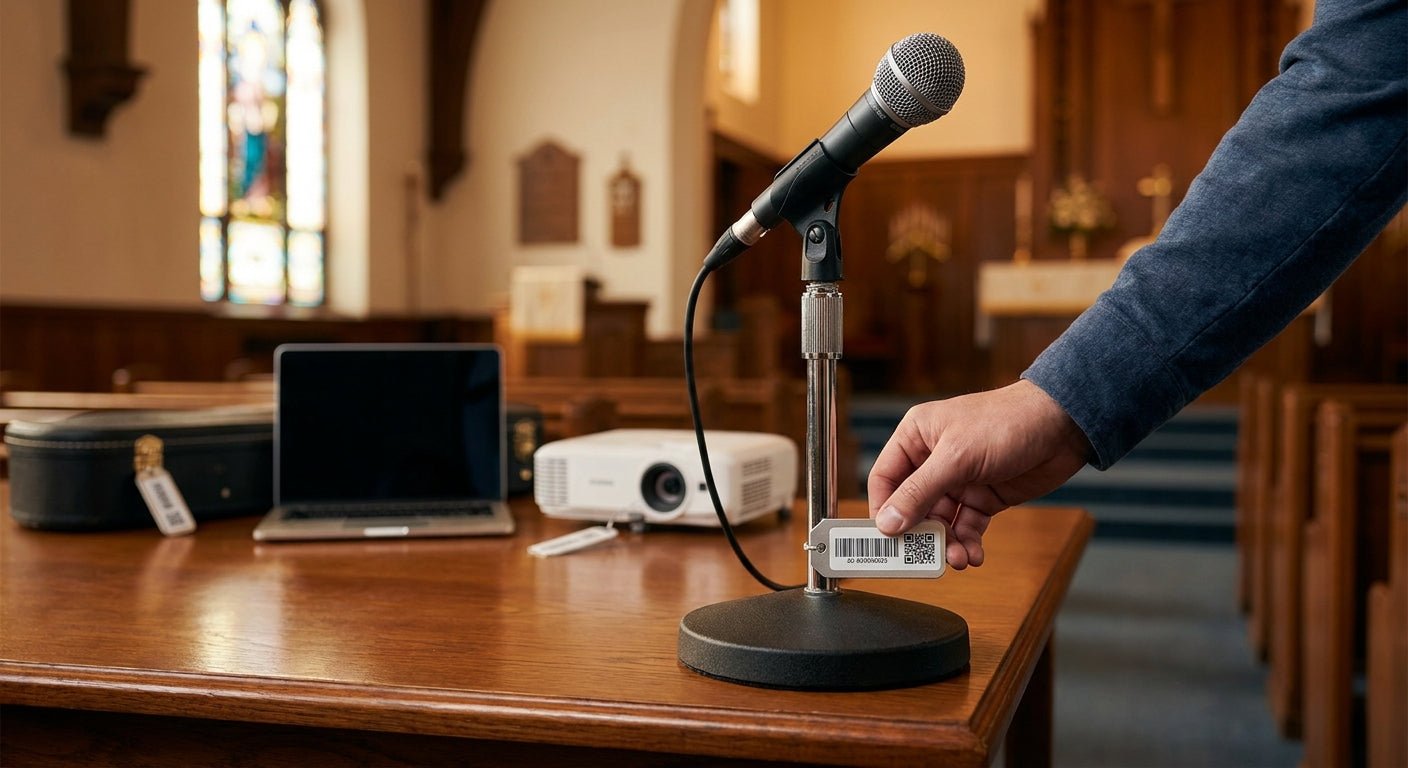
Church buildings and nonprofit facilities lose track of equipment fast because the people managing it turn over every year or two, and nobody hands off a spreadsheet. Asset tags for church property fix that by putting a scannable, physical ID on every folding table, sound board, and HVAC unit before it walks off or gets forgotten in a storage closet.
TL;DR
For asset tags for church property, the practical pick for anything that lives outdoors or gets moved often is the McAuley Labels heavy duty silver ID label — Buy. For indoor-only items like folding chairs, AV carts, and office equipment, the semi-gloss white ID label costs less and holds up fine for 2026 budget cycles — Buy. If your church or nonprofit is tagging 500+ items across multiple buildings, skip the standard catalog and request a custom quote — Consider.
Why this matters
Most churches and nonprofits run property management the same way: a volunteer with a clipboard, a spreadsheet nobody updates, and a sound system that vanishes between the winter retreat and Easter service. Insurance carriers and grant auditors increasingly ask for proof of fixed-asset tracking, and a barcode tag is the cheapest way to answer that question without hiring staff.
The same logic that facilities teams in office buildings use — see how asset tag printers for facilities management teams handle rotating staff and shared equipment — applies almost exactly to a church campus with a sanctuary, a fellowship hall, a nursery, and a maintenance shed. The difference is budget: nonprofits need tags that survive years without replacement, because there's rarely money to re-tag in 2027 or 2028.
Who this is for
This guide is for facilities coordinators, church administrators, and nonprofit operations staff responsible for tracking chairs, tables, AV gear, kitchen equipment, HVAC units, vehicles, and grounds tools across one or more buildings — usually with volunteer labor doing the actual tagging and a tight annual budget for supplies.
What to look for in asset tags for church property
Outdoor durability
Any tag going on a trailer, generator, mower, or HVAC condenser needs to survive rain, UV exposure, and temperature swings without fading or peeling. A tag that lasts one Texas summer isn't worth the labor to apply it.
Adhesive strength on mixed surfaces
Church property spans painted drywall, powder-coated metal chairs, plastic folding tables, and textured HVAC housings. A tag that peels off a plastic table after six months means re-tagging every chair in the fellowship hall.
Barcode readability for volunteer scanning
Volunteers doing an annual inventory count aren't trained warehouse staff. High-contrast barcodes or QR codes that scan on the first try with a phone camera save hours during an audit.
Sequential numbering for audit trails
Insurance claims and grant reporting go faster when every tag carries a unique, sequential ID that matches a spreadsheet row. Random or duplicate numbering defeats the purpose of tagging at all.
Cost per tag at scale
A campus with 300 chairs, 40 tables, 15 AV pieces, and a handful of vehicles needs pricing that scales, not a per-unit cost built for a 20-piece office rollout.
Print-in-house flexibility
Some nonprofits want pre-printed sequential tags shipped ready to apply. Others want a printer on-site so a new item gets tagged the same day it arrives. Both models work — but know which one your team can actually maintain.
Top picks
The outdoor workhorse. The heavy duty silver ID label from McAuley Labels is built on a metalized polyester face rated for outdoor exposure, which matters for mowers, generators, trailers, and rooftop HVAC units that sit outside year-round. One spec that matters: the aggressive adhesive is designed to hold on textured and curved metal, not just flat indoor surfaces. Verdict: Buy for anything that lives outside or in a maintenance shed.
The budget indoor pick. The semi-gloss white ID label handles chairs, tables, kitchen equipment, and office gear at a lower material cost than the metalized options, since it's built for indoor conditions rather than UV and weather exposure. For a fellowship hall with 200 stacking chairs, that price difference adds up fast across a full tagging project. Verdict: Buy for indoor-only inventory where budget matters more than weatherproofing.
The bulk campus option. Once a project crosses roughly 500 tags — a common threshold for a multi-building church campus or a nonprofit with several program sites — a custom quote gets you sequential numbering, matched barcode formats, and pricing built for volume instead of paying catalog rates per small batch. Verdict: Consider if you're tagging more than one building's worth of equipment in 2026.
What to avoid
- Generic paper labels from an office supply store. They look fine on day one and start peeling within a few months on metal chairs and outdoor equipment — the opposite of what an audit trail needs.
- Tags with no sequential ID system. A barcode that doesn't map to a spreadsheet row defeats the point; you'll scan it and still not know what building or ministry it belongs to.
- Ultra-cheap glossy tags for outdoor gear. Glossy stock built for indoor retail shelving isn't rated for UV and moisture, and it's the wrong choice for anything sitting on a trailer or roof.
Verdict comparison
| Criteria | Heavy Duty Silver ID Label | Semi-Gloss White ID Label | Custom Quote (Bulk) |
|---|---|---|---|
| Best for | Outdoor / mechanical | Indoor furniture & office | Multi-building campuses |
| Durability | Rated for outdoor exposure | Indoor use only | Depends on material chosen |
| Cost at scale | Moderate | Lower per tag | Scales down per unit |
| Sequential numbering | Yes | Yes | Yes, custom formatted |
| Verdict | Buy | Buy | Consider |
FAQ
What are the best asset tags for church property? For 2026, metalized silver ID labels rated for outdoor exposure are the best fit for mowers, trailers, and HVAC units, while semi-gloss white labels work fine for indoor chairs, tables, and office equipment at a lower cost.
Do church asset tags need to be barcoded? Not always, but a barcode or QR code speeds up annual inventory counts dramatically when volunteers are doing the scanning instead of trained staff.
How long do outdoor asset tags last? Metalized polyester tags with an aggressive adhesive are built to hold up through multiple years of UV and weather exposure without peeling or fading, which matters for equipment that sits outside year-round.
Is it cheaper to tag in bulk? Yes — once a project passes roughly 500 tags across multiple buildings, a custom quote typically beats ordering small batches from a standard catalog.
Can volunteers apply asset tags without training? Yes. Metalized and semi-gloss ID labels are designed for peel-and-stick application, so a volunteer team can tag 100+ items in an afternoon without special equipment.
What size asset tag works for church equipment? Most churches and nonprofits use small ID labels sized for chairs, tables, and equipment panels — large enough to hold a readable barcode without covering branding or serial plates.
Do asset tags help with insurance claims? A sequential, barcoded tagging system gives you a documented inventory trail, which speeds up claims processing after theft, storm damage, or fire compared to relying on memory or an outdated spreadsheet.
Should a church buy a label printer or order pre-printed tags? Small one-time tagging projects usually make more sense with pre-printed sequential tags, while nonprofits adding new equipment throughout the year benefit from an in-house printer setup.
One last thing
The detail most churches miss: tag the HVAC units and roof-mounted equipment first, not last. Those are the items most likely to get replaced by a contractor without anyone updating the inventory sheet, and they're also the highest-value line items on most property insurance schedules for 2026.