
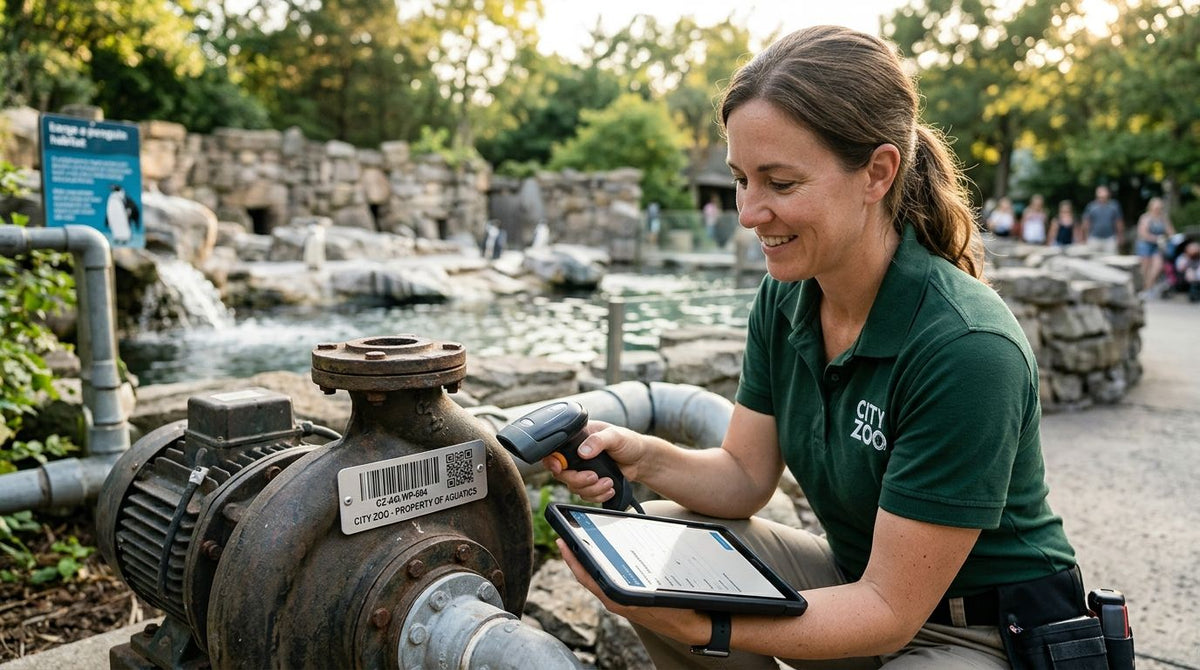
Asset tags for zoo equipment identify filtration pumps, life-support systems, HVAC units, and exhibit fixtures so maintenance teams can pull service history by scanning a number instead of searching a paper binder. Zoo and aquarium facilities run this equipment through standing water, chlorine, saltwater spray, and direct outdoor UV — conditions that strip ordinary printed labels within a single season.
- Asset tags for zoo equipment need 3M heavy-duty or metalized silver polyester stock, not paper, to survive humidity and UV in 2026.
- 3M heavy-duty asset tags hold up against saltwater and chlorine exposure where standard barcode labels fail inside a year.
- QR code asset tags let keepers and maintenance staff scan equipment for service history instead of searching paper logs.
- A GoDEX thermal transfer printer becomes worth owning once a facility tracks a few hundred pieces of equipment across exhibits.
Why asset tags matter for zoo and aquarium equipment
Zoo and aquarium campuses often run as one operation with two very different equipment environments under one roof. A life-support pump sitting in a wet, chlorinated filtration room needs a completely different tag than a projector in the education center.
McAuley Labels supplies the tag stock and printers used by facilities teams solving exactly this split — durable, water-resistant material for exhibit-side equipment, and standard barcode stock for the office and retail side. Accredited facilities also face periodic equipment audits, and a tag that's peeled off or faded to blank turns a five-minute inventory check into a half-day search.
Most zoo and aquarium maintenance departments are small relative to the equipment count they manage. That ratio is exactly why a scannable asset tag system pays off faster here than in a typical office environment — one technician covering a dozen exhibits can't afford to open a binder for every pump.
Audit every exhibit and life-support asset before you order tags
Start with a walkthrough, not a spreadsheet template. Equipment gets added exhibit by exhibit over the years, and undocumented gear is the first thing that goes missing from a maintenance schedule.
- Filtration pumps, protein skimmers, and UV sterilizers per tank or habitat
- Chillers, heaters, and backup generators tied to life-support systems
- HVAC and dehumidification units in reptile houses and aviaries
- Maintenance carts, hand tools, and shop equipment in the service yard
- Vehicles and utility trailers used across the grounds
Match tag material to where the equipment actually lives
The single biggest mistake in zoo and aquarium asset tagging is ordering one material for the entire campus. Indoor office equipment and a submerged pump housing don't need the same stock.
- Semi-gloss white barcode tags for indoor equipment rooms, offices, and dry storage
- Metalized silver polyester tags for general exhibit mechanical rooms and equipment that stays dry but outdoors
- 3M heavy-duty polyester tags for anything near saltwater tanks, chlorine rooms, or full sun exposure
- Flexible polyester stock (not rigid plastic) for curved pump housings and rounded tank fittings
The metalized silver barcode asset tags cover most general exhibit equipment; step up to 3M heavy-duty stock for anything that touches saltwater directly.
Add barcodes or QR codes so scans replace paper logs
A numbered tag without a scan format still requires someone to write the number down by hand. Barcodes and QR codes turn that into a two-second scan tied to a record.
- Sequential numbering by exhibit or department, not one running count campuswide
- QR codes for staff scanning with a phone camera rather than a dedicated scanner
- Barcodes for facilities already running a scanner-based inventory system
- Tag number matched to the same ID used in the maintenance work order system
- A printed legend on the tag itself (not just the code) for staff without a scanner handy
Custom QR code asset tags work well here because keeper staff can scan with a personal phone during daily rounds — no dedicated hardware required.
Print tags in-house once your asset count grows
Ordering pre-printed tags in small batches works fine under a hundred pieces of equipment. Past that, a facility loses time waiting on reprints every time a new pump or exhibit fixture shows up.
- Thermal transfer printing for tags that need to survive outdoor UV and wet handling
- 203 DPI resolution for standard barcodes, 300 DPI for smaller codes on compact equipment housings
- On-demand reprinting when a tag gets scraped off during a tank cleaning
- No minimum order wait when a new exhibit opens mid-season
A GoDEX thermal transfer printer running at 300 DPI handles both barcode and QR formats on the same roll of stock, which matters when one facility mixes both formats across departments.
Apply tags correctly on wet, curved, or corroded surfaces
Material choice only solves half the problem. Application matters just as much in a marine mammal building or reptile house.
- Clean the surface with isopropyl alcohol before applying — oil and mineral deposits cause early peeling
- Never place a tag where it sits below the waterline or gets scrubbed during routine tank cleaning
- Avoid algae-prone surfaces where buildup will cover the code within weeks
- Use polyester tags, not vinyl decals, on curved pump and filter housings
- Press firmly along the full edge — corners lift first in humid rooms
Build a tracking system tied to tag numbers
The tag is only useful if the number connects to a record somewhere. A spreadsheet works for smaller facilities; larger campuses need something closer to a real maintenance log.
- Columns for tag number, exhibit location, install date, and last service date
- A numbering scheme that groups by department (aquarium filtration vs. zoo grounds vs. education building)
- An annual audit built into the existing accreditation inspection cycle
- QR codes linked to whatever work-order software the maintenance team already uses
Train keeper and maintenance staff to scan, not guess
A tagging system fails when only one person knows how to use it. Zoo and aquarium staff turn over, and seasonal keepers need the system to be obvious on day one.
- A five-minute scanning demo during onboarding, not a written manual nobody reads
- A laminated quick-reference card posted in the filtration room
- One point person per exhibit responsible for flagging missing or damaged tags
- A yearly walk-through to catch tags that faded or fell off since the last audit
Comparing tag options for zoo and aquarium equipment
| Option | Best for | Material | Key limitation |
|---|---|---|---|
| Semi-gloss white asset tags | Indoor equipment rooms, dry storage | Semi-gloss white polyester | Fades faster under direct outdoor UV |
| Metalized silver barcode asset tags | General exhibit mechanical rooms | Metalized silver polyester | Not rated for constant submersion |
| 3M heavy-duty asset tags | Saltwater tanks, chlorine rooms, outdoor exhibits | 3M heavy-duty polyester | Costs more per tag than standard stock |
| QR code asset tags | Facilities running maintenance software | Metalized silver or 3M heavy-duty polyester | Needs a phone or scanner at point of use |
| Standard paper labels | Not recommended for exhibit equipment | Paper stock | Peels and fades within months in humidity |
Verdict: 3M heavy-duty asset tags are the right call for anything within splash distance of a saltwater tank or chlorine room in 2026 — everything else can run on metalized silver or semi-gloss white stock.
Common mistakes zoo and aquarium facilities make
- Tagging saltwater-adjacent equipment with standard barcode stock instead of 3M heavy-duty polyester, then replacing tags every few months
- Running separate numbering systems for the zoo side and the aquarium side of a combined campus, which breaks cross-department audits
- Placing tags where they get submerged or scrubbed during routine tank cleaning
- Skipping QR or barcode formats entirely and relying on a paper maintenance log that keeper staff rarely update
- Ordering one tag material for the whole facility instead of matching stock to indoor vs. outdoor vs. submerged use


FAQ
What material holds up best for asset tags for zoo equipment?
3M heavy-duty polyester holds up best for equipment near saltwater tanks, chlorine rooms, or full outdoor sun in 2026. Metalized silver polyester is fine for equipment that stays dry but sits outdoors, and semi-gloss white works for indoor-only rooms.
Do zoo and aquarium equipment tags need to be waterproof?
Yes, for anything in a filtration room, near a tank, or exposed to hose-down cleaning. Standard paper labels peel and fade within months in that environment, while 3M heavy-duty and metalized silver polyester tags are built for it.
Is a QR code or barcode better for zoo equipment tracking?
QR codes work better when keeper staff scan with personal phones during daily rounds, since no dedicated scanner is needed. Barcodes make more sense for facilities that already run a scanner-based inventory system.
Can one asset tag system cover both zoo and aquarium equipment on a combined campus?
Yes, but only with a shared numbering scheme by department rather than two separate running counts. Mixed numbering across a combined campus is one of the most common tracking failures at these facilities.
How often should zoo and aquarium equipment tags be audited?
Once a year, tied to the existing accreditation inspection cycle rather than a separate schedule. That timing catches tags that faded or peeled since the last review without adding a new administrative task.
What printer resolution is needed for small equipment tags?
300 DPI handles small barcodes and QR codes on compact pump housings and fittings better than 203 DPI. 203 DPI is fine for larger tags on flat equipment surfaces where code size isn't a constraint.
Should tags go on equipment that gets submerged?
No — place tags above the waterline and away from surfaces that get scrubbed during tank cleaning. Even heavy-duty polyester stock will lift faster under constant submersion and abrasive cleaning.
One last thing
The facilities that get the most out of asset tags for zoo equipment don't tag everything the same way — they split stock by exposure, not by department. A pump six inches from a saltwater tank and a pump in a dry mechanical closet across the hall have completely different failure timelines on the same tag material, and treating them the same is the fastest way to end up re-tagging equipment twice in 2026.