
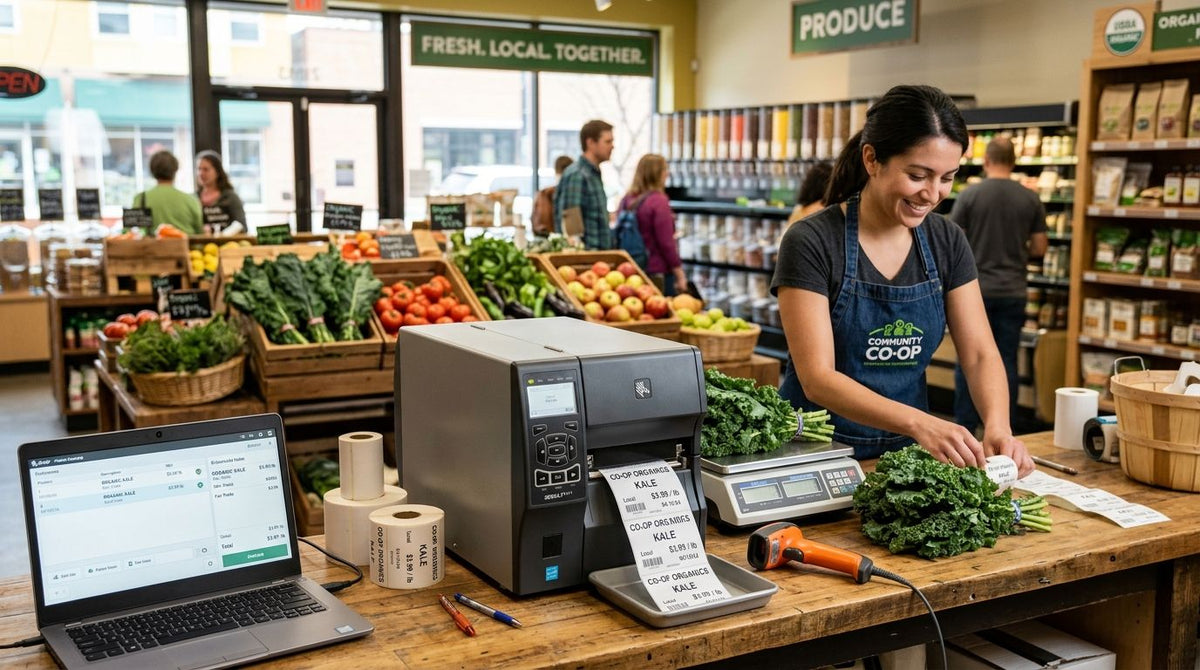
Co-op and community grocery stores print more label types in a day than most retailers touch in a week — deli counter tags, produce PLU stickers, bulk-bin pricing, shelf edge tags, and receiving labels all move through the same backroom. The right label printer for co-op grocery store operations has to switch between those formats without becoming five separate machines.
- GoDEX DT200L is the best label printer for co-op grocery store deli counters and shelf tags in 2026.
- GoDEX ZX430i+ prints at 300 DPI for small produce PLU text and dense bulk-bin barcodes.
- GoDEX GX4200i runs up to 16 inches per second for high-volume backroom and receiving labeling.
- GoDEX RT700i+ is the budget entry point for single-location co-ops under heavy label volume.
- GoDEX GX4300i adds Ethernet and 300 DPI for co-ops printing from multiple registers or departments.
Why this matters
A single-location co-op and a three-store buying club need different machines even though they're both shopping for a "grocery label printer." Deli counters print short runs of 2-inch direct thermal tags all day; produce departments need fine barcode resolution for small PLU codes; receiving needs speed, not precision. Most co-ops solve this by buying one printer that's wrong for two of the three jobs.
The fix is matching the printer to the department, not the store. A direct thermal printer built for grocery deli counters behaves differently than one built for backroom receiving, and the difference shows up in DPI, print speed, and connectivity — not in the brand name on the case.
What makes the best label printer for co-op grocery stores
- Print speed for peak-hour runs — deli and shelf-tag printing spikes at open and during weekend rushes
- Direct thermal vs. thermal transfer — perishable tags turn over fast enough that ribbon-free direct thermal often wins on simplicity
- DPI resolution — small PLU text and dense barcodes need 300 DPI; standard shelf tags do fine at 203 DPI
- Label width flexibility — 2-inch deli tags and 4-inch shelf or shipping labels aren't the same job
- Network connectivity — multi-register or multi-department co-ops need Ethernet, not just USB
- Duty cycle — a printer running six to eight hours a day needs an industrial-grade engine, not a home office unit
At a glance: label printers for co-op grocery stores in 2026
| Printer | Best for | Standout feature | Key limitation |
|---|---|---|---|
| GoDEX DT200L | Deli counters and shelf tags | Linerless direct thermal, no ribbon | 2-inch width caps larger label formats |
| GoDEX RT700i+ | Single-location budget printing | Color display, dual thermal capability | Not built for networked multi-register setups |
| GoDEX GX4200i | High-volume backroom and receiving | Up to 16 ips print speed, 5-inch touchscreen | Larger footprint than a counter unit |
| GoDEX ZX430i+ | Produce and bulk-bin PLU labels | 300 DPI resolution | Slower throughput than industrial models |
| GoDEX GX4300i | Networked multi-department printing | 300 DPI plus Ethernet | Higher-capability printer than small single-counter co-ops need |
1. GoDEX DT200L: best label printer for co-op grocery store deli counters and shelf tags
The GoDEX DT200L is a 2-inch linerless direct thermal printer built for QSR and retail counters, running at 203 DPI with no ribbon required. That makes it the practical default for a co-op's deli case and fast-turnover shelf tags, where labels change daily and ribbon changeovers just slow down staff.
GoDEX DT200L pros:
- Linerless design skips ribbon purchases and backing-liner waste
- Compact footprint fits directly at a deli counter or scale station
- Direct thermal keeps consumables down to labels only
- 203 DPI handles standard barcodes and shelf tag text cleanly
GoDEX DT200L cons:
- 2-inch width isn't wide enough for larger shipping or pallet labels
- 203 DPI is fine for shelf tags but not for dense multi-line nutrition panels
Best for: deli counters and daily shelf-tag turnover. Verdict: Buy.
2. GoDEX RT700i+: best label printer for co-op grocery store on a single-location budget
The GoDEX RT700i+ is a 4-inch dual thermal printer with a color display and 203 DPI resolution. It covers both direct thermal shelf tags and ribbon-based thermal transfer labels for anything that needs to survive handling, which suits a single-store co-op that doesn't want to run two machines.
GoDEX RT700i+ pros:
- Dual thermal capability covers both disposable and durable label needs
- Color display speeds up switching between label templates
- Compact desktop unit fits a single front-office or back-counter setup
GoDEX RT700i+ cons:
- Best suited to a single counter, not networked multi-register printing
- 203 DPI ceiling limits fine barcode or small-text detail
Best for: a single-location co-op standardizing on one printer. Verdict: Buy.
3. GoDEX GX4200i: best label printer for co-op grocery store backroom and receiving
The GoDEX GX4200i is an industrial 203 DPI dual thermal printer that prints up to 16 inches per second, with a 5-inch touchscreen and USB, serial, and Ethernet connectivity. That throughput is built for receiving docks and backroom labeling, where pallets and cases move faster than a counter printer can keep up with.
GoDEX GX4200i pros:
- 16 ips print speed clears high-volume receiving runs fast
- Ethernet connectivity supports networked printing from inventory software
- 5-inch touchscreen simplifies switching label templates by department
- Industrial duty cycle handles continuous daily printing
GoDEX GX4200i cons:
- Larger footprint doesn't fit at a deli counter or checkout station
- More printer than a small co-op needs for light shelf-tag volume
Best for: backroom and receiving labeling in higher-volume co-ops. Verdict: Buy.
4. GoDEX ZX430i+: best label printer for co-op grocery store produce and bulk-bin labels
The GoDEX ZX430i+ is a 4-inch dual thermal printer running at 300 DPI, with a color display and USB, serial, and Ethernet ports. The higher resolution matters most in produce and bulk-bin departments, where small PLU codes and dense barcodes need to stay scannable at close range.
GoDEX ZX430i+ pros:
- 300 DPI renders small PLU text and tight barcodes without blur
- Ethernet connectivity supports printing from a central register system
- Color display keeps department switching fast
GoDEX ZX430i+ cons:
- Not built for the highest-volume backroom print runs
- Dual thermal option adds cost if the store only needs direct thermal deli tags
Best for: produce departments and bulk-bin pricing. Verdict: Buy.
5. GoDEX GX4300i: best label printer for co-op grocery store multi-department networked printing
The GoDEX GX4300i pairs 300 DPI resolution with Ethernet connectivity in an industrial-grade body. It's the printer for a co-op running label printing from more than one register or department that wants one central resolution standard across the store instead of mixing 203 and 300 DPI units.
GoDEX GX4300i pros:
- 300 DPI plus Ethernet covers high-detail and networked printing in one machine
- Industrial build handles continuous multi-department use
- Standardizes label resolution across shelf, produce, and receiving
GoDEX GX4300i cons:
- More capability than a single-counter co-op typically needs
- Setup across a network takes more IT coordination than a standalone unit
Best for: multi-register or multi-department co-ops centralizing on one printer standard. Verdict: Buy for multi-location operations, Wait for single-counter shops.
How we ranked these label printers
Each printer above was scored against the six criteria listed earlier — speed, thermal method, DPI, width, connectivity, and duty cycle — and matched to the department where that combination actually pays off. No single GoDEX model wins every category, which is why this list reads as a decision by department rather than a single top pick.


Which label printer should you choose?
For most co-op and community grocery stores in 2026, the GoDEX DT200L is the right default — it covers deli counters and shelf tags without ribbon costs and fits in a tight counter space. If your store runs receiving out of a busy backroom, add a GoDEX GX4200i for the speed. If produce and bulk-bin PLU labels are your pain point, the GoDEX ZX430i+ earns its higher resolution. Stores centralizing label printing across more than one register or department should standardize on the GoDEX GX4300i instead of running mismatched DPI units. Single-location co-ops with modest volume can stop at the GoDEX RT700i+ and skip the industrial-grade machines entirely.
McAuley Labels supplies all five as GoDEX label printers built for continuous commercial use, not home-office label makers rebadged for retail.
FAQ
What's the best label printer for a co-op grocery store in 2026?
The GoDEX DT200L is the best label printer for co-op grocery store deli counters and shelf tags in 2026 because it prints 2-inch linerless direct thermal labels without ribbon. Stores with heavier backroom volume should pair it with a GoDEX GX4200i.
Is direct thermal or thermal transfer better for grocery shelf tags?
Direct thermal is better for grocery shelf tags because they turn over daily and don't need to survive months of handling. Thermal transfer ribbon labels make more sense for durable asset or equipment tags, not perishable pricing.
How many DPI do I need for produce PLU labels?
300 DPI is the safer choice for produce PLU labels because the barcodes and text are small and dense. 203 DPI works fine for standard shelf tags with larger text.
Can one printer handle both deli tags and shelf price tags?
Yes, a 4-inch dual thermal printer like the GoDEX RT700i+ can handle both deli tags and shelf price tags in a single-location co-op. Stores printing high volumes in both departments often split the load across two printers instead.
Do co-op grocery stores need networked label printers?
Only if labels print from more than one register or department at once. A single-counter co-op can run a standalone USB printer like the GoDEX DT200L without Ethernet.
What's the difference between the GoDEX DT200L and RT700i+?
The GoDEX DT200L is a 2-inch linerless direct thermal printer built for counter use, while the RT700i+ is a 4-inch dual thermal printer that also runs ribbon-based thermal transfer labels. Choose the DT200L for deli tags and the RT700i+ for mixed label types.
How fast should a grocery backroom label printer print?
A backroom or receiving printer should run at least 6 to 8 inches per second to keep up with pallet and case volume; the GoDEX GX4200i runs up to 16 ips. Counter printers for deli or shelf tags don't need that speed.
One last thing
Linerless direct thermal labels, like the ones the GoDEX DT200L runs, skip the backing liner that most co-ops peel off and throw away by the roll every week — worth mentioning to any store tracking packaging waste alongside its label printer decision in 2026.