
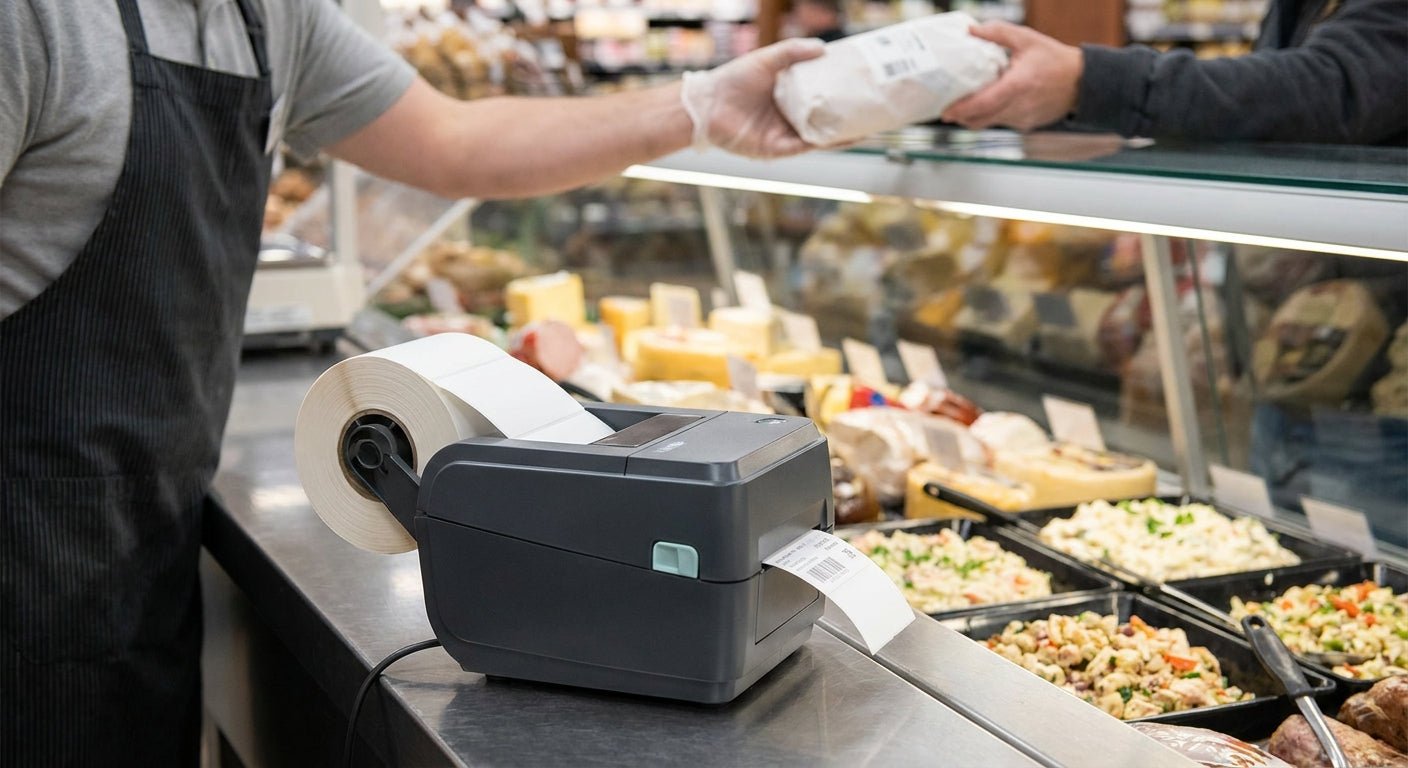
Deli counters print hundreds of scale labels a day — weight, price, sell-by date — on paper that gets wet, greasy, and tossed in a walk-in within minutes of printing. A direct thermal label printer for deli counters skips the ribbon entirely, because that workflow doesn't need labels that outlive the product inside them.
- GoDEX ZX430i+ at $945 is the direct thermal label printer for deli counters most single-location operations should buy in 2026.
- GoDEX GX4200i at $2,246 handles multi-lane delis printing high label volumes daily — Buy for scale.
- Skip thermal transfer printers and ribbon for deli labels; sell-by stickers don't need years of durability.
- 203 DPI covers standard scale labels; step up to 300 DPI only for dense barcodes or fine print.
- Look for USB, serial, and Ethernet on one unit if the printer needs to talk to a deli scale.
Why this matters
A deli counter isn't a shipping dock or a warehouse floor. Labels print in short bursts during rush, get applied to wet product, and get thrown out or eaten within a day or two. Paying for wax/resin ribbon systems built for outdoor asset tags or five-year equipment IDs is money spent on durability nobody needs at a deli case.
Direct thermal printing solves this because it burns the image directly into heat-sensitive paper — no ribbon, no ribbon cost, no ribbon jams during a Saturday rush. The tradeoff is that direct thermal labels fade under prolonged heat or sunlight, which is irrelevant for a label that lives on a wrapped sandwich for six hours.
Who this is for
This buying guide is for deli managers, grocery ops leads, and independent butcher shop owners buying a printer to run scale labels, service tags, and short-run pricing stickers at a counter — not for warehouses labeling pallets or IT teams tagging servers. If the printer sits next to a scale and prints a label every 30-60 seconds during peak hours, this guide is calibrated for that job.
What to look for in a direct thermal label printer for deli counters
Print resolution matched to label size
Most deli scale labels run at 2"x1" or 2"x3" and only need 203 DPI to keep price, weight, and barcode legible. Jump to 300 DPI only if the deli also prints small nutrition-fact panels or dense 2D barcodes that need finer resolution to scan cleanly. Buying 300 DPI "just in case" adds cost without solving a problem most delis actually have.
Throughput during rush hours
A counter that serves 200+ customers between 11am and 1pm needs a printer that keeps up without jamming or overheating. Print speed matters less than reliable feed and consistent print quality at speed — a printer that smears the fifth label in a row during rush is a bigger problem than one rated a few inches per second slower.
Interface compatibility with the scale
Most deli operations run the printer off a connected scale, not a standalone keypad. Confirm the printer supports serial, USB, and Ethernet together, because scale integrations vary by vendor and switching interfaces later means buying a new printer, not a new cable.
Washdown and humidity tolerance
Deli counters sit near sinks, meat cases, and steam tables. A printer housed in a sealed or splash-resistant enclosure survives that environment; a consumer desktop printer built for a quiet office does not. Check the enclosure spec before checking the price tag.
Total cost with no ribbon
Direct thermal eliminates ribbon costs entirely, which is the single biggest ongoing savings versus thermal transfer for this use case. Run the math on labels-per-day times 365 and the ribbon line item on a thermal transfer printer adds up fast for a label nobody needs to last past the sell-by date.
Top picks for deli counters in 2026
The budget pick: GoDEX RT200i (203 DPI). This is a compact desktop unit built for standard scale-label formats without paying for resolution the deli doesn't use. Verdict: Buy if the counter runs one lane and standard 2x1 or 2x3 labels.
The workhorse: GoDEX ZX430i+ (300 DPI, $945). A 4" dual thermal printer with a color display for at-a-glance status during rush, priced at $945 and rated for daily counter use. It runs direct thermal without a ribbon and steps up to 300 DPI when a location also needs finer barcode detail on the same machine. Verdict: Buy — this is the default recommendation for most single-location delis in 2026.
The volume pick: GoDEX GX4200i (203 DPI, $2,246). Built as an industrial 4" dual thermal printer rated up to 16 inches per second, this is the unit for a multi-lane deli or a grocery chain running one printer across several counters. It's priced well above the ZX430i+ because it's built for continuous duty, not intermittent counter bursts. Verdict: Consider for high-volume or multi-location operations; Skip for a single low-volume counter.


The precision pick: GoDEX GX4300i (300 DPI, $2,425.50). Same industrial chassis as the GX4200i, but built for shops printing fine-detail barcodes or nutrition panels alongside standard price labels. Verdict: Consider only if the deli genuinely prints small, dense barcodes daily; otherwise this is more resolution than a standard counter needs.
“If the label smears before the sell-by date, that's a thermal transfer printer doing a direct thermal printer's job.”
What to avoid
- Thermal transfer printers marketed as "universal." They print direct thermal labels fine but add a ribbon spool, ribbon inventory, and ribbon cost to a workflow that never needed the extra durability.
- Sub-203 DPI consumer printers. These blur barcodes at small sizes, which fails at checkout when a scale label needs to scan on the first pass.
- Printers without a sealed enclosure. A printer rated for a quiet office desk, not a wet counter, fails faster near sinks and steam than the spec sheet suggests.
Verdict comparison
| Printer | Resolution | Price | Interface | Verdict |
|---|---|---|---|---|
| GoDEX RT200i | 203 DPI | Budget desktop | Standard | Buy — single-lane counters |
| GoDEX ZX430i+ | 300 DPI | $945 | USB/Serial/Ethernet | Buy — default 2026 pick |
| GoDEX GX4200i | 203 DPI | $2,246 | USB/Serial/Ethernet | Consider — multi-lane volume |
| GoDEX GX4300i | 300 DPI | $2,425.50 | USB/Serial/Ethernet | Consider — fine-detail barcodes only |
FAQ
What's the best direct thermal label printer for deli counters in 2026?
The GoDEX ZX430i+ at $945 is the best fit for most single-location delis in 2026, running 300 DPI with USB, serial, and Ethernet on one unit. Multi-lane or high-volume operations should size up to the GoDEX GX4200i instead.
Is direct thermal better than thermal transfer for deli labels?
Yes, direct thermal is better for deli labels because it skips the ribbon cost entirely and the label doesn't need long-term durability. Thermal transfer earns its keep on equipment tags and outdoor labels, not sell-by stickers.
How much does a deli label printer cost in 2026?
Compact 203-300 DPI direct thermal printers for a single counter run roughly $500-$1,000 in 2026, while industrial multi-lane units run $2,200-$2,500. The right size depends on daily label volume, not counter square footage.
Do deli counters need 300 DPI or is 203 DPI enough?
203 DPI is enough for standard 2x1 and 2x3 scale labels with normal barcodes and pricing. Move to 300 DPI only if the deli prints small nutrition panels or dense 2D barcodes that need finer resolution to scan reliably.
Can a direct thermal printer connect to a deli scale?
Yes, as long as the printer supports the same interface the scale uses — usually serial, USB, or Ethernet. Confirm all three are present on one unit before buying, since scale integrations vary by vendor.
How long do direct thermal deli labels last?
Direct thermal labels stay legible for days under normal refrigeration and counter conditions, which covers any deli product's sell-by window. They fade faster under direct heat or sunlight, which isn't a factor inside a deli case.
Do direct thermal printers need ribbon?
No, direct thermal printers burn the image directly into heat-sensitive label stock and never use ribbon. That's the entire point of choosing direct thermal for short-lived deli labels over thermal transfer.
One last thing
The printer spec sheet that actually predicts rush-hour reliability isn't DPI or print speed — it's the interface list. A 203 DPI printer with USB, serial, and Ethernet all present outlasts a 300 DPI printer with only one interface, because the scale integration is what breaks first when a deli switches point-of-sale systems in 2026.