
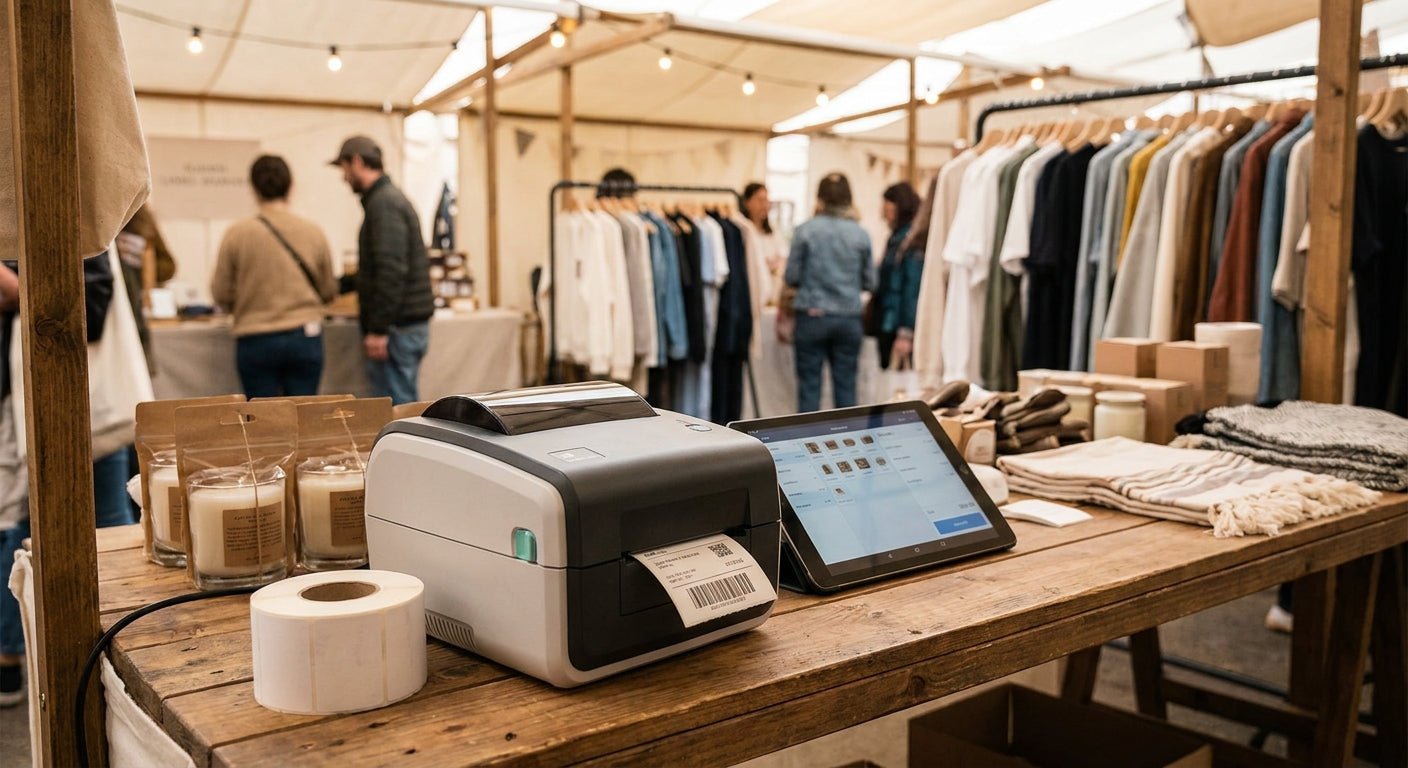
Pop-up shops and mobile retail booths need a label printer that survives a folding table, a car trunk, and eight hours without a wall outlet — not a warehouse machine bolted to a workstation. This guide ranks the label printer for pop-up shops that holds up under real market conditions in 2026, from the safest starter buy to the printer built for a warehouse floor you should skip entirely.
- GoDEX DT230 wins for pop-up shops running all day off one ribbon-free spool — buy it for 2026 markets.
- Skip the GoDEX GX4200i for mobile retail; its $2,246 price and ethernet setup target warehouses, not folding tables.
- GoDEX RT200i stays the safest starter buy at 203 DPI for price tags and barcodes under a booth table.
- Custom logo stickers turn a sub-$700 printer setup into on-brand packaging for craft fairs and trunk shows.
Why this matters
A label printer chosen for a stockroom fails fast at a farmers market. Ribbon changes eat into setup time between customers, a power cord limits where the booth table can sit, and a printer built for high-speed barcode runs is dead weight when the job is $8 price tags and QR codes for a payment link.
Pop-up retail adds constraints a permanent storefront never deals with: no guaranteed outlet, no IT staff to configure a network printer, and setup windows measured in minutes, not hours. More markets in 2026 run cashless entirely, which means labels increasingly carry a QR code linking to a payment page instead of just a price — another reason resolution below 203 DPI isn't viable anymore, since a blurry QR code just doesn't scan reliably from three feet away.
The 203 DPI GoDEX RT200i thermal printer solves the most common version of this problem: it runs off a standard USB connection with no network configuration required, so it works the same in a rented booth space as it does at home. McAuley Labels builds every label printer on this list around US-based support and thermal media that ships fast, which matters when a vendor finds out Thursday night that Saturday's market needs 200 more labels than planned.
How the picks were ranked
The ranking below weighs three things pop-up vendors care about more than office buyers do: footprint, ribbon dependency, and price measured against how many market days a small business actually runs in a year. Specs come from published 2026 GoDEX printer documentation and current McAuley Labels pricing; verdicts weigh that cost against real mobile-retail constraints — folding tables, extension cords, and Saturday-only setups that don't leave room for a full IT install.
A printer built for 16 inches per second of throughput and a full ethernet stack belongs on a production floor, not next to a card reader and a cash box. Every printer below ships with a manufacturer warranty and runs on GoLabel or comparable label design software, so software onboarding isn't part of the score here — reliability under folding-table conditions, and how much gear a vendor has to load into a car, is.
What to look for before you buy
Power and portability
A booth needs a printer that runs off a wall outlet, a battery pack, or a car inverter without complaint. Weight matters too — anything that adds a second trip to unload isn't worth the resolution bump.
Ribbon dependency
Ribbon-fed printers print sharper, more durable labels, but ribbon is one more consumable to track, restock, and replace mid-market. Direct thermal removes that variable at the cost of some label longevity in heat.
Print speed versus setup time
A printer rated for high throughput doesn't help a vendor printing one label every few minutes between customer conversations. Setup speed and reliability matter more than inches-per-second specs built for production lines.
Label size flexibility
Markets sell everything from lip balm to framed art, and each needs a different label size. A printer that only handles one roll width limits what a vendor can sell without buying a second unit.
The ranked list: label printer for pop-up shops and mobile retail
GoDEX DT230 — the no-ribbon pick
Direct thermal printing at 300 DPI means the GoDEX DT230 direct thermal printer skips ribbon entirely — one less consumable to pack, restock, or forget in the car on setup morning. It prints clean text and barcodes for price tags, inventory stickers, and QR codes without a wax or resin ribbon spool taking up trunk space next to the tent poles and folding tables.
For a vendor running back-to-back weekend markets through 2026, cutting ribbon changes out of the setup routine saves real minutes before doors open, and it's one fewer part that can jam mid-transaction with a line forming. Watch heat exposure, though: direct thermal labels can fade under prolonged sun or trunk heat above roughly 140°F, so this isn't the right printer for a vehicle that sits in a parking lot all summer between markets. Buy for indoor markets, craft fairs, and tented outdoor pop-ups where labels don't sit in direct sun for hours.
GoDEX RT200i — the budget entry point
Already linked above, the GoDEX RT200i is the safest first purchase for a vendor moving off hand-written price tags and sticky-note inventory. At 203 DPI it handles price tags, basic barcodes, and QR codes for payment links without paying for print resolution a booth table doesn't actually need.
It runs off USB with zero network configuration, which matters when setup happens in a parking lot or a rented hall fifteen minutes before opening and there's no time to troubleshoot a driver. It's also light enough to carry in with the rest of the booth gear in one trip. Buy if this is a first dedicated label printer and budget outranks print speed for now.
Custom logo stickers — the branding pick
Custom logo stickers aren't a printer, but they pair with any thermal setup on this list to turn plain product labels into packaging that looks intentional at craft fairs, trunk shows, and seasonal markets. Pre-printed with a shop's logo ahead of time, they cost far less setup effort on market morning than designing artwork in GoLabel between customers.
For 2026 vendors selling candles, bath products, or small-batch food, a custom sticker on the lid or box is the fastest route to looking like an established retail brand instead of a card table with handwritten tags. Buy as a supplement to whichever printer above gets the nod for day-to-day labeling.
GoDEX G500 — the compact desktop upgrade
The GoDEX G500 thermal printer steps up print speed and build durability over the RT200i for vendors running multiple markets a week instead of one Saturday a month. It's still desktop-sized, not a warehouse unit, so it fits on a booth table without crowding out the cash box and card reader.
The tradeoff is a higher price for speed most single-market vendors won't use. Consider it once a single RT200i genuinely can't keep pace with order volume during a busy season — not before.
GoDEX RT700i+ — the color-display pick
At $581, the GoDEX RT700i+ thermal printer adds a color display for on-the-fly settings changes without a laptop tethered to it — useful when a booth runs off a phone hotspot and not much else. It's a 4-inch dual thermal printer, so it handles both direct thermal and ribbon-fed labels depending on the job at hand.
That flexibility costs more than a single-purpose printer, and most pop-up vendors only ever use one label type anyway. Consider it for vendors who specifically want settings changed on the unit itself rather than through software mid-market.
GoDEX ZX430i+ — the compact color alternative
Priced at $945, the GoDEX ZX430i+ thermal printer offers the same color-display convenience as the RT700i+ in a smaller footprint, with 300 DPI resolution for sharper barcodes on small labels like jewelry tags or supplement bottle codes.
It's a strong pick for a vendor whose product line needs dense barcodes on tiny labels, but it's overkill for a booth just printing $10 price tags. Consider it over the RT700i+ specifically when barcode density on small tags matters more than raw print speed.
GoDEX GX4200i — the one to skip for pop-up shops
At $2,246, the GoDEX GX4200i thermal printer is built for 16 inches-per-second throughput and full ethernet integration — specs that matter on a production line moving thousands of labels a shift, not a folding table moving dozens.
It's the wrong label printer for mobile retail in 2026 unless the same unit is also running a fixed warehouse operation between market weekends. The price alone puts it out of range for most single-booth vendors. Skip it for pop-up shops; the throughput and footprint don't match the use case.


Comparison table
Across all seven printers, the split comes down to ribbon dependency and price point relative to how many market weekends a vendor works in 2026 — not raw print speed.
| Printer | Resolution | Ribbon Needed | Best For | Verdict |
|---|---|---|---|---|
| GoDEX DT230 | 300 DPI | No | Frequent indoor markets | Buy |
| GoDEX RT200i | 203 DPI | Yes | First-time buyers, price tags | Buy |
| GoDEX G500 | Standard DPI | Yes | Weekly multi-market vendors | Consider |
| GoDEX RT700i+ | 203 DPI | Yes | On-unit settings changes | Consider |
| GoDEX ZX430i+ | 300 DPI | Yes | Small, dense barcodes | Consider |
| GoDEX GX4200i | 203 DPI | Yes | Warehouse-scale, not mobile | Skip |
Where to buy
- Order the printer and its matching ribbon or direct thermal stock from McAuley Labels or a comparable supplier at the same time — a mismatched SKU order later takes one phone call instead of three when a market changes tag size overnight.
- Confirm ribbon width against the printer model before ordering anything. A wrong-width ribbon jams mid-market, not mid-warehouse, where swapping it out costs nothing but five minutes.
- Order custom logo stickers and blank label stock together heading into a busy 2026 market season so restocks for both don't land on two separate lead times right before a big weekend event.
FAQ
What's the best label printer for pop-up shops in 2026?
The GoDEX DT230 direct thermal printer is the best label printer for pop-up shops in 2026 because it skips ribbon entirely, cutting one consumable from setup. The GoDEX RT200i is the stronger pick for a first printer on a tighter budget.
Do pop-up shops need a thermal transfer or direct thermal printer?
Direct thermal works for most pop-up shops because labels don't sit in heat or direct sun for months at a time. Thermal transfer with ribbon is worth the extra step only when labels need to survive outdoor weather or long-term storage.
How much does a label printer for a pop-up shop cost in 2026?
Compact GoDEX thermal printers for mobile retail range from around $581 for the RT700i+ to $945 for the ZX430i+ in 2026. Industrial-tier printers like the GX4200i run over $2,200 and are built for warehouse volume, not booth setups.
Is the GoDEX RT200i good enough for a small market booth?
Yes, the GoDEX RT200i's 203 DPI resolution handles price tags, barcodes, and QR codes cleanly at booth scale. It's the safest first purchase before stepping up to a higher-speed model.
Can I print custom logo stickers on the same printer as price tags?
Most GoDEX label printers handle both price tags and small custom sticker runs on the same media path, provided label width matches the printer's roll size. For pre-branded packaging, custom logo stickers ordered in bulk save setup time compared to printing artwork on-site.
What should I avoid when buying a label printer for mobile retail?
Avoid ethernet-dependent industrial printers like the GoDEX GX4200i, built for 16 inches-per-second production lines priced and sized for warehouses, not folding tables. Also skip any printer that requires a wired network connection to configure at every new venue.
Does a direct thermal label fade over time?
Direct thermal labels can fade with prolonged heat or UV exposure, typically above roughly 140°F or months of direct sunlight. For indoor markets and short-term retail use, that's rarely a practical issue.
One last thing
The detail most pop-up vendors miss: direct thermal labels are heat-sensitive, so a GoDEX DT230 that sat in a hot trunk through July can print faded labels by August even though the printer itself still works fine. Store direct thermal label stock in an air-conditioned space, not the vehicle between markets, and it'll hold up through a full 2026 market season instead of degrading by midsummer.
Pair whichever label printer wins the buy decision here with McAuley Labels' label stock ordered in the exact size the booth actually uses — not whatever roll happened to be left over from the last event.