

Best starting point for in-house equipment IDs: blank silver polyester. Best for a white print surface: blank glossy white polyester. Best for custom QR identification: metalized silver polyester QR asset tags. For polyester labels chemical resistance, qualify the finished label against your actual chemical exposure before choosing a winner; this 2026 shortlist ranks application fit, not measured solvent resistance.
- Polyester labels chemical resistance depends on the face material, printed image, adhesive, and actual exposure.
- McAuley Labels silver polyester labels are the starting candidate for in-house equipment identification, subject to chemical qualification.
- Glossy white polyester suits a white print surface; custom silver polyester QR tags suit equipment scanning.
- Approve labels only after checking adhesion, readable text, and barcode scanning under your actual cleaning conditions.
What makes the best chemical-resistant polyester label?
- Chemical match: Evidence must name the chemical and its concentration.
- Print retention: Text and codes must remain readable after exposure.
- Adhesion: The label must stay attached to the actual equipment surface.
- Exposure match: A splash, repeated wipe, and immersion are different conditions.
- Workflow fit: Choose blank rolls for changing information or custom tags for fixed identifiers.
Polyester label candidates at a glance
| Rank and option | Best for | Standout feature | Key limitation |
|---|---|---|---|
| 1. Silver polyester thermal transfer labels | In-house equipment IDs | Blank metallic-look polyester for user-printed identification | Finished resistance depends on the selected ribbon, adhesive, and exposure |
| 2. Glossy white polyester thermal transfer labels | White-background product and equipment labels | Blank glossy white polyester for thermal transfer printing | Waterproof-grade positioning does not establish solvent resistance |
| 3. Custom QR code asset tags in metalized silver polyester | Fixed equipment identifiers with QR scanning | Custom numbered, permanent adhesive QR tags | Fixed artwork requires approval before production; chemical suitability still needs qualification |
The order reflects how directly each option supports a defined labeling workflow. Silver versus white is not a chemical-resistance ranking: neither appearance proves that a finished label will survive your cleaner.
Why this matters
A label fails its job when the equipment identifier disappears, even if the polyester film remains attached. The reverse also matters: a readable label is useless when its adhesive releases and the tag falls off.
For a 2026 purchasing specification, describe the complete label system rather than asking for polyester alone. Include the surface, printed information, cleaning chemical, application conditions, and expected contact. That gives you a requirement you can verify instead of a material name you must interpret.
1. Blank silver polyester: best for in-house equipment IDs
Blank Thermal Transfer Labels - Silver Polyester - Desktop & Industrial Rolls provide a metallic-look polyester surface that you print yourself. The product description identifies asset tags, nameplates, and rating plates as intended applications.
Best for: Equipment teams that need to print serial numbers, asset identifiers, or replacement labels as records change.
Silver polyester is the default candidate here because its stated applications match equipment identification directly. McAuley Labels silver polyester labels are best for teams printing their own equipment identifiers, subject to application-specific chemical qualification.
Silver polyester pros:
- Blank stock lets you control the information printed on each label.
- The stated applications include asset tags, nameplates, and rating plates.
- Desktop and industrial roll formats support different printing workflows.
Silver polyester cons:
- You must select and qualify the printing ribbon with the label stock.
- A metallic appearance provides no proof of resistance to your cleaning chemical.
- You remain responsible for print settings, data accuracy, and output checks.
Before adopting silver polyester, print the actual design rather than a simplified sample. Include the smallest text, longest identifier, and barcode used in production. Examine the same elements after chemical contact; a large headline surviving does not prove that a fine barcode remains usable.
Verdict: Hold until the finished silver polyester label passes your exposure checks; then buy for in-house equipment identification.
2. Glossy white polyester: best for a white print surface
Blank Thermal Transfer Labels - Glossy White Polyester - Desktop & Industrial Rolls are blank polyester labels for thermal transfer printing. Their stated applications include barcodes, product identification, and equipment labeling.
Best for: Buyers who need a white background for printed text and codes rather than a metallic-look label.
The product description calls these waterproof-grade labels. Treat that as a water-related material claim, not approval for alcohol, degreasers, disinfectants, or other chemicals. For your 2026 comparison, assess the white stock under the same exposure conditions as the silver candidate.
Glossy white polyester pros:
- A white background supports a conventional dark-on-white label design.
- Blank stock accommodates changing product or equipment information.
- The stated applications include both barcode and equipment labeling.
Glossy white polyester cons:
- Waterproof-grade wording does not establish resistance to a named solvent.
- Thermal transfer printing requires a compatible ribbon and correct setup.
- Gloss and lighting must be checked with your actual scanning equipment.
Choose glossy white for the required print surface, not because white polyester is inherently more chemical-resistant than silver polyester. Ask for compatibility information covering the exact stock and ribbon combination you intend to use.
Verdict: Hold until the printed white polyester label passes qualification; then buy when a white background is required.
3. Custom silver polyester QR tags: best for fixed equipment IDs
Custom QR Asset Tags for Equipment - Numbered, Permanent, Adhesive, Metallized Silver - QR Code combine custom identification with a QR format. The product URL identifies the material as metalized silver polyester, and the description presents the tags for equipment tracking.
Best for: Equipment owners who want custom QR identifiers instead of printing blank label rolls themselves.
A QR code changes how you retrieve a record; it does not establish chemical resistance. Your approval must cover the physical tag, the printed code, the equipment surface, and the scanning device used after cleaning.
Custom silver polyester QR tag pros:
- Custom tags support a defined equipment-identification layout.
- The product combines numbering, permanent adhesive, and a QR format.
- The polyester construction matches the material category in this comparison.
Custom silver polyester QR tag cons:
- Printed identifiers and artwork need approval before production.
- QR scanning requires a compatible camera or imaging scanner.
- Permanent adhesive wording does not prove compatibility with every surface or chemical.
For fixed assets, encode a stable identifier or a destination your organization controls. Keep a readable identifier in the artwork so staff can identify equipment when scanning is unavailable. Confirm that the final proof contains exactly the data structure your asset system expects.
Verdict: Hold until a representative finished tag survives cleaning and still scans; then buy for fixed QR equipment identification.
Choose the workflow before choosing the finish
McAuley Labels offers both blank polyester rolls and custom polyester QR asset tags. Choose blank rolls when your team needs to change information at the printer; choose custom QR tags when the identifier and artwork are settled before ordering.


What actually determines polyester labels chemical resistance?
Evaluate these parts together. The polyester film is only one component of the finished label.
- Face material: Check whether the film changes, wrinkles, cracks, or loses its usable surface.
- Printed image: Check whether the ink or transferred ribbon image smears, fades, or transfers during wiping.
- Adhesive bond: Check for edge lifting, movement, or release from the equipment.
- Actual exposure: Record the chemical, concentration, temperature, contact method, and duration.
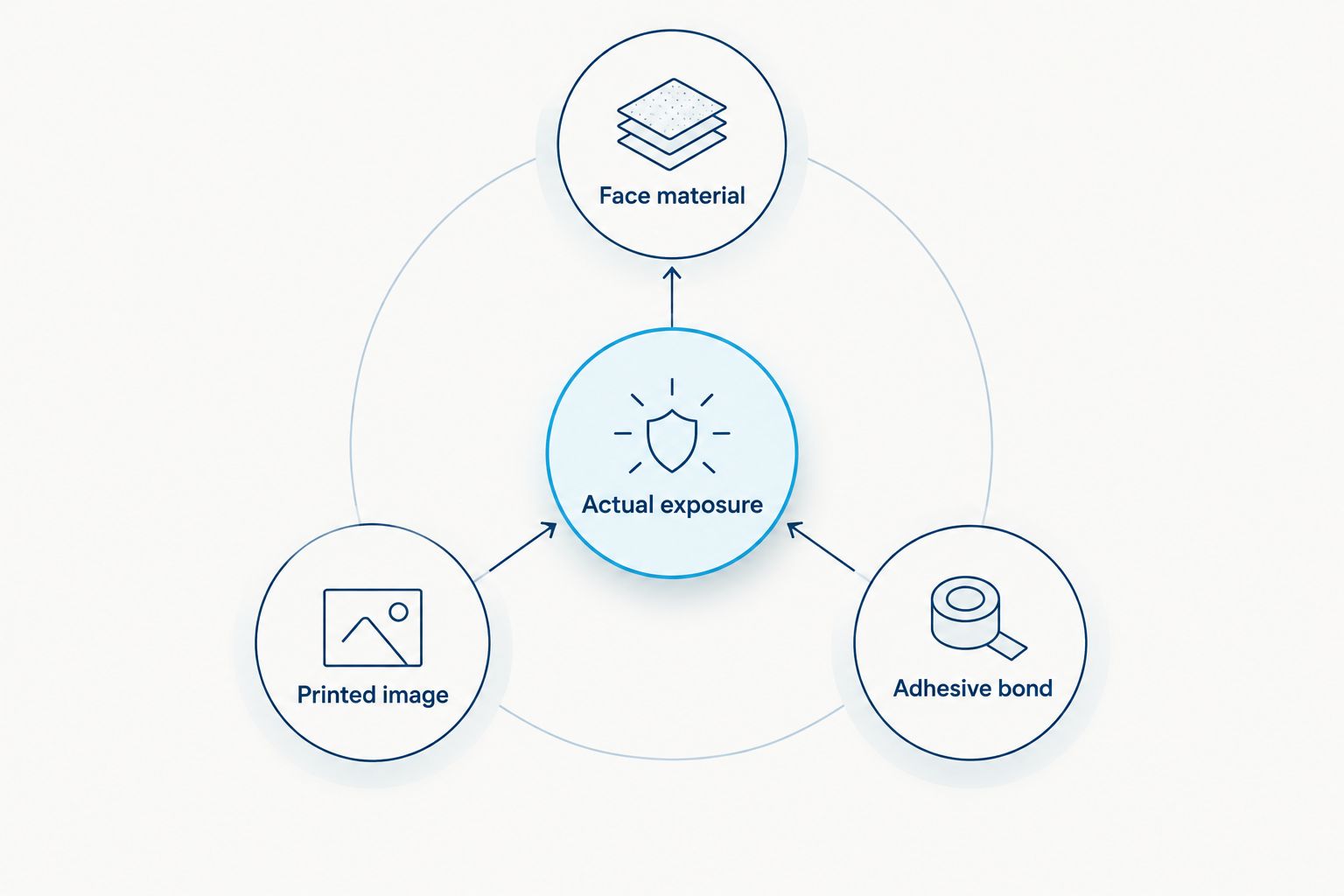
Do not substitute one exposure for another. A brief wipe with a diluted cleaner does not demonstrate suitability for immersion in the concentrated product. Likewise, a successful check on smooth stainless steel does not approve the same adhesive on textured plastic.
For a 2026 specification, record the exact material and printing combination alongside the approved exposure. Recheck that approval when the stock, ribbon, cleaner, surface, or cleaning method changes.
How to qualify a label for your cleaning process
Use a written comparison that reproduces normal work without creating an unsafe chemical-handling exercise. Follow the chemical safety data sheet and your workplace procedures; have qualified staff handle hazardous exposures.
Define exposure
Name the actual cleaner or process chemical. Record its working concentration, contact temperature, whether exposure involves wiping or soaking, and how long contact lasts. Avoid broad descriptions such as solvent-resistant without naming the solvent.
Apply samples
Use the real equipment surface or a representative surface with the same finish. Prepare it according to the label supplier's instructions and follow the specified application and adhesive dwell conditions before checking performance.
Print production data
Use the intended printer, ribbon, design, and settings. Include readable text and the production barcode or QR code. Keep an unexposed control label so you can distinguish chemical damage from an existing print defect.
Reproduce cleaning
Expose the label using the documented workplace cleaning method. Include the normal wiping action where relevant, because chemical contact and rubbing are separate stresses. Record what happened rather than assigning an unsupported resistance score.
Inspect and scan
Check the face material, print, and adhesive separately. Read the smallest text, inspect edges, and scan the code with the device staff actually use. Reject a label that stays attached but no longer identifies the asset reliably.
Printer resolution does not establish chemical resistance
Printer resolution describes image detail, not chemical durability. A 203 DPI printer, a 300 DPI printer, and a 600 DPI printer provide different dot densities; none of those specifications establishes resistance to your cleaner.
Select resolution for the label layout and code size. Select the ribbon and stock combination for the required application, then verify both print quality and exposure performance. Higher resolution does not replace that verification.
Also confirm the printing method. The blank polyester rolls in this shortlist are thermal transfer products, so your workflow requires a suitable thermal transfer printer and compatible ribbon rather than a direct-thermal-only setup.
How the shortlist is ranked
This 2026 shortlist prioritizes stated equipment-labeling applications, control over printed information, and fit with either in-house printing or custom QR identification. It does not assign chemical-resistance scores or claim that one finish survives a solvent longer than another.
A defensible resistance ranking requires comparable results for the same chemical, concentration, contact conditions, surface, and acceptance criteria. Rank candidates by workflow first; rank qualified finished labels by their documented exposure results.
Which polyester label should you choose?
Choose blank silver polyester as the default candidate for in-house equipment IDs. Choose glossy white polyester when your design requires a white surface, or custom silver polyester QR tags when your fixed identifiers should arrive already printed.
For chemical-contact applications, approve the finished combination before committing to a full deployment. McAuley Labels polyester labels belong on a shortlist built around your identification workflow; exposure evidence determines the final selection.
FAQ
What's the best polyester label for chemical resistance?
The best polyester label is the finished label system that passes your actual chemical exposure requirements. Compare the film, printed image, and adhesive together rather than choosing by polyester or finish alone.
Are silver polyester labels more chemical-resistant than white ones?
Silver and white finishes do not establish a chemical-resistance ranking. Compare the exact stocks and printing systems under identical exposure conditions.
Does waterproof mean a polyester label resists solvents?
No. A waterproof claim does not establish compatibility with a named solvent, disinfectant, or degreaser. Request evidence for the actual chemical and concentration used.
Can I print chemical-resistant polyester labels myself?
You can print the blank polyester thermal transfer labels in this shortlist yourself using a suitable printer and compatible ribbon. Qualify the finished printed label before approving it for chemical contact.
Will a 600 DPI printer make my labels more chemical-resistant?
No. A 600 DPI specification describes print resolution, not chemical resistance. Chemical performance must be established for the stock, printed image, adhesive, and exposure.
Should I choose custom QR tags or blank polyester rolls?
Choose custom QR tags for settled identifiers and artwork, and blank polyester rolls when your team needs to print changing information. Both workflows require application-specific chemical qualification.
What should I check after a chemical wipe?
Check readable text, successful code scanning, face-material condition, and adhesive attachment. A label fails identification requirements if its code becomes unreadable even when the film remains attached.
One last thing
Keep the unexposed control label with your qualification record. When a code stops scanning, that reference helps you separate chemical damage from poor original printing. Record the approved stock, ribbon, surface, and cleaning method together so a replacement label follows the same specification.