
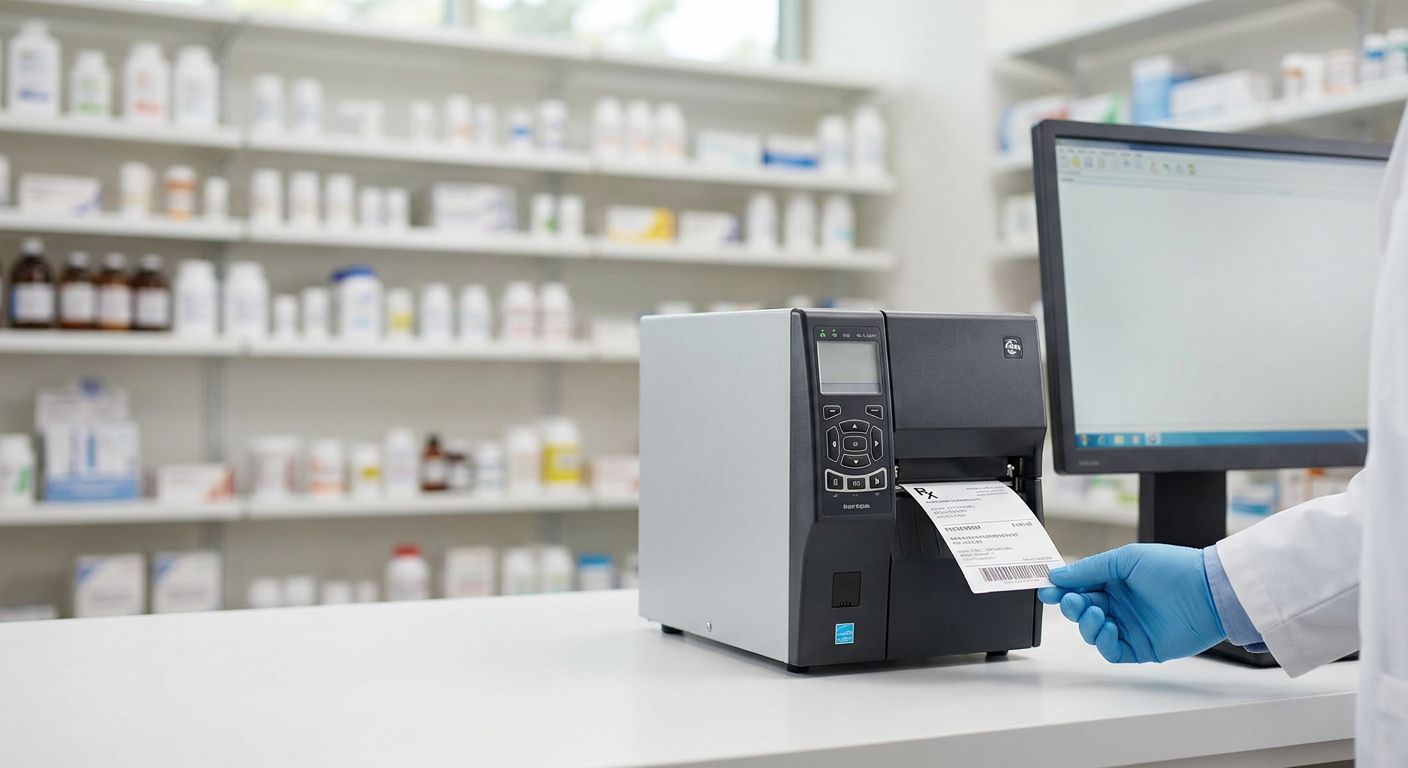
Hospital pharmacies scan more barcodes per shift than almost any other department in the building, and the printer producing those labels decides whether that scan works on the first try. This guide ranks the prescription label printer for hospital pharmacy applications by DPI, print width, and price, with a straight verdict on each model for 2026.
- GoDEX ZX430i+ is the top prescription label printer for hospital pharmacy barcode clarity at 300 DPI. Buy.
- GoDEX RT700i+ covers high-volume outpatient windows at 203 DPI for $581. Buy for standard label runs.
- GoDEX GX4200i suits central fill and mail-order volume at $2,246; overkill for a single satellite pharmacy.
- Thermal transfer beats direct thermal for records that need to survive months in a patient chart.
- All GoDEX printers here carry a 3-year manufacturer warranty, per McAuley Labels product listings.
Why this matters
Hospital pharmacies run barcode medication administration checks at the bedside, and a blurry or misaligned label breaks that check before a nurse ever scans it. Prescription labels pack small print into a one- or two-inch panel — drug name, strength, lot number, sometimes a two-dimensional barcode — which makes this a resolution problem before it's a workflow problem.
Independent and retail pharmacies often get by on a 203 DPI printer built for shipping labels. Hospital pharmacies running unit-dose packaging, compounding logs, or dense barcodes need more resolution headroom, plus a printer built for 24/7 duty cycles instead of a desktop model rated for light office use.
McAuley Labels sells the GoDEX printer line pharmacies already run for these exact jobs — see the thermal label printer for pharmacy use breakdown for the workflow side of this. The rankings below focus on the hardware decision: DPI, print width, duty cycle, and price, based on 2026 GoDEX spec sheets.
How we ranked
Every printer below is ranked on four factors that matter specifically for a hospital pharmacy label: print resolution (DPI), print width, thermal transfer versus direct thermal capability, and price relative to duty cycle. DPI decides whether a small barcode or micro-print lot number scans clean on the first pass. Print width and thermal transfer capability decide whether the printer can also handle compounding labels or long-retention records without fading.
Price is weighed against volume: a $2,246 industrial printer is a poor fit for a two-pharmacist satellite window, and a $581 desktop model won't keep up with a central fill operation running thousands of labels a shift. Every spec cited below comes from the GoDEX manufacturer listing for that model, not a lab test — confirm your label stock and pharmacy software before ordering.
The ranked list
1. GoDEX ZX430i+ — the resolution pick
The GoDEX ZX430i+ 300 DPI printer prints across a 4-inch web at 300 DPI, the sharpest resolution in this lineup, with a color display for on-the-fly settings changes. That resolution matters most on small-format prescription labels where drug name, strength, and a compact barcode compete for the same one-inch panel — at 203 DPI, the barcode usually survives, but the human-readable text underneath can get soft edges.
At $945, it costs more than the base RT700i+, and the jump is worth it anywhere staff scan barcodes at the bedside or fill unit-dose trays where a failed scan means a manual override. For 2026, this is the printer to standardize on for any pharmacy running barcode medication administration workflows. Buy for high-scan-rate, small-format labeling.
2. GoDEX RT700i+ — the workhorse
The GoDEX RT700i+ dual thermal printer prints at 203 DPI across the same 4-inch web, with a color display and dual thermal transfer/direct thermal support, for $581. That's the price of a printer built for a full shift of outpatient window volume rather than a home-office desktop model rebadged for the counter.
203 DPI is enough for standard prescription vial labels, service reminder tags, and most unit-dose runs that don't depend on dense two-dimensional codes. Pair it with thermal transfer ribbon and it holds up on synthetic stock for records that need to survive handling, not just a single dispense. Buy as the standard printer for a pharmacy that doesn't need the ZX430i+'s extra resolution.
3. GoDEX GX4200i — the industrial pick
The GoDEX GX4200i is a 203 DPI, 4-inch dual thermal printer rated up to 16 inches per second, with a 5-inch touchscreen and USB, serial, and Ethernet connectivity built in. At $2,246, it costs roughly four times the RT700i+, and that premium buys sustained print speed for a pharmacy printing thousands of labels a shift rather than hundreds.
Central fill operations and mail-order pharmacies are the real fit here — a satellite window with two staff members doesn't need that throughput. Consider it only if label volume already strains a desktop printer; otherwise it's overkill.
4. GoDEX RT200i — the satellite-pharmacy pick
The GoDEX RT200i is a 203 DPI entry point into the same RT-series as the RT700i+, built for lower-volume counters where a full industrial printer doesn't pencil out. It's the model to standardize on for a satellite pharmacy window or a secondary station that only needs to keep pace with occasional dispensing.
Because it shares the RT-series platform, ribbon and label stock carry over if the main pharmacy already runs an RT700i+ or ZX430i+, which keeps supply ordering simple across departments. Consider it for low-volume satellite stations; skip it for any window handling bedside barcode scanning at scale.
5. GoDEX GE330 — the durability pick
The GoDEX GE330 is a 4-inch, 203 DPI thermal transfer printer built for label runs that need to hold up past a single dispense — compounding room logs, controlled-substance cabinet tags, and records pulled back out of a chart months later. Thermal transfer resin locks the print into the label surface instead of sitting on top of it, which matters once a label goes through repeated handling or storage.
It's not the printer for a fast-moving outpatient window; it's the printer for the label that has to still be legible when someone pulls the record for an audit. Consider it specifically for compounding and controlled-substance labeling.
6. GoDEX RT730i — the wildcard
The GoDEX RT730i sits in the same RT-series line as the RT700i+ and RT200i, and it's worth a look if a pharmacy is standardizing every department on one printer family for supply and service simplicity. McAuley Labels doesn't publish enough spec differentiation between the RT730i and RT700i+ to call a clear winner without a direct comparison against your label stock.
Wait — call for a spec sheet against your exact label size and ribbon before ordering this one over the RT700i+.
“If a barcode fails three scans in a row at the bedside, the printer's resolution is usually the problem, not the label.”


Comparison table
| Printer | DPI | Print Width | Price | Best For | Verdict |
|---|---|---|---|---|---|
| GoDEX ZX430i+ | 300 | 4" | $945 | Small text, dense barcodes | Buy |
| GoDEX RT700i+ | 203 | 4" | $581 | High-volume outpatient windows | Buy |
| GoDEX GX4200i | 203 | 4" | $2,246 | Central fill, mail-order | Consider |
| GoDEX RT200i | 203 | Not listed | Not listed | Satellite pharmacy windows | Consider |
| GoDEX GE330 | 203 | 4" | Not listed | Compounding, controlled-substance labels | Consider |
| GoDEX RT730i | Not listed | Not listed | Not listed | Departments standardizing on one printer family | Wait |
Where to buy
Buy direct from the manufacturer, not a reseller, so the 3-year GoDEX warranty listed on the McAuley Labels product pages actually applies — some marketplace listings resell without honoring that coverage.
Match ribbon to printhead: thermal transfer models like the RT700i+, ZX430i+, and GE330 need wax/resin ribbon sized to the label width, not repurposed shipping-label ribbon.
Confirm your prescription vial or unit-dose label size against the printer's maximum print width — 4 inches on every RT- and ZX-series model above — before you commit to an order.
FAQ
What's the best prescription label printer for a hospital pharmacy in 2026?
The GoDEX ZX430i+ is the best prescription label printer for hospital pharmacy use in 2026 because it prints at 300 DPI across a 4-inch web, keeping small text and barcodes sharp on compact vial labels. The GoDEX RT700i+ is the value alternative at 203 DPI for pharmacies that don't need that extra resolution.
Is 300 DPI better than 203 DPI for prescription labels?
Yes, 300 DPI produces sharper small text and denser barcodes than 203 DPI, which matters most on compact prescription vial labels packed with drug name, strength, and lot data. 203 DPI still scans fine for standard-size barcodes and larger label formats.
Should a hospital pharmacy use direct thermal or thermal transfer printing?
Thermal transfer is the better choice for any prescription label that needs to survive handling or storage past the initial dispense, since resin ribbon locks print into the label surface. Direct thermal works fine for short-lived labels read once at pickup but fades faster under heat or UV exposure.
How much does a GoDEX prescription label printer cost?
GoDEX printer pricing runs from $581 for the RT700i+ dual thermal model to $2,246 for the industrial GX4200i, based on 2026 pricing listed by McAuley Labels. The right model depends on label volume per shift, not just print quality.
Do GoDEX printers include a warranty?
Yes, GoDEX printers sold through McAuley Labels carry a 3-year manufacturer warranty. Confirm warranty terms directly with the seller if buying through a third-party marketplace instead of the manufacturer listing.
What's the difference between the GoDEX RT700i+ and ZX430i+?
The RT700i+ prints at 203 DPI and costs $581, while the ZX430i+ prints at 300 DPI for $945 — the ZX430i+'s extra resolution is worth the premium for small-format labels with dense barcodes. Both print across a 4-inch web with a color display.
Can one printer handle both prescription labels and hospital asset tags?
A 203 DPI thermal transfer printer like the GoDEX RT700i+ can print both prescription labels and durable asset tags if the label stock and ribbon are matched to each job. Most hospital pharmacies still run a dedicated prescription printer separate from facilities' asset-tagging setup to avoid switching stock mid-shift.
One last thing
Direct thermal prints fade under heat and UV exposure over time, which is fine for a label read once at pickup but a problem for one pulled back out of a chart or evidence log months later. If any label in your pharmacy needs to survive past the dispense — compounding records, controlled-substance tags — run it through a thermal transfer model with resin ribbon, not direct thermal stock. That single distinction, more than any DPI number, is what separates a pharmacy's short-term labels from its long-term records in 2026.