
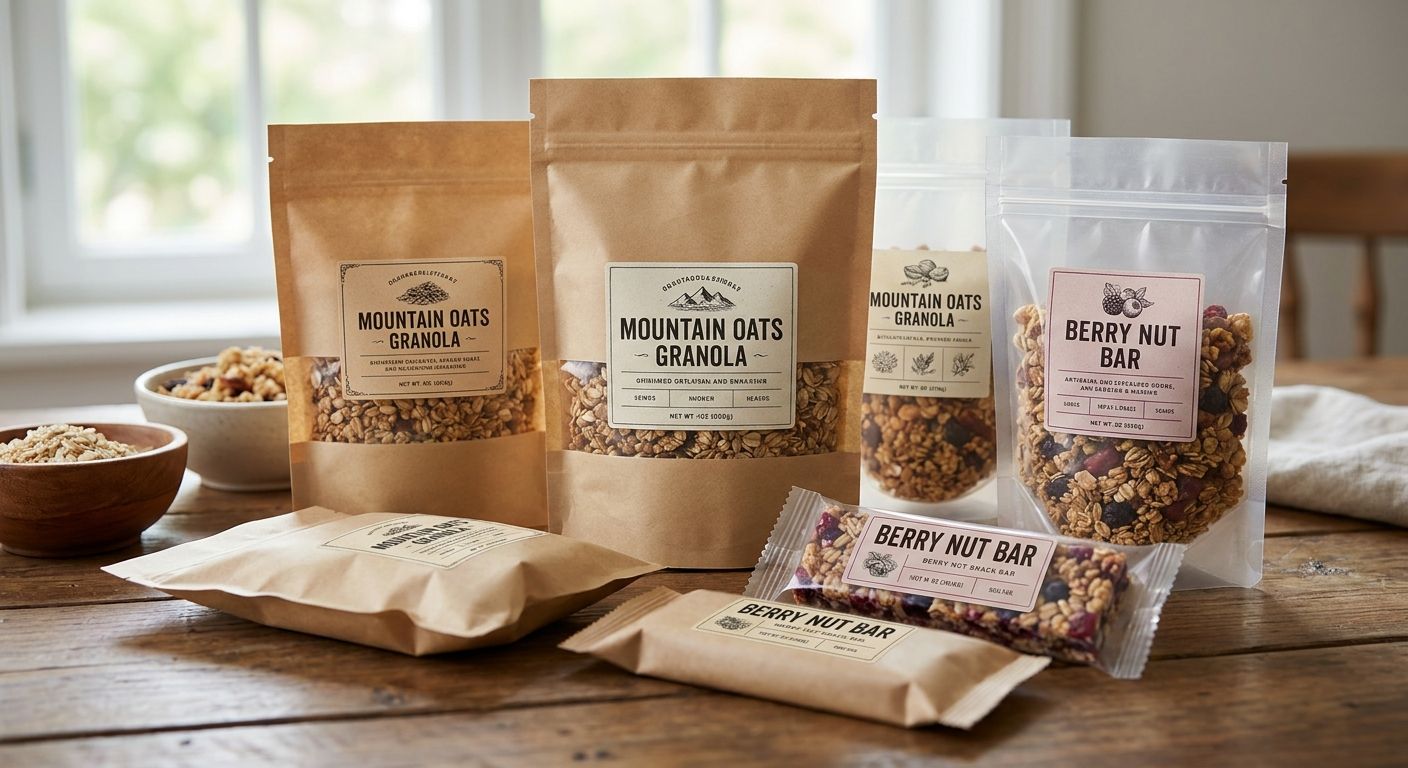
Granola and snack bar packaging takes a beating that plain paper labels were never built for — nut butter oils bleed through, freezer-to-shelf temperature swings crack brittle adhesive, and a blurry barcode kills a scan at grocery checkout. This guide covers what actually holds up on custom labels for granola bar packaging, which print method survives shelf life past 90 days, and which printer setup keeps a UPC scannable in 2026.
- Thermal transfer paper is the safest material for custom labels for granola bar packaging — buy for 2026 retail runs.
- Direct thermal labels start at $6 a roll, fine for pilot batches sold within roughly 90 days.
- A 300 DPI printer like the GoDEX ZX430i keeps small UPC barcodes scannable at grocery checkout.
- Skip glossy paper with no grease resistance — nut butter oil bleeds through and lifts the adhesive.
Why this matters
A granola bar wrapper isn't a static jar label sitting on a shelf indoors. It gets handled in a delivery van in July, stacked in a cooler at a farmers market, and rubbed against oily nut butter or coconut oil coatings for the entire time it sits in inventory. A label that lifts, smears, or fades before the sell-by date isn't a cosmetic problem — it's a returned pallet or a rejected order from a retail buyer.
Barcode legibility adds a second failure point that most small food brands don't think about until a cashier scans a bar three times and gives up. Retail buyers and co-packers both check scan rate before they sign a purchase order, and a fuzzy 203 DPI barcode on a 1.5-inch panel fails that check more often than people expect.
Who this is for
This guide is for small-batch granola and snack bar makers moving from farmers markets into regional grocery, co-packers running private-label snack lines, and food brands that print labels in-house instead of outsourcing every run to a commercial print shop. If you're printing 500 to 50,000 labels a month and need the roll on hand today rather than a 3-week turnaround from a print vendor, the material and printer choices below apply directly to you.
McAuley Labels supplies the direct thermal printer labels and thermal transfer stock that food brands run in-house on desktop and industrial thermal printers, which is the setup most small snack bar operations land on once they outgrow ordering pre-printed rolls from a packaging vendor.
What to look for in custom labels for granola bar packaging
Grease and oil resistance
Granola bars built on nut butter, coconut oil, or honey binders sweat oil through the wrapper over weeks in storage. A label stock without a grease-resistant topcoat lets that oil migrate into the paper fiber, which softens the adhesive and causes edges to curl within days. This is the single most common reason a food brand's labels look fine on day one and peel off by day thirty.
Cold-chain and condensation resistance
Bars stored in a cooler at a market stand or shipped in a refrigerated truck pick up condensation every time they move between temperatures. Paper labels with a standard adhesive absorb that moisture and wrinkle; polyester and synthetic stocks shed it. If any part of your distribution touches refrigeration, this criterion outranks price.
Print method: direct thermal vs thermal transfer
Direct thermal labels print without ribbon because the label stock itself is heat-reactive — that also means the image fades under sustained heat or direct sunlight over a few months. Thermal transfer uses a wax or resin ribbon to bond ink into the label, which holds sharp text and barcodes for 6 to 12 months even in a warm delivery van. For anything sitting on a shelf past 90 days, thermal transfer is the safer call.
Barcode resolution for retail scanning
A granola bar wrapper is small, which usually means the UPC module is compressed into a narrow strip. A 203 DPI printer can blur those thin bars into an unreadable block; 300 DPI printers render the same barcode with enough edge definition to scan on the first pass at a grocery register.
Roll size flexibility for short runs
Small snack brands change flavors, run seasonal SKUs, and test new packaging more often than large manufacturers. A label setup that only makes sense at 100,000-unit minimums doesn't fit that pattern — printing in-house on demand lets you run 500 labels for one flavor test without committing to a print-shop minimum order.
Top picks
The safe pick — direct thermal printer labels. Starting at $6, no ribbon required, and no printhead cleaning cycle to manage. Best for pilot runs and flavor tests sold within roughly 90 days, where fade resistance past that window doesn't matter. Buy for short-run and test-batch labeling in 2026.
The workhorse — thermal transfer printer labels. Starting at $10, printed with a wax or resin ribbon that bonds ink into the paper fiber instead of relying on heat-reactive coating. Holds sharp text and barcode contrast through 6 to 12 months of retail shelf time, coolers, and warm delivery vans. Buy for any granola bar SKU with a shelf life longer than a few months.
The barcode fix — GoDEX ZX430i 300 DPI printer. The spec that matters here is the 300 DPI print head, which renders small UPC modules with crisp bar edges instead of the smudged blocks a 203 DPI printer produces on compact snack labels. Buy if bars are going into grocery or convenience stores where a failed scan means a rejected sale; Skip if you're selling direct-to-consumer online only, where scan rate at checkout isn't a factor.
The wildcard — custom stickers for business logo. A secondary branded seal or tamper strip doesn't replace the nutrition panel, but it adds shelf presence on a wrapper that's otherwise dominated by required text. Useful once the primary label is locked and you want a second touchpoint for brand recognition. Consider once the main label design is finalized, not before.


What to avoid
- Glossy paper labels with no grease-resistant topcoat. They look fine on the shelf display but curl and lift within days of contact with a nut butter or oil-coated bar.
- 203 DPI printers for compact barcode panels. The resolution is fine for shipping labels but blurs thin UPC modules on a 1.5-inch snack wrapper strip.
- Direct thermal stock for long shelf-life SKUs. Great for a 90-day pilot run, a poor fit for a bar rated to sit on a shelf for six months or more — the print fades under heat and light well before the sell-by date.
Verdict comparison
| Criterion | Direct thermal labels | Thermal transfer labels | 300 DPI printer |
|---|---|---|---|
| Grease resistance | Moderate | High | N/A (printer, not stock) |
| Cold-chain durability | Moderate | High | N/A |
| Shelf-life fit | Under 90 days | 6-12 months | Any |
| Barcode scan quality | Adequate | Adequate | Best |
| Starting cost | $6 | $10 | Higher upfront, no ribbon cost |
| Verdict | Buy for pilots | Buy for retail runs | Buy for grocery/retail scan reliability |
FAQ
What's the best label material for granola bar packaging?
Thermal transfer paper or polyester stock is the best material for granola bar packaging because it resists grease and holds barcode contrast for 6 to 12 months. Direct thermal stock works for short pilot runs but fades faster under heat and light.
Is direct thermal or thermal transfer better for snack bar labels?
Thermal transfer is better for any snack bar SKU with a shelf life longer than a few months because the ribbon-bonded ink resists fading. Direct thermal is cheaper and ribbon-free, which makes it a better fit for short test runs sold within about 90 days.
How much do custom labels for granola bar packaging cost?
Direct thermal label rolls start at $6 and thermal transfer paper rolls start at $10 based on 2026 pricing. Waterproof polyester thermal transfer stock costs more but adds grease and moisture resistance for cold-chain or oily bar formulas.
What DPI do I need to print nutrition facts on a granola bar label?
A 300 DPI printer renders small nutrition-facts text and compact barcodes clearly on a snack bar wrapper. A 203 DPI printer is fine for larger shipping labels but tends to blur fine text and thin barcode bars at small sizes.
Can I print allergen warnings directly on my own labels in-house?
Yes, an in-house thermal printer can print allergen text directly on the label as long as the resolution is high enough to keep the required text legible. A 300 DPI printer handles small allergen disclosures more reliably than a 203 DPI model.
Do granola bar labels need to be waterproof?
Labels need moisture and grease resistance if the product touches refrigeration, coolers, or oil-based ingredients like nut butter or coconut oil. Standard paper stock without a protective topcoat tends to wrinkle or lift under those conditions.
What size label works best for a granola bar wrapper?
Label size depends on wrapper dimensions, but compact panels under 2 inches wide need a higher-resolution printer to keep the UPC scannable. Match the roll width to your printer's compatible label sizes before ordering a large run.
Is a direct thermal printer worth it for a small snack bar brand?
A direct thermal printer is worth it for a small snack bar brand running short test batches or flavors sold within about 90 days. Brands running longer retail shelf cycles get more consistent results from thermal transfer printing instead.
One last thing
The fade problem catches more snack bar brands off guard than any adhesive issue. A batch of direct thermal labels printed in January can look noticeably duller by the time a summer delivery van sits in the sun for a few hours — the print itself is heat-reactive, so heat and UV exposure degrade it the same way that originally created the image. If your bars sit anywhere near a hot dashboard, a sunny market table, or a warehouse without climate control for more than a few weeks, thermal transfer stock is the one upgrade worth making before the next print run in 2026.