
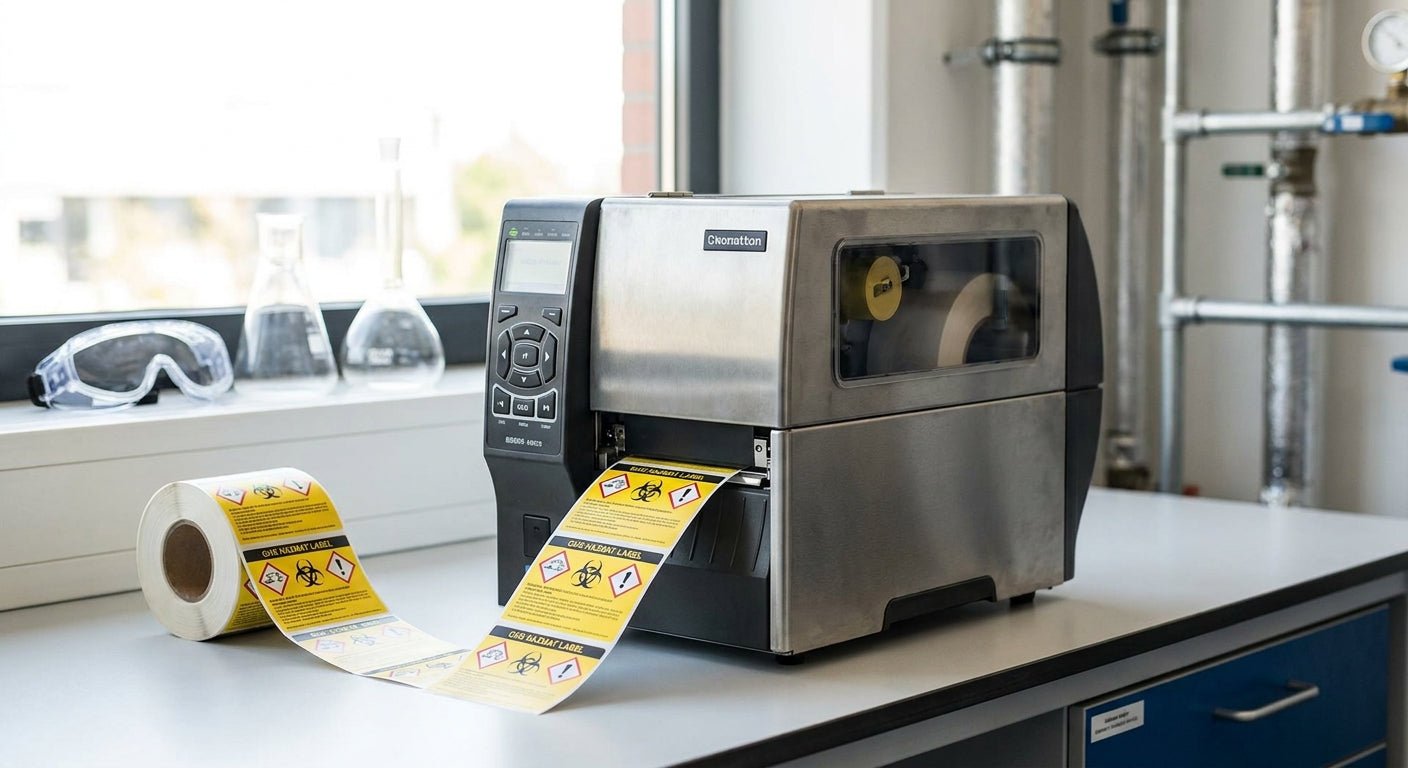
Chemical and hazmat facilities need labels that survive solvent wipe-downs, forklift abrasion, and an OSHA HazCom audit — not warehouse-grade paper stock that fades in six weeks. This guide breaks down what actually matters when you're shopping for an industrial label printer for chemical facilities in 2026, and which McAuley Labels printers and label stocks hold up on a working plant floor.
- GoDEX ZX430i+ at 300 DPI is the industrial label printer for chemical facilities that need sharp GHS pictogram detail — buy it.
- GoDEX RT700i+ at $581 covers standard 203 DPI barcode and placard labeling for lower-volume plants.
- 3M Heavy-Duty Silver Barcode asset tags at $115 survive solvent wipe-downs; semi-gloss paper tags don't.
- Direct thermal labels fade under chemical and UV exposure within weeks — thermal transfer with resin ribbon is the 2026 standard for hazmat labeling.
Why this matters
A hazmat label that peels off a drum during a forklift move isn't a labeling problem — it's an OSHA HazCom violation waiting for an inspector. Chemical facilities running GHS-compliant labeling in 2026 need stock and print resolution that survive forklift traffic, chemical splash, and repeated handling, not office-grade adhesive that lifts after a week in a warehouse. Get chemical storage drum labeling wrong and you're relabeling drums every quarter instead of once.
Most facilities default to whatever direct thermal printer sits in the shipping department. That's a mistake for anything touching solvents, acids, or outdoor drum storage — direct thermal print fades under UV and heat with no ribbon protecting it. Thermal transfer with resin ribbon is the baseline McAuley Labels recommends for anything that needs to survive past 90 days.
Who this is for
This is written for EHS coordinators, plant safety managers, and warehouse operations leads at chemical manufacturing, storage, and distribution facilities who label drums, totes, secondary containment, and shelving with GHS pictograms, batch codes, or barcode asset tags. If your team needs labels that survive solvent exposure and an audit — not just retail inventory tracking — this is your buyer profile.
What to look for in an industrial label printer for chemical facilities
Label material: polyester beats paper every time
Paper and semi-gloss stock absorb solvents and fade within days of chemical contact. Metalized silver and white polyester stock resist abrasion, moisture, and most industrial solvents — that's why polyester is the default for drum ID and equipment asset tags in chemical plants, not the semi-gloss paper stock built for indoor retail shelving.
300 DPI vs 203 DPI: resolution decides pictogram legibility
GHS pictograms and small hazard-code text need enough resolution to stay legible at arm's length. A 203 DPI printer handles standard barcodes and large text fine, but 300 DPI keeps small pictogram detail sharp on a 2-inch label. If your facility prints diamond hazard placards or small secondary-container labels, 300 DPI isn't optional.
Ribbon chemistry: resin over wax for anything touching solvents
Wax ribbon smears under a gloved wipe; resin ribbon resists scuffing, chemical splash, and heat. Facilities storing or handling solvents, acids, or petroleum products should run resin or wax/resin ribbon exclusively — wax-only ribbon on a drum label is a compliance liability by month two.
Direct thermal vs thermal transfer: pick transfer for anything permanent
Direct thermal embeds heat directly into the label coating with no ribbon — cheap and fast, but it fades under UV and heat within weeks. Thermal transfer bonds ink through a ribbon onto polyester or paper stock, and it's the only choice for labels that need to survive outdoor drum storage or a chemical-splash zone past a few months.
Connectivity and duty cycle for plant-floor integration
A printer that only connects by USB won't integrate cleanly with a warehouse management system tracking lot numbers across multiple stations. Look for USB, Serial, and Ethernet on the same unit, and match print speed to your batch volume — a facility relabeling hundreds of drums per shift needs more throughput than a lab printing occasional specimen tags.
Warranty and service turnaround
Industrial printers run daily in dusty, chemical-adjacent environments, and downtime on a labeling line stalls shipping. McAuley Labels ships GoDEX printers with a 3-year manufacturer warranty as the baseline — anything shorter signals a printer built for light office use, not a plant floor.
Top picks for chemical and hazmat facilities
GoDEX ZX430i+ Thermal Printer — the resolution pick
300 DPI, color display, USB/Serial/Ethernet, priced at $945. This printer is built for facilities printing GHS pictograms, small secondary-container labels, or dense batch-code text where legibility can't slip. Ethernet connectivity means it drops into a plant floor network without a workaround. Verdict: Buy for any facility printing pictogram-heavy or high-detail hazmat labels. GoDEX ZX430i+ Thermal Printer
GoDEX RT700i+ Thermal Printer — the budget workhorse
4-inch, color display, 203 DPI, priced at $581. It won't render fine pictogram detail as sharp as the ZX430i+, but for standard hazard placards, lot codes, and barcode asset tags, 203 DPI is enough — and it's $364 cheaper. Verdict: Buy for facilities running standard barcode and text labels without dense small print. GoDEX RT700i+ Thermal Printer
3M Heavy-Duty Silver Barcode Asset Tags — the drum-and-tank pick
Priced at $115. Built for tank, drum, and equipment ID that gets wiped down with solvents daily, the 3M heavy-duty adhesive holds where semi-gloss paper tags lift within a shift. Verdict: Buy for permanent drum, tank, and heavy-equipment ID in chemical-handling zones. 3M Heavy-Duty Silver Barcode Asset Tags


What to avoid
- Direct thermal-only printers for outdoor or high-heat storage. No ribbon means no UV or heat protection — labels fade to unreadable within weeks in a chemical yard.
- Semi-gloss white paper tags on drums and tanks. Built for indoor equipment ID, not solvent wipe-downs; a metalized silver or 3M heavy-duty stock survives what paper won't.
- Wax-only ribbon on anything touching solvents. It smudges under a gloved wipe-down and won't hold up past a routine chemical splash.
Verdict comparison
| Printer / Label | Resolution | Ribbon needed | Price | Best for | Verdict |
|---|---|---|---|---|---|
| GoDEX ZX430i+ | 300 DPI | Resin/wax-resin | $945 | GHS pictograms, dense text | Buy |
| GoDEX RT700i+ | 203 DPI | Resin/wax-resin | $581 | Standard barcodes, placards | Buy |
| 3M Heavy-Duty Silver Barcode Tags | N/A (label stock) | N/A | $115 | Drum, tank, equipment ID | Buy |
“If a label can't survive a diesel wipe-down, it doesn't belong on a chemical drum.”
FAQ
What's the best label printer for chemical and hazmat facilities in 2026?
The GoDEX ZX430i+ at 300 DPI is the best industrial label printer for chemical facilities printing GHS pictograms and dense hazard text in 2026. For standard barcode and placard labeling without fine pictogram detail, the GoDEX RT700i+ at $581 covers the job for less.
Is direct thermal or thermal transfer better for chemical labels?
Thermal transfer is better for chemical facility labeling because it bonds ink through a ribbon instead of embedding heat into the label coating. Direct thermal labels fade under UV and heat exposure within weeks, which fails an OSHA HazCom audit fast.
How much does an industrial label printer for a chemical facility cost?
GoDEX printers built for chemical and hazmat labeling run from $581 for a 203 DPI model like the RT700i+ to $945 for a 300 DPI model like the ZX430i+. Heavy-duty asset tag stock for drum and tank ID runs around $115.
What DPI do I need for GHS pictogram labels?
300 DPI is the resolution that keeps GHS pictogram detail legible on a 2-inch label. 203 DPI handles standard barcodes and larger hazard text fine, but small pictogram icons blur at that resolution.
Can polyester labels survive solvent and chemical exposure?
Metalized silver and white polyester label stock resist abrasion, moisture, and most industrial solvents far better than paper or semi-gloss stock. That durability is why polyester is the standard for drum ID and equipment asset tags in chemical-handling facilities.
What's the difference between wax and resin ribbon for hazmat labels?
Resin ribbon resists chemical splash, scuffing, and heat; wax ribbon smears under a gloved wipe-down. Facilities handling solvents, acids, or petroleum products should run resin or wax/resin ribbon exclusively, never wax-only.
Do hazmat facilities need barcode asset tags in addition to hazard labels?
Yes — barcode asset tags track equipment, drums, and containment units separately from the GHS hazard labeling on the contents. 3M Heavy-Duty Silver Barcode tags are built for that permanent equipment-ID use case in chemical-handling zones.
How long does a GoDEX industrial printer warranty last?
GoDEX printers come with a 3-year manufacturer warranty as standard. That's the baseline to expect on any printer running daily in a plant-floor or chemical-adjacent environment.
One last thing
The detail most facilities miss: ribbon width has to match label width almost exactly, or the ribbon wrinkles and skips print on part of the label — a common failure nobody catches until a pictogram half-prints on a drum during a real audit. Match ribbon width to label stock width before you order in bulk, not after 2026 buying decisions get locked into a purchase order.