
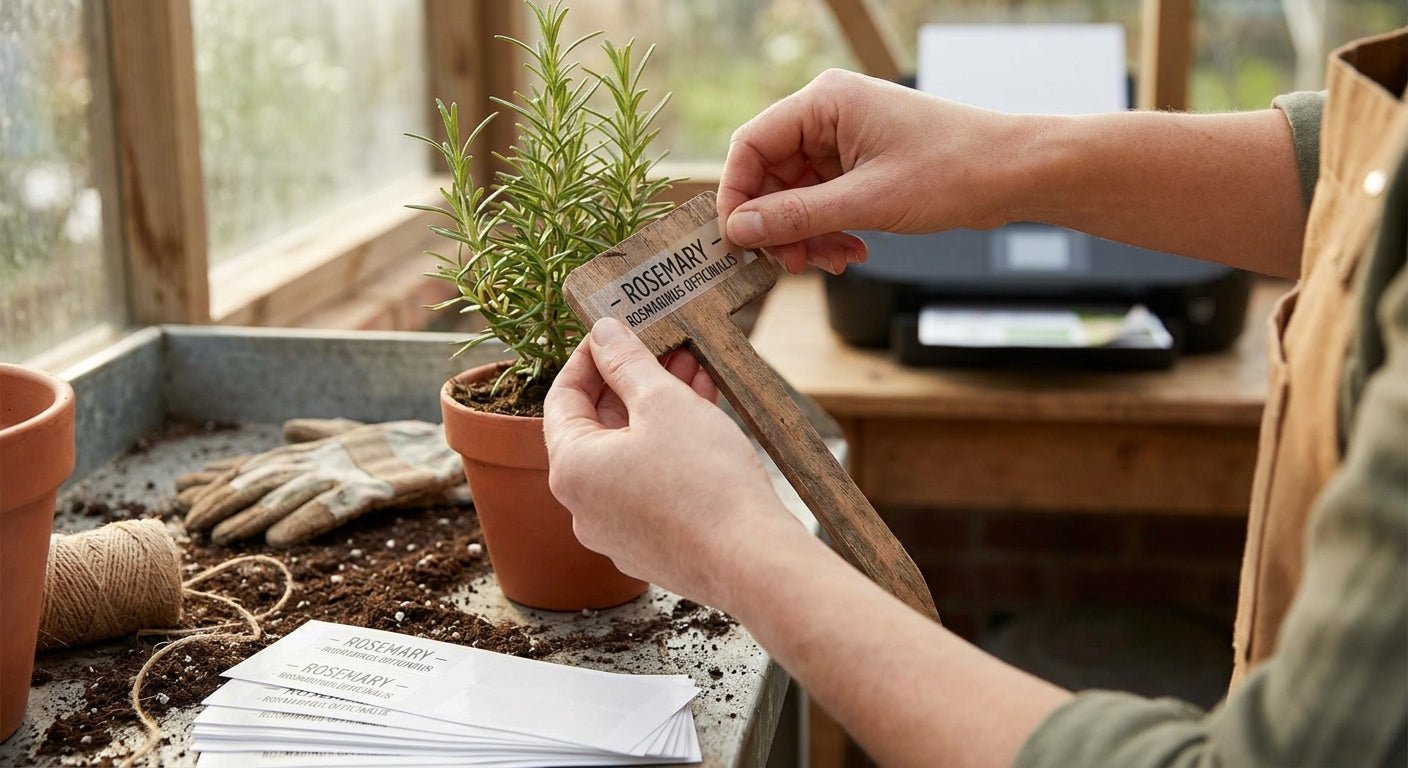
Outdoor plant stakes take direct sun, sprinkler spray, and freezing overnight temps, and a label printed on regular paper stock lasts maybe two weeks before the ink smears into an unreadable blur. This guide covers exactly what material, printer, and settings produce waterproof labels for outdoor plant stakes that survive a full growing season outdoors in 2026.
TL;DR
Waterproof labels for outdoor plant stakes need thermal transfer printing on polyester or vinyl stock, not direct thermal paper, because direct thermal fades under UV within 30-60 days. Print at 300 DPI minimum using a resin ribbon matched to polyester label stock, and the labels hold legible text and barcodes through rain, frost, and full-sun exposure for 12+ months. Verdict: thermal transfer on polyester is the only setup worth buying for outdoor stakes in 2026 — direct thermal paper is a Skip for this use case.
Why this matters
A mislabeled plant stake costs a nursery real money — replanting time, customer complaints, and inventory that doesn't match what's actually in the ground. Growers who switch from handwritten or inkjet stakes to thermal-printed waterproof labels report the labels still read clearly after a full season of irrigation and sun, versus faded or peeling labels within weeks on paper stock. The difference isn't the printer alone — it's matching ribbon chemistry to label material, which is where most DIY setups go wrong in 2026.
What you'll need
- A thermal transfer printer (not a direct thermal-only unit) — the GoDEX GE330 prints at 203 DPI and handles polyester stock without jamming
- Polyester label stock rated for outdoor use, not paper or vinyl cling
- A resin thermal transfer ribbon sized to match your label width
- Design software or GoLabel (bundled with most GoDEX units) for text and barcode layout
- A stake or spike applicator, or double-sided outdoor tape if labels attach directly to a stake
- 20-30 minutes for setup and calibration before your first production run
The steps
1. Choose polyester over paper — no exceptions
Paper labels absorb moisture and disintegrate within days of consistent outdoor watering. Polyester label stock is non-porous, so water beads and rolls off instead of soaking into the fiber. This single material choice determines whether your stakes last one season or fail in three weeks. Common mistake: buying "waterproof" direct thermal paper — it resists splashes but not UV, and the printed image itself fades even though the paper survives.
2. Match resin ribbon to the stock
Thermal transfer printing melts wax, wax-resin, or pure resin ribbon onto the label surface, and for outdoor durability you want pure resin. Resin ribbon bonds to polyester at a molecular level and resists UV fade, abrasion, and chemical exposure from fertilizer or pesticide overspray far better than wax-resin blends. Load a thermal transfer ribbon rated for polyester, not the wax ribbon that ships with some starter kits for paper labels.
3. Set print resolution to 300 DPI for small text
Plant stake labels often carry small type — Latin genus names, cultivar codes, care instructions — packed into a 1-2 inch label. At 203 DPI, fine serif text and small barcodes blur at close range; 300 DPI resolves that detail cleanly. If your printer only runs 203 DPI, increase font size to at least 8pt and avoid thin barcode symbologies.
4. Calibrate darkness and print speed before a full run
Run a test strip of 5-10 labels at your printer's default darkness setting, then check for smudging or ribbon wrinkle. For polyester stock, darkness settings between 12-18 (on a 0-30 GoDEX scale) and print speeds of 2-4 inches per second typically produce clean, fully-cured text without scorching the resin. Common mistake: printing at full speed to save time — faster speeds under-cure the resin bond, and labels that look fine on day one peel or smear after the first watering.
5. Apply labels to dry, clean stakes
Moisture or dust on the stake surface at application time weakens adhesive bond strength within the first 48 hours, which is when most premature failures happen. Wipe stakes clean and let them air-dry fully before pressing labels on. If you're using adhesive-backed polyester rather than a slide-on stake sleeve, press firmly along the full label edge to seat the adhesive.
6. Add a laminate overlay for high-sun zones
In regions with intense summer UV — full-sun nurseries in the Southwest, for example — a clear laminate overlay adds another layer of fade resistance on top of resin-printed text. This step is optional in moderate climates but recommended anywhere stakes sit in direct sun for 8+ hours a day through summer 2026.
7. Batch-print by plant variety, not one at a time
Printing labels in batches sorted by variety cuts setup time and reduces the chance of mismatched labels ending up on the wrong stake. Use GoLabel or your design software's database import to pull variety names, SKUs, and care codes from a spreadsheet rather than retyping each label.
Troubleshooting
- Text fades within a month: you're likely using direct thermal paper or wax ribbon instead of resin ribbon on polyester — switch materials, not just print settings.
- Ribbon wrinkles during printing: print speed is too high or darkness is too low for the stock thickness; drop speed to 2 ips and raise darkness incrementally.
- Labels curl or lift at the edges outdoors: adhesive wasn't fully cured before application, or the stake surface had residual moisture — reapply on a dry stake after 24 hours.
- Barcode won't scan after a season outdoors: UV fade has reduced contrast; move to resin ribbon plus a laminate overlay for any barcoded stakes.
- Print looks fine on paper but smears when wet: confirm the label stock itself is polyester or vinyl, not laminated paper — paper substrate fails regardless of ribbon quality.
- Small text is unreadable at 203 DPI: bump resolution to 300 DPI or increase font size to 8pt minimum before reprinting the batch.
Tools and resources
- GoDEX GE330 thermal transfer printer — 203 DPI, built for polyester and resin ribbon runs
- Polyester label stock, white — the base material for any outdoor stake project
- Resin thermal transfer ribbon — match width to your label roll before ordering
- GoLabel software for batch design and variety database imports
- A custom quote request if you need stock sizes or ribbon widths outside standard catalog listings
What to do next
Once your stake labels are printing clean, the same resin-on-polyester approach applies to garden bed markers, greenhouse tags, and larger nursery signage — read how to print durable labels for outdoor use for the broader material and printer comparison across outdoor label formats.
FAQ
What's the best material for waterproof labels for outdoor plant stakes? Polyester label stock printed with resin thermal transfer ribbon is the best combination for outdoor plant stakes in 2026 — it resists UV fade, water, and abrasion far longer than paper or vinyl cling alternatives.
Is thermal transfer better than direct thermal for outdoor plant labels? Yes — direct thermal printing has no ribbon and relies on heat-sensitive paper that fades under UV within 30-60 days outdoors, while thermal transfer resin ink bonds to polyester and holds up through a full season.
How much does it cost to print plant stake labels in-house? Costs depend on printer, ribbon, and stock choices — a custom quote covering your label size and volume gives an accurate per-label number rather than a generic estimate.
Can I use a regular inkjet printer for outdoor plant labels? No — inkjet ink is water-soluble and runs the first time a label gets wet or rained on, making it unsuitable for any label that stays outdoors.
What DPI do I need for small plant stake text? 300 DPI resolves small Latin names and barcode symbologies cleanly; 203 DPI works if text is 8pt or larger and barcodes use a wider symbology.
Do waterproof plant labels need a laminate layer? Laminate isn't required for moderate climates but adds meaningful UV protection in high-sun regions where stakes sit in direct light for 8+ hours a day through summer.
How long do resin-printed polyester plant labels last outdoors? Expect 12 months or more of full legibility through rain, frost, and sun exposure when resin ribbon is properly matched to polyester stock and darkness settings are calibrated correctly.
What's the difference between wax-resin and pure resin ribbon for plant stakes? Pure resin bonds more permanently to polyester and resists UV and chemical exposure better than wax-resin blends, which is why resin is the standard choice for anything staying outdoors long-term.
One last thing
Most growers assume the printer is the variable that determines label life, but the ribbon-to-stock match matters more — a 203 DPI GoDEX printer running resin ribbon on polyester will outlast a 600 DPI printer running wax ribbon on paper every time. Get the material pairing right first, then worry about resolution.