
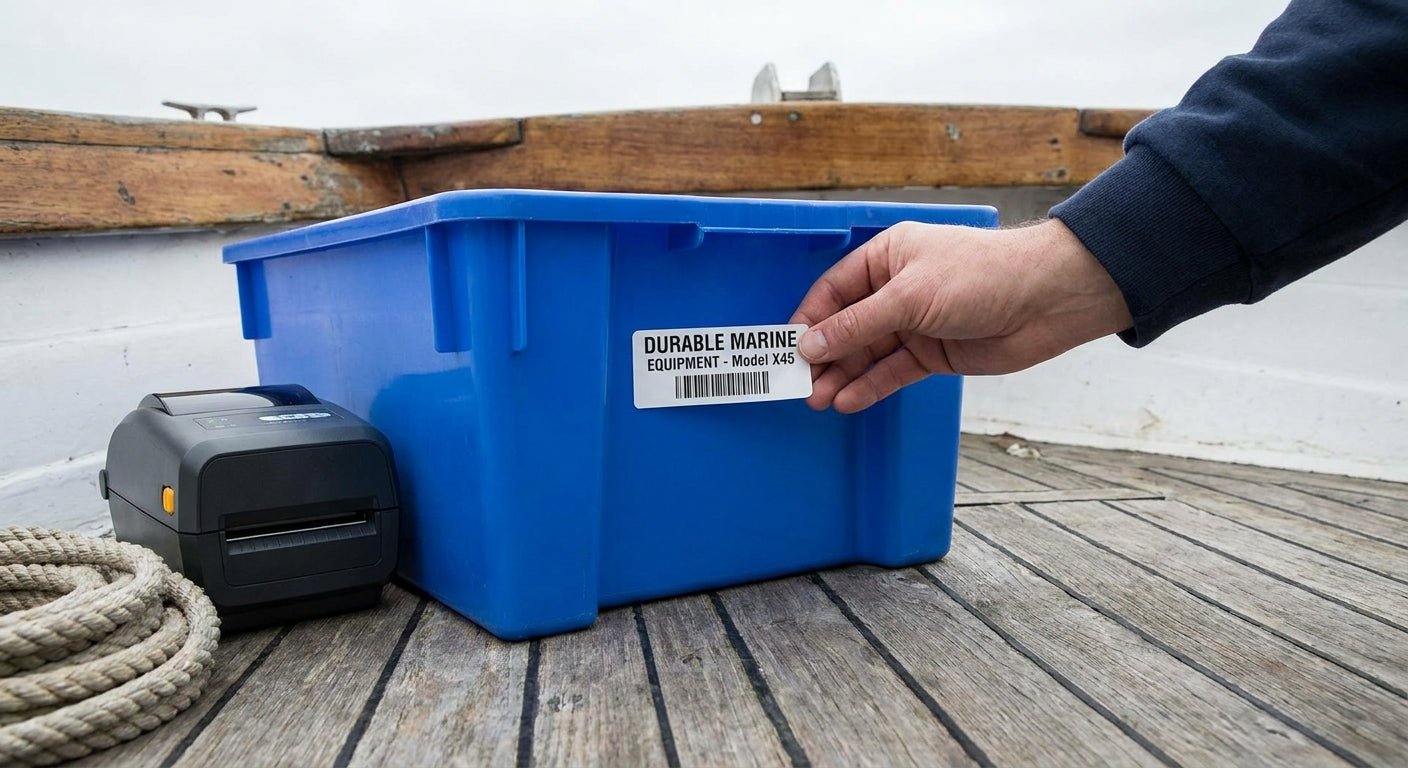
Saltwater, UV, and vibration destroy standard labels within weeks on marine equipment — this guide covers the material and printer combination that actually survives a season on the water in 2026.
- 3M Heavy-Duty metalized silver asset tags hold up against saltwater spray and UV where paper labels fail in 2026 — buy them for engine bays and hulls.
- Thermal transfer printing with resin ribbon beats direct thermal for durable labels for marine equipment exposed to sun and moisture.
- A 300 DPI GoDEX printer handles small serial numbers and QR codes on curved marine surfaces without blurring.
- Skip static cling and standard paper stock — neither survives one boating season below deck or on deck hardware.
Why this matters
A boat engine compartment runs hotter and wetter than almost any other equipment environment a facilities team deals with. Salt fog corrodes adhesive edges, UV bleaches ink within 90 days, and constant vibration peels anything not rated for heavy-duty use.
Most businesses tagging marine equipment in 2026 default to whatever asset label worked in a warehouse. That's the mistake. A label rated for indoor shelving lasts maybe one dock season before the text fades and the edges lift. Durable labels for marine equipment need a different material spec and a different print method from the start.
What you'll need
- A metalized silver or heavy-duty polyester label stock rated for outdoor and marine exposure
- A thermal transfer printer (not direct thermal) capable of at least 300 DPI for small text and barcodes
- Resin-based thermal transfer ribbon matched to your label stock
- Isopropyl alcohol wipes for surface prep before application
- A heat gun or hair dryer for cold-weather application (adhesive bonds poorly below 50°F)
- 15-30 minutes per batch of labels, plus curing time before the boat goes back in the water
For engine identification, serial tracking, and inventory tags on marine hardware, start with 3M Heavy-Duty silver barcode asset tags — the adhesive is rated for rough, curved, and metal surfaces, which covers most engine housings, transom brackets, and fuel system components.
The steps
1. Choose the right label material first
Material choice determines everything downstream. Metalized silver polyester resists UV fading and holds adhesion on curved metal surfaces like engine blocks and outboard housings. Semi-gloss white works for interior cabin equipment that doesn't face direct salt spray.
Common mistake: picking paper-based labels because they're cheaper upfront. They cost less per label and more per replacement cycle — expect to reprint every 60-90 days in a marine environment instead of once a season.
2. Match the printer to the job
Direct thermal printers are fine for indoor shipping labels that get scanned once and thrown away. Marine labels need to survive months of sun and salt, which means thermal transfer with resin ribbon — the ink is fused into the label surface instead of sitting on top of it.
A 300 DPI printer resolves small serial numbers and QR codes cleanly at the size most asset tags require (roughly 1 to 2 inches). Drop below 203 DPI and barcodes on curved surfaces start failing to scan after a few months of wear.
3. Prep the surface before applying
Wipe down the mounting surface with isopropyl alcohol and let it dry fully — 60 seconds minimum. Any residual oil, salt film, or wax on fiberglass or metal cuts adhesive bond strength dramatically.
Expected outcome: a properly prepped surface holds a 3M heavy-duty label through full-season exposure without lifting at the corners.
4. Apply in temperatures above 50°F
Adhesive doesn't set properly in cold weather. If you're tagging equipment in an unheated marina building in winter, warm the label and the surface with a heat gun for 10-15 seconds before pressing it down.
Common mistake: applying labels in cold storage sheds and wondering why they peel by spring. Cold application is the single biggest cause of early adhesive failure on marine gear.
5. Press and hold for full contact
Use firm, even pressure across the entire label — a squeegee or credit card edge works better than fingers alone. Air pockets under the label trap moisture, which accelerates lifting at the edges.
Hold pressure for at least 10 seconds on curved surfaces like railings or engine housings where the label has to conform to a radius.
6. Add a QR code for service and maintenance tracking
If you're tagging engines, pumps, or safety equipment that needs maintenance logs, a QR code on the label links directly to a service record or spreadsheet. This matters more on marine equipment than almost anywhere else — maintenance intervals are shorter and the cost of a missed service is higher.
7. Let it cure before exposure
Give fresh labels 24 hours before the boat goes back in the water or the equipment gets rained on. Adhesive continues bonding during this window, and early exposure to moisture before full cure is the second most common cause of failure after cold application.
Troubleshooting
- Label edges lift within a month: surface wasn't cleaned before application, or the boat went out before the 24-hour cure window closed.
- Text fades to illegible within a season: direct thermal printing was used instead of thermal transfer with resin ribbon — direct thermal has no UV resistance built in.
- Barcode won't scan after a few weeks: print resolution was too low for the label size, or the label was applied to a surface with too tight a curve for the material.
- Adhesive won't bond to gelcoat or fiberglass: surface has wax or polish residue — clean with isopropyl alcohol, not soap and water, which leaves a film.
- Label cracks in cold weather: standard vinyl stock was used instead of a cold-flex polyester rated for temperature swings.


“If the label fades before the boating season ends, it was printed on the wrong material to begin with.”
Tools and resources
- Metalized silver or 3M heavy-duty polyester label stock for engines and deck hardware
- A thermal transfer printer running at 300 DPI or higher for small text and barcodes
- Resin ribbon matched to the label material — wax ribbon smears under UV and moisture
- Isopropyl alcohol for surface prep, plus a heat gun for cold-weather application
- Background reading on waterproof label printing for outdoor use if you're setting up a labeling workflow for the first time
McAuley Labels builds its heavy-duty asset tags and label printers specifically for outdoor and industrial use, which is the same spec marine equipment needs — corrosion-resistant adhesive, UV-stable ink, and print resolution that holds up on curved, oily, or textured surfaces.
What to do next
If you're deciding between print methods before you buy a printer, read the breakdown on direct thermal versus thermal transfer printing — the choice changes your ribbon costs, your label lifespan, and which printer model actually makes sense for a marine equipment program.
FAQ
What's the best material for durable labels for marine equipment?
Metalized silver or 3M heavy-duty polyester is the best material for marine equipment labels in 2026. Both resist UV fading, saltwater exposure, and adhesive lift on curved metal or fiberglass surfaces.
Is thermal transfer better than direct thermal for boat labels?
Yes, thermal transfer with resin ribbon is better than direct thermal for boat and marine equipment labels. Direct thermal ink has no UV resistance and fades within weeks of sun exposure.
How much does a marine-grade label printer cost?
Thermal transfer printers capable of 300 DPI output for marine-grade labels vary by model and features, so check current pricing on individual printer product pages before buying.
Do marine labels need to be waterproof or just water-resistant?
Marine equipment labels need full waterproof adhesive and ink, not just water resistance. Splash exposure, submersion, and salt spray all require a heavy-duty polyester or metalized stock rated for continuous moisture contact.
Can I use a standard barcode scanner on marine asset tags?
Yes, standard barcode scanners read metalized silver and semi-gloss white asset tags without modification. Scan reliability depends more on print resolution and label placement than on scanner type.
Do QR codes work better than barcodes on boat equipment?
QR codes work well for linking maintenance records to marine equipment, while barcodes remain simpler for basic inventory counts. Choose based on whether you need to store service history or just identify the item.
How long do marine equipment labels last?
A properly applied 3M heavy-duty label lasts a full boating season or longer with correct surface prep and cure time. Paper or direct thermal labels typically fail within 60 to 90 days in the same conditions.
What temperature range do marine labels need to survive?
Marine labels need to handle temperature swings from below freezing in winter storage to over 150°F in an engine compartment during summer use. Standard vinyl stock often cracks at the cold end of that range.
One last thing
The detail most people skip is cure time — a label applied and immediately exposed to rain or spray fails at nearly double the rate of one given a full 24 hours to bond. If you're tagging a fleet of boats before a season launch, print and apply everything at least a full day before the first equipment hits the water.