
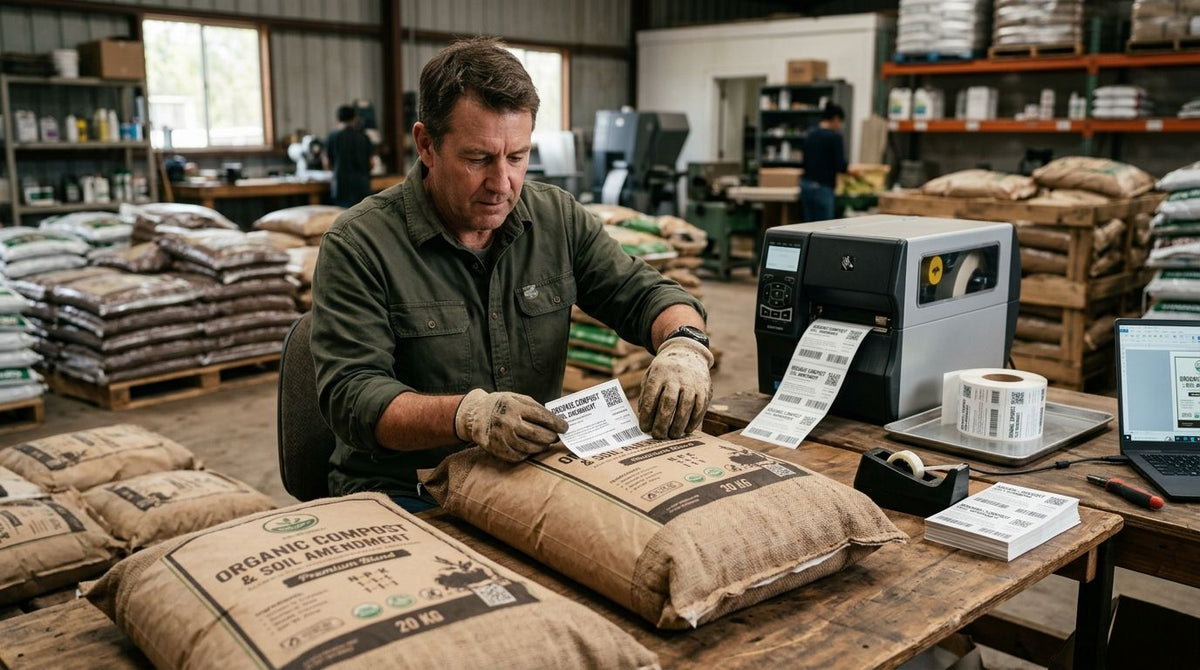
Printing labels for compost and soil amendment bags means choosing a thermal printer and a weatherproof label stock built for dirt, moisture, and UV — not the paper labels sitting in most office supply closets. Get the material and resolution right and one setup handles branding, net weight, ingredient lists, and QR-linked guaranteed analysis sheets for the whole 2026 bagging season.
- Print compost and soil amendment bag labels on a 300 DPI printer like the GoDEX ZX430i for sharp small-text barcodes.
- Use white polyester or metalized silver stock, not paper — moisture and dirt degrade standard labels within days.
- Direct thermal skips ribbon costs for short runs; thermal transfer with a ribbon holds up longer in outdoor pallet storage.
- QR codes on bag labels let buyers pull up nutrient analysis, lot numbers, and application instructions instantly.
Why this matters
Compost and soil amendment bags spend weeks stacked on pallets, in open-air garden centers, or on delivery trucks before anyone opens them. A paper label with a standard adhesive smears the first time it gets rained on or handled with dirty gloves, and a blurred lot code turns into a recall headache if a batch gets flagged. The label material and printer resolution matter more here than for almost any other packaging category — this is not a shelf-stable dry good sitting in a climate-controlled store.
Most bagging operations also have to fit a lot of required text into a small label footprint: brand name, net weight, guaranteed analysis, ingredient or nutrient breakdown, and increasingly a QR code linking to a full spec sheet. That density is exactly where printer resolution and label stock choice start to show up as legible-versus-illegible on the finished bag.
How do you print labels for compost and soil amendment bags?
Follow these steps in order — skipping the material step is the single most common mistake bagging operations make in 2026:
- Pick a moisture- and dirt-resistant label material. White polyester or metalized silver polyester stock resists smearing, tearing, and UV fading far better than uncoated paper.
- Match printer resolution to your smallest text or barcode. 203 DPI handles bold logos and large lot numbers fine; anything with a QR code or a small guaranteed-analysis table needs 300 DPI or higher to stay scannable.
- Confirm adhesive strength for poly bag surfaces. Woven poly and BOPP compost bags need an aggressive, permanent adhesive — standard paper-label adhesive releases on textured poly surfaces within days.
- Choose direct thermal or thermal transfer. Direct thermal needs no ribbon and costs less upfront; thermal transfer uses a ribbon and holds up longer against sun exposure and outdoor handling.
- Design the label to the required footprint. Fit brand name, net weight, ingredient or nutrient content, lot/batch code, and a QR code linking to a guaranteed analysis sheet or application guide.
- Run a test bag through your actual line before ordering bulk stock. Print speed, bag texture, and dust from soil product can all affect adhesion in ways a desk test won't catch.
Direct thermal vs. thermal transfer for compost bag labels
| Factor | Direct thermal | Thermal transfer |
|---|---|---|
| Ribbon required | No | Yes |
| Outdoor/UV durability | Fades over months in direct sun | Holds color and text longer outdoors |
| Upfront cost | Lower | Higher (ribbon adds a consumable) |
| Best for | Short runs, indoor bagging, fast turnover | Pallet storage, retail display, longer shelf time |
Direct thermal labels for compost bags work well when bags move fast — bagged same week, shipped same month, no long outdoor storage. Skip the ribbon, print on demand, and reprint at low cost when a lot number changes. Verdict: Buy for high-turnover, short-storage operations.
Thermal transfer labels for compost bags make sense when bags sit on a retail pallet through a full growing season or ride in an uncovered truck bed. The ribbon-printed image resists the fading and smudging that direct thermal struggles with after 60-90 days of sun exposure. Verdict: Buy for retail displays and long outdoor storage.
Why label material and printer choice vary for compost and soil bags
- Storage environment — indoor bagging with same-week shipping tolerates less-durable stock than pallets left outside a garden center.
- Bag surface material — woven poly, BOPP film, and kraft paper bags each grip adhesive differently; test on your actual bag stock, not a sample swatch.
- Required label content — state departments of agriculture often require net weight, ingredient content, and guarantor information on soil amendment bags; check your state's specific rules before finalizing layout.
- Print volume — a small operation bagging a few hundred units a week has different ribbon and label economics than a high-volume production line.
- Branding requirements — full-color logos favor thermal transfer with color ribbon or a pre-printed label stock; black-and-white barcodes and lot codes work fine on direct thermal.
- UV and weather exposure — bags displayed outdoors at a retail center need more UV-resistant stock than bags stored in a warehouse until shipment.
For a deeper look at stock selection when labels live outside for weeks at a time, see printing waterproof labels for outdoor use.
What size label works best for compost bags?
Most compost and soil amendment bags use a label between 4x6 and 6x4 inches to fit brand name, net weight, and a guaranteed analysis panel without crowding. Smaller 2x3 or 3x2 labels work for QR-only lot tags applied alongside a larger printed panel on the bag itself.
Do compost bag labels need to be waterproof?
Yes — compost and soil amendment bags are handled outdoors, stacked on pallets exposed to rain, and often stored in unconditioned warehouses through 2026's full growing season. A label rated for moisture and dirt, printed on polyester or metalized stock, avoids the smearing and peeling that paper labels show within a week of outdoor storage.
Can I print soil amendment labels with a home inkjet printer?
A home inkjet printer works for one-off test prints but is not built for the print volume or durability soil amendment bags need. Inkjet ink smears when it contacts moisture or dirt, and most home printers can't feed roll label stock, which makes a thermal printer the practical choice once you're bagging in any real quantity.
McAuley Labels' compact printers and polyester label stock are built for exactly this kind of dirt-and-moisture exposure. A 300 DPI GoDEX ZX430i prints small barcodes and QR codes cleanly, and white polyester thermal transfer stock resists the smudging that paper labels show after one wet delivery route.


FAQ
What's the best printer for compost bag labels?
A 300 DPI thermal printer like the GoDEX ZX430i is the best fit for most compost and soil amendment bag labels in 2026, printing crisp barcodes and QR codes at production speed. Go to 600 DPI only when the label has very small guaranteed-analysis text.
Is thermal transfer better than direct thermal for outdoor labels?
Thermal transfer holds up better outdoors because the ribbon-printed image resists UV fading and smudging longer than direct thermal. Direct thermal still works fine for bags that ship out within weeks of printing.
Do soil amendment labels need to list ingredients?
Many states require soil amendment bags to list net weight, guaranteed analysis, and guarantor information, so check your state department of agriculture's specific rules before finalizing your label layout. Requirements vary by product category and state.
What DPI is needed for QR codes on compost bags?
300 DPI is the minimum resolution for a reliably scannable QR code on a compost bag label, especially at smaller print sizes. 203 DPI can work for larger QR codes but risks scan failures at smaller footprints.
Can direct thermal labels handle full-color logos?
Direct thermal prints in a single color (usually black) because it uses heat-sensitive paper instead of ink or ribbon. Full-color branding needs thermal transfer with color ribbon or a pre-printed label stock.
How do you attach labels to poly compost bags?
Poly and BOPP compost bags need an aggressive, permanent adhesive rated for textured plastic surfaces, not the general-purpose adhesive used on paper labels. Test the adhesive on your specific bag stock before ordering in bulk.
What's the difference between polypropylene and polyester label stock?
Polyester label stock offers stronger tear and moisture resistance and is the more common choice for compost and soil bags stored outdoors. Polypropylene is a lower-cost alternative that still resists moisture but tears more easily under rough handling.
Can I print compost bag labels in-house instead of ordering pre-printed bags?
Yes — an in-house thermal printer lets you print labels on demand, update lot codes per batch, and avoid minimum order quantities tied to pre-printed bag runs. Most operations that switch save time on reorders once volume passes a few hundred bags a month.
One last thing
The detail most bagging operations miss is dust. Soil and compost product residue coats the printhead and label edges during the bagging process itself, not just during outdoor storage — a printer that isn't rated for a dusty environment will start printing streaky barcodes within a few weeks, not months. Wipe the printhead on a set schedule and keep spare label stock sealed until it's loaded, and the resolution problem most people blame on the printer usually disappears.