
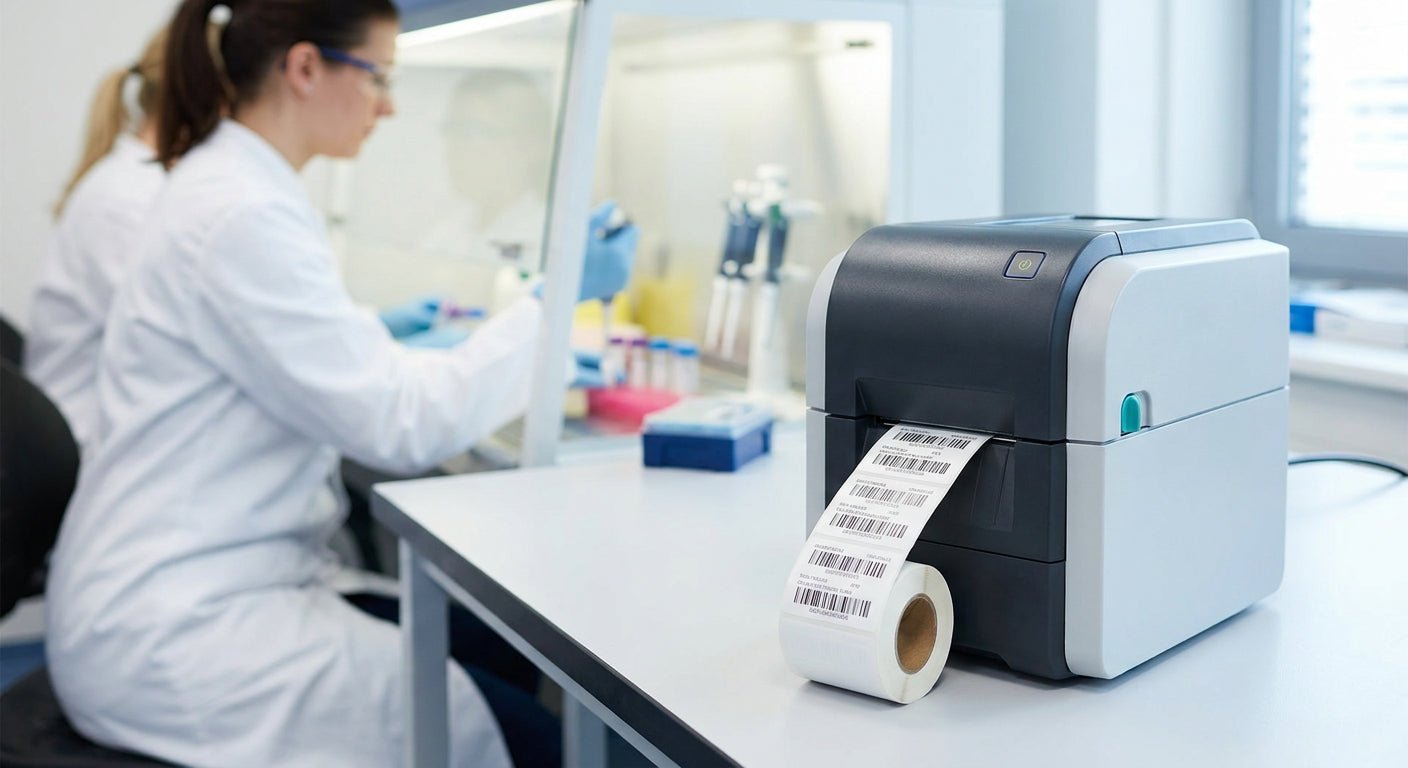
Genetic testing labs run tube volumes that break consumer label printers within a year, and a printer that smears a barcode at -80°C costs more in re-runs than it ever saved on the sticker price. This guide picks the label printer for genetic testing labs that survive freezer storage, LIS integration, and daily specimen throughput in 2026.
- GoDEX DT230 at 300 DPI is the buy for daily specimen and tube labeling in 2026 - no ribbon, no smear risk.
- GoDEX RT700i+ earns Consider for labs running mixed barcode formats off a color touchscreen.
- GoDEX G530 is Skip for labs under 500 tubes a day - the throughput is wasted capacity.
- Cryogenic storage below -70°C needs resin-ribbon or freezer-rated polyester stock, not standard direct thermal paper.
Why this matters
A sample-ID barcode that fades after 90 days in a -80°C freezer isn't a labeling problem, it's a chain-of-custody problem. Genetic testing labs handling rare disease panels, carrier screening, or research cohorts can't re-collect a sample when a scanner throws an error six months into storage.
Most off-the-shelf label printers are built for shipping labels and retail tags, not for surviving cryostorage, autoclave cycles, or reagent exposure. Getting this wrong means re-labeling entire freezer racks by hand, which is exactly the failure mode this guide is written to prevent.
Who this is for
This is written for lab managers and procurement leads at genetic testing labs, clinical diagnostics companies, and university research labs handling DNA extraction, sequencing prep, or long-term specimen banking. If your lab prints 50 to 2,000 tube labels a day and needs barcodes that survive freezer storage without a dedicated print technician on staff, the picks below are built for your workflow.
What to look for in a label printer for genetic testing labs
Print resolution at 300 DPI or higher
Tube labels for genetic testing are small, often 25mm x 10mm or smaller, and a 203 DPI printer blurs 2D barcodes at that size. 300 DPI is the floor for reliable Data Matrix and QR scanning on standard 12mm and 13mm tubes in 2026.
Direct thermal vs. thermal transfer
Direct thermal print heads skip ribbon but fade under UV and heat over months. Thermal transfer with resin ribbon holds ink through freezer cycles, autoclaves, and chemical wipe-downs — the standard for anything going into long-term storage.
Cryogenic-rated label stock
Standard paper labels crack and peel below -20°C. Labs storing samples at -80°C need polyester or cryo-rated adhesive stock rated for that range, applied before the freeze, not after.
LIS/LIMS connectivity
A printer that only accepts manual entry slows down accessioning. Ethernet and serial connections that pull directly from your lab information system cut transcription errors, which matter more in genetic testing than almost any other lab discipline.
Throughput for your daily tube count
A desktop printer rated for 4-6 inches per second handles under 500 tubes a day fine. Labs running 1,000+ specimens daily need a printer built for sustained runs, not one that overheats after two hours.
Top picks for genetic testing labs
GoDEX DT230 Direct Thermal Printer, 300 DPI — the safe pick. No ribbon to manage, 300 DPI resolution handles small tube barcodes cleanly, and it's priced for labs that don't want a dedicated print operator. For daily specimen labeling under freezer conditions where labels are read within weeks, this is the GoDEX DT230 direct thermal printer most labs should start with. Buy.
GoDEX RT700i+ Thermal Transfer, 4-inch, color display — the wildcard. The color touchscreen simplifies template switching between specimen types, accession labels, and chain-of-custody tags without reflashing firmware. It runs thermal transfer, so resin ribbon compatibility matters for long-term cryostorage jobs. The GoDEX RT700i+ thermal printer fits labs juggling more than one label format a day. Consider.
GoDEX G530, higher-DPI thermal transfer — the high-volume option. Built for sustained runs beyond what a desktop unit handles, this is overkill for a lab printing under 500 labels a day. If your genetic testing operation runs multiple accessioning stations feeding one central label queue, the GoDEX G530 thermal printer earns its footprint. Under that volume, it's Skip.


What to avoid
Standard direct thermal paper for freezer storage. It fades and curls below -20°C, and genetic testing labs storing samples at -80°C need better stock than that.
Any printer without ribbon-transfer capability if you archive samples long-term. Direct thermal is fine for same-week processing; it's the wrong call for anything sitting in storage for months.
203 DPI printers for sub-15mm tube labels. The resolution simply isn't there for 2D codes at that scale — you'll get scan failures at accessioning, not just at the freezer. Genetic testing labs running whole exome sequencing for rare disease diagnosis in particular need labels that hold up through months of -80°C storage, which is exactly the kind of workflow covered in guides on cryogenic labeling for lab samples.
Verdict comparison
| Printer | Resolution | Ribbon type | Best for | Verdict |
|---|---|---|---|---|
| GoDEX DT230 | 300 DPI | Direct thermal, no ribbon | Daily specimen labeling, under 500/day | Buy |
| GoDEX RT700i+ | 203 DPI | Thermal transfer, resin-capable | Mixed formats, touchscreen control | Consider |
| GoDEX G530 | Higher DPI | Thermal transfer | 1,000+ tubes/day, multi-station labs | Skip under 500/day |
Long-term cryogenic labeling with either printer holds up better on polyester stock than paper — see the guide on printing cryogenic labels for lab samples before you standardize on a stock.
FAQ
What's the best label printer for genetic testing labs in 2026?
The GoDEX DT230 at 300 DPI is the top pick for most genetic testing labs in 2026 because it prints small tube barcodes cleanly without ribbon management. Labs running mixed label formats do better with the GoDEX RT700i+ and its color touchscreen.
Do genetic testing labs need 300 DPI or 203 DPI printers?
300 DPI is the floor for tube labels under 15mm because 203 DPI blurs small 2D barcodes at that size. Labs printing larger rack or box labels can get away with 203 DPI.
Can direct thermal labels survive -80°C freezer storage?
Standard direct thermal paper cracks and fades below -20°C, so it's not reliable for -80°C cryostorage. Freezer-rated polyester or resin-ribbon thermal transfer stock holds up through long-term storage instead.
How much does a lab-grade label printer cost in 2026?
Desktop thermal transfer printers built for lab use start around $581 for the GoDEX RT700i+ and run past $2,400 for industrial units like the GoDEX GX4300i. Automated tube labelers for high-volume accessioning cost more, running near $3,000.
Is thermal transfer better than direct thermal for specimen tubes?
Thermal transfer with resin ribbon holds up better for anything going into long-term storage or repeated freeze-thaw cycles. Direct thermal is fine for same-week processing but fades faster under heat and UV exposure.
What barcode format should genetic testing labs use on tube labels?
2D Data Matrix codes pack more data into the small label area typical of 12mm and 13mm tubes than 1D barcodes. They also scan more reliably at odd angles during automated retrieval.
How many tubes can a desktop label printer handle per day?
A desktop unit rated for 4-6 inches per second comfortably handles under 500 tubes a day. Labs running 1,000 or more specimens daily need an industrial printer built for sustained runs.
Does LIS integration matter for a lab label printer?
Yes - printers with Ethernet or serial connections that pull directly from your lab information system cut manual transcription errors at accessioning. That matters more in genetic testing, where a mislabeled sample can mean a misdiagnosis.
One last thing
Most genetic testing labs standardize on one label stock for every sample type, which is exactly why racks fail together during freezer audits. Run a small batch test at your actual storage temperature for 30 days before committing an entire specimen bank to one adhesive - the failure shows up at day 20, not day one, and it's cheaper to catch it on ten test labels than ten thousand production tubes.