
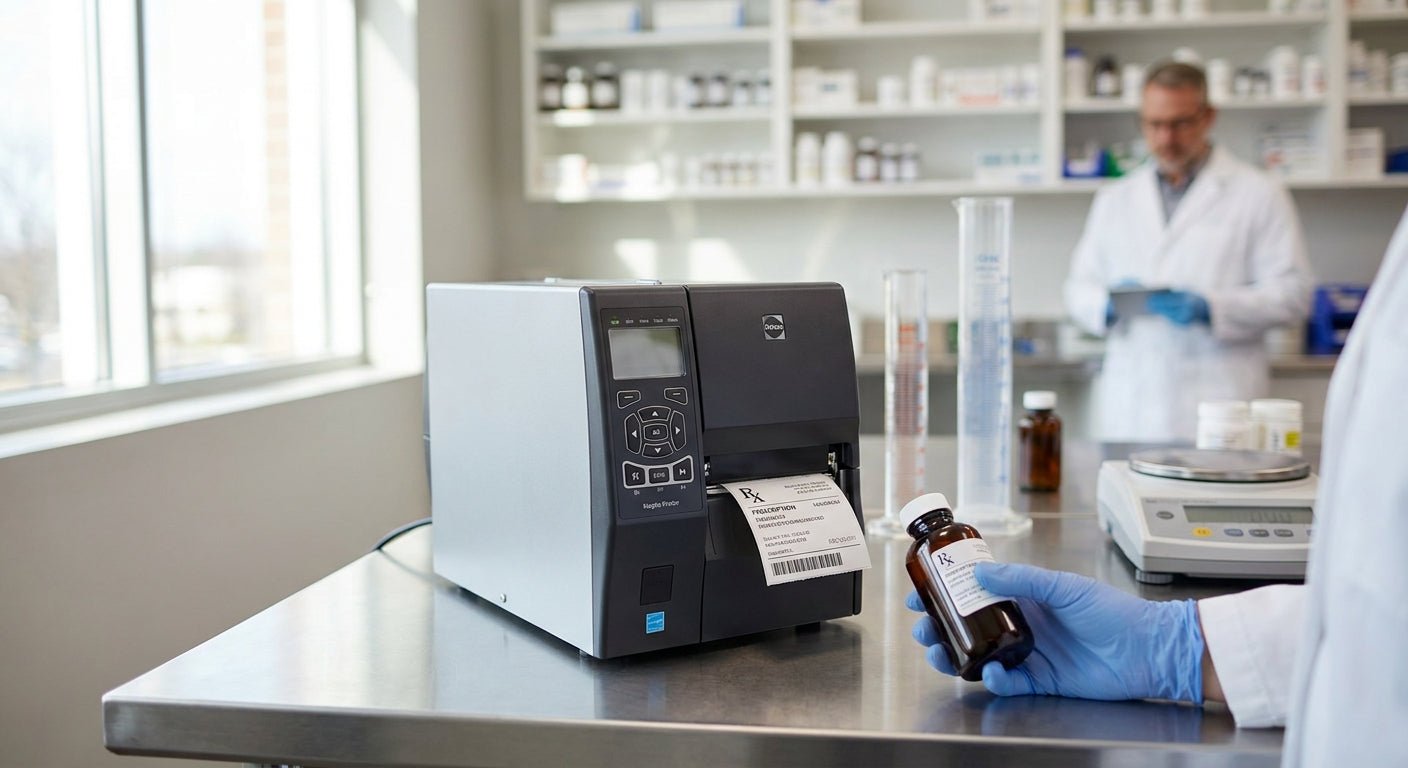
Compounding pharmacies print prescription labels, auxiliary warnings, and beyond-use-date stickers on vials, syringes, and unit-dose packs that are smaller and more chemically exposed than a standard retail label — the printer you pick has to keep barcodes scannable at 6-point text and survive alcohol wipes without smearing.
- GoDEX DT230 (300 DPI direct thermal) is the safe buy for standard prescription and vial labels in 2026.
- GoDEX G500 thermal transfer wins when labels need to survive refrigeration, chemo handling, or repeated wipe-downs.
- 203 DPI printers are a Skip for compounding work — barcodes under 0.75 inches blur at that resolution.
- A thermal label printer for compounding pharmacy use should hit at least 300 DPI and support GS1 barcode formatting.
Why this matters
A compounding pharmacy label carries more information per square inch than almost any other retail label: drug name, strength, lot number, beyond-use date, patient instructions, and often a barcode tied to a verification system. Squeeze that onto a 1-inch by 2-inch vial label and resolution stops being a spec sheet detail — it decides whether the pharmacist can read the auxiliary warning without a magnifier.
Most general-purpose label printers are built for shipping labels or retail tags at 203 DPI, which is fine for a 4x6 box label and rough for a 1-inch vial barcode. Pharmacies compounding sterile or hazardous preparations also need labels that hold up to isopropyl wipe-downs and cold storage — a direct thermal label printed on the wrong stock will fade inside a week in a refrigerator.
Who this is for
This guide is for compounding pharmacy operators, pharmacy techs setting up a new label station, and facility managers replacing an aging printer that can no longer keep barcodes scannable at small label sizes. If you're labeling standard retail prescription bottles at a high-volume chain pharmacy, your needs and budget look different — this guide focuses specifically on compounding: small-batch, small-label, high-precision printing.
What to look for in a thermal label printer for compounding pharmacies
Print resolution — 300 DPI minimum
A compounding pharmacy label often shrinks a full GS1 barcode and drug name onto a 1-inch label. At 203 DPI, small text and dense barcodes blur enough to fail a scanner on the first pass. 300 DPI is the practical floor for 2026 — 600 DPI only pays off if you're printing sub-0.5-inch labels for oral syringes or unit-dose blister packs.
Direct thermal vs. thermal transfer
Direct thermal printers need no ribbon and cost less to run, but the image fades with heat, sunlight, or repeated alcohol wipes — a real risk in a compounding environment. Thermal transfer, run with a GoDEX G500 thermal transfer printer, bonds ink into the label facestock and holds up through refrigeration and cleaning cycles that direct thermal can't survive.
Label stock compatibility
Vial labels, syringe labels, and IV bag labels all need different facestock — polyester holds up better than paper when a label gets wiped with alcohol or stored cold. Confirm the printer accepts polyester thermal transfer labels in the narrow widths compounding work actually uses, not just the 4x6 shipping sizes most printers are built around.
GS1 barcode and verification system support
Many compounding workflows tie into barcode verification at the point of dispensing. The printer's driver and firmware need to render GS1-128 or Data Matrix codes cleanly at small sizes — a printer that only handles Code 39 at low density will force a workaround later.
Print speed for batch runs
Compounding pharmacies print in bursts — a batch of 20 to 50 labels for a preparation run, not a continuous shipping line. Speed matters less than consistency: a printer that needs recalibration every few dozen labels costs more in tech time than a slightly slower unit that holds registration.
Footprint and workstation fit
Label stations in a compounding cleanroom or pharmacy bench are tight. A compact desktop unit that doesn't need a separate rewinder for short runs fits better than an industrial floor unit built for warehouse throughput.
Top picks for 2026
The safe pick — GoDEX DT230 Direct Thermal Printer, 300 DPI This is the standard workhorse for prescription and vial labels: 300 DPI resolution, no ribbon to manage, and a price point that fits a single-station pharmacy setup. It handles the small barcodes and drug-name text compounding labels need without the ribbon cost of thermal transfer. If labels don't face refrigeration or heavy chemical wipe-downs, this is the GoDEX DT230 direct thermal printer to buy. Verdict: Buy.
The archival pick — GoDEX G500 Thermal Transfer Printer When labels need to survive cold storage, chemo handling, or repeated alcohol wipes, thermal transfer with a resin or wax/resin ribbon holds the print where direct thermal fades. The tradeoff is ribbon cost and a slightly higher setup step. For hazardous or sterile compounding lines running labels through refrigeration cycles, this earns its keep. Verdict: Consider.
The high-volume pick — GoDEX RT700i+ Thermal Printer, 4-Color Display Built for pharmacies running multiple compounding stations or higher batch counts, this unit's onboard display lets techs switch label templates without a connected PC for every job. It's more printer than a single-station pharmacy needs, but for a facility running several preparation lines in 2026, the GoDEX RT700i+ color display printer earns the extra cost. Verdict: Consider.
The one to skip — 203 DPI general-purpose printers A 203 DPI unit prints a clean 4x6 shipping label and a muddy 1-inch vial barcode. If the printer's spec sheet stops at 203 DPI, it wasn't built for compounding label sizes, no matter how cheap it looks on the shelf. Verdict: Skip.


What to avoid
- Consumer photo label printers marketed for home crafting — they look cheap and print in color, but they don't support the barcode densities or label widths compounding pharmacies need.
- 203 DPI "all-purpose" printers sold for shipping labels — fine for a 4x6 box label, a poor match for a 1-inch vial barcode.
- Paper-only direct thermal stock for anything going into a refrigerator or freezer — the print fades inside days without a resin-compatible facestock.
Verdict comparison
| Printer | Resolution | Print method | Best for | Verdict |
|---|---|---|---|---|
| GoDEX DT230 | 300 DPI | Direct thermal | Standard vial and prescription labels | Buy |
| GoDEX G500 | 300 DPI | Thermal transfer | Refrigerated or chemically exposed labels | Consider |
| GoDEX RT700i+ | 300 DPI | Thermal transfer | Multi-station, high-volume compounding | Consider |
| Generic 203 DPI unit | 203 DPI | Direct thermal | Large-format shipping labels only | Skip |
FAQ
What's the best thermal label printer for a compounding pharmacy in 2026?
The GoDEX DT230 at 300 DPI direct thermal is the standard pick for 2026 compounding pharmacy labeling. It handles small vial barcodes and prescription text without ribbon costs, and steps up to thermal transfer only when labels face refrigeration or chemical wipe-downs.
Is direct thermal or thermal transfer better for prescription labels?
Direct thermal works for standard prescription labels stored at room temperature and handled briefly. Thermal transfer is the better choice when labels go into refrigeration, freezer storage, or get wiped with alcohol repeatedly, since the image is bonded rather than heat-etched.
How much does a pharmacy-grade thermal label printer cost in 2026?
Pharmacy-grade 300 DPI thermal printers run from roughly $370 for compact direct thermal units up to $2,400 for industrial 300 DPI thermal transfer printers with touchscreen controls. Price scales with resolution, connectivity options, and daily print volume.
What DPI do I need for small vial and unit-dose labels?
300 DPI is the minimum for compounding pharmacy labels in 2026. 600 DPI only becomes worthwhile for sub-0.5-inch labels on oral syringes or unit-dose blister packs where barcode density is extreme.
Can a thermal label printer print GS1 barcodes for verification workflows?
Yes, a 300 DPI thermal printer with GS1-128 or Data Matrix support handles verification barcodes cleanly. Confirm the printer's driver supports the specific barcode symbology your dispensing system scans before buying.
Do compounding pharmacies need thermal transfer ribbon or can they use direct thermal only?
Direct thermal only works for labels that won't face refrigeration, freezing, or repeated wipe-downs. Sterile and hazardous compounding lines generally need thermal transfer ribbon to keep labels legible through cold storage and cleaning.
What label size works best for oral syringes and small vials?
Oral syringe labels typically run under 1 inch wide, and small vial labels run 1 to 2 inches. A 300 DPI printer keeps barcodes and drug names legible at both sizes; going smaller than that pushes toward needing 600 DPI.
One last thing
The detail that trips up most new compounding label setups isn't the printer — it's the ribbon-to-label pairing. A wax ribbon on polyester stock smears under an alcohol wipe test, while a resin ribbon on the same stock survives it; matching ribbon chemistry to facestock matters as much as the DPI spec in 2026.