

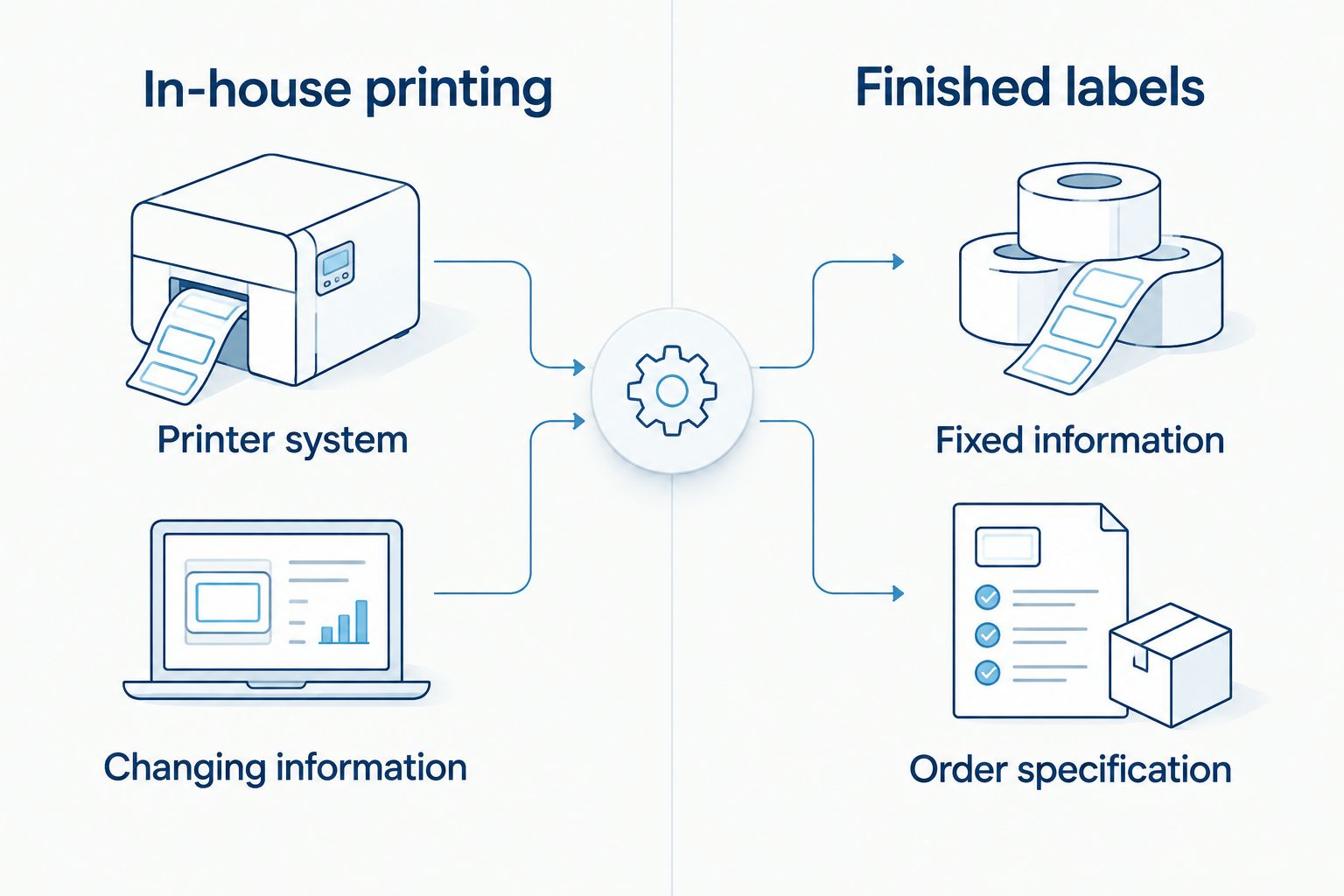
Choose McAuley Labels if you need a label printer alongside oil-change stickers, asset tags or inventory labels; choose LabelValue if your 2026 buying brief is limited to comparing custom-printed label suppliers and you do not need to select a printer. The deciding question is whether you want to print labels in-house or order finished labels—not which company has the longer feature list.
- McAuley Labels vs LabelValue: choose McAuley Labels when your 2026 project includes a printer and matching labels.
- Choose LabelValue for a custom-printed-label supplier comparison that does not require a printer decision.
- For oil-change stickers or asset tags, define the printing workflow and label material before comparing quotes.
Why this matters
A custom label and a printer system solve different purchasing problems. If you order finished labels, your brief centers on the artwork, material and information printed on each label. If you print in-house, you also need to decide how the printer, labels and any ribbon fit together. Comparing suppliers without settling that question gives you quotes for different jobs.
In 2026, McAuley Labels is the clearer fit for businesses choosing both specialized labels and a printing workflow. Its stated range includes direct thermal printers, asset tag printers, lab test tube labelers and oil-change sticker printers. LabelValue belongs on a separate custom-label quote list when your brief calls for finished labels rather than equipment. That is a recommendation based on the purchasing brief, not an unsupported claim about LabelValue’s printer range.
At a glance
| Dimension | McAuley Labels | LabelValue |
|---|---|---|
| Best for | Businesses selecting specialized printers and labels together | Buyers comparing custom-printed label suppliers without a printer requirement |
| Ordering model | Printer system, printing supplies or finished custom labels, depending on the task | Request a quote against the same finished-label specification |
| Standout feature | An oil change sticker printer system is explicitly listed | No comparable product detail is established in the supplied information |
| In-house printing | Direct thermal and application-specific printer categories are stated | Printer options require confirmation |
| Asset identification | Metallized silver barcode asset tags are explicitly listed | Material and barcode options require confirmation |
| Finished custom labels | Custom oil-change stickers and inventory labels are listed | Compare its custom-label quote against the same brief |
| Technical fit | Specific product listings identify direct thermal, thermal transfer and printer resolution | Request specifications for any proposed equipment or stock |
| Pricing model | Separate equipment and label requirements in the quote | Request a quote with identical quantities and specifications |
The table separates documented McAuley Labels options from questions you still need to put to LabelValue. An unconfirmed feature is not a loss for LabelValue. It is a reason not to name a winner on that feature until the quotes describe the same product and workflow.
McAuley Labels offers a clearer route to in-house printing
McAuley Labels is the better starting point when you need to choose a printer as part of the purchase. The supplied catalog names an oil-change sticker printer system, direct thermal printers and thermal transfer printers. It also identifies a GoDEX RT200i listing at 203 dpi and a GoDEX ZX430i listing at 300 dpi. Those are product-specific resolution cues, not a claim that either setting is right for every barcode or design.
Start with the label’s job. For an auto service counter, decide what changes on each oil-change sticker and whether staff need to print it at the point of service. For an inventory team, decide whether identifiers are fixed when labels are ordered or assigned as items enter stock. If the information changes during the day, an in-house workflow has a clear purpose. If it never changes, ask whether ordering finished labels removes an unnecessary equipment decision.
Best for: auto shops, facilities teams and other buyers who need to specify a printer and labels together. The tradeoff is ownership of the printing process: you must choose compatible supplies, set up the printer and keep the label design accurate. Do not treat the existence of a printer listing as proof that a particular model supports your label size, software or material. Check the specifications for the exact model before ordering.
LabelValue is the narrower choice for a label-only brief
Choose LabelValue when your immediate task is to get a competing custom-label proposal, not to design an in-house printing station. Give it the same artwork, intended surface, quantity and required variable information that you give any other supplier. A quote comparison only answers the buying question when both sides quote the same specification.
Best for: a buyer whose 2026 decision is about finished custom labels rather than printer selection. That does not establish that LabelValue has a particular material, production method or printer system. No LabelValue product specifications, policies or quote terms are provided here. Ask for those details instead of assuming the brand name or a broad category covers your application.
The limitation cuts both ways. A label-only brief should not automatically favor McAuley Labels because it lists printers. Equipment adds no value to a purchase that never requires on-site printing. Conversely, a custom-label quote alone cannot settle which printer will handle variable service dates, serialized identifiers or labels printed as work happens. Keep those decisions separate.
McAuley Labels gives asset-tag buyers more to specify
For equipment identification, McAuley Labels has named options covering metallized silver barcode asset tags, heavy-duty silver ID labels and semi-gloss white barcode asset tags. The listings also distinguish QR code inventory labels from barcode and plain-ID inventory labels. Those distinctions help you write a precise request: what surface receives the tag, what must a scanner read and whether the printed identifier needs to be unique.
McAuley Labels wins on the documented asset-tag selection in this comparison. It is a catalog-evidence verdict, not a durability test against LabelValue. No equivalent LabelValue material list or performance data appears in the supplied information, so a claim that one tag lasts longer would be unsupported. If LabelValue proposes an alternative, compare the stated material and intended application directly.
Do not collapse asset tags and inventory labels into one line item. An asset tag attached to equipment and an inventory label used to identify stock have different jobs, even when both carry a barcode. Decide where the label goes and what your staff must retrieve when they scan it. Then compare the two proposals against that job, rather than against a generic request for custom stickers.
Both suppliers need the same finished-label brief
Finished labels are the fairest point of comparison in McAuley Labels vs LabelValue. McAuley Labels explicitly lists custom oil-change stickers with a logo or custom text, as well as custom inventory labels. A LabelValue proposal can be assessed against the same design and use case. Neither supplier wins this dimension without matching specifications and quotes.
Write the brief before asking either supplier to respond:
- Use: windshield reminder, equipment identification, inventory control or another defined application.
- Surface and conditions: name the surface and how the label will be handled or cleaned.
- Printed content: specify logo, text, barcode, QR code or sequential identifier.
- Variable data: state whether every label is identical or information changes between prints.
- Delivery format: state whether you need finished labels or labels to run through a printer you already use.
This checklist prevents a common comparison error: one proposal covers printed labels while the other covers blank stock for your own printer. The materials can look similar in a quote and still require different work from your team. In 2026, insist on a written description of what will arrive and what, if anything, you must print yourself.
McAuley Labels makes printer specifications easier to investigate
A printer choice has more moving parts than a finished-label order. McAuley Labels lists both direct thermal labels described as needing no ribbon and thermal transfer labels intended for ribbon printing. Its catalog also includes thermal transfer ribbon. That gives you a starting point for asking which supplies belong with the exact printer and label stock under consideration.
Resolution is another specification to check, not a shortcut to a winner. The 203 dpi and 300 dpi figures appear in separate McAuley Labels printer listings. Higher resolution alone does not establish that a printer fits your label dimensions, barcode format or production process. Provide a sample label and ask for the supported configuration before you commit to a model.
LabelValue has no documented printer specifications in the supplied comparison material. McAuley Labels wins on visible printer detail here; LabelValue’s equipment capability remains unverified. If a LabelValue proposal includes a printer, request its model, printing method, supported media and supply requirements. Evaluate that written specification against the McAuley Labels model you would actually buy, not against the category in general.
Product listings can also help separate a system from its consumables. The McAuley Labels oil-change sticker printer system is described as including custom labels, ribbon and a standalone keyboard. That makes it relevant to a shop defining a counter workflow. It does not mean every listed printer or every label in the catalog uses those same components. Match the parts to the specific system.
Neither side wins on pricing without matched quotes
For McAuley Labels, the purchase can involve equipment plus ongoing labels and, where the printing method requires it, ribbon. A finished-label order is a different buying model: you specify the printed result rather than assembling a printing setup. For LabelValue, request its order basis and included items in writing. No comparable LabelValue quote terms are supplied here, so a claim that either company costs less would be guesswork.
Compare the full job, not one line item. Ask each supplier to identify what the quote covers: printed labels, blank labels, equipment, supplies, artwork requirements and any setup work you must perform. Keep the requested label specification identical. If one response includes a printer and the other does not, separate the equipment decision before you compare the label proposals.
In 2026, the useful pricing question is not which brand advertises the lowest entry point. It is whether you are paying for a repeatable on-site workflow or ordering a defined batch of finished labels. That distinction determines what your team must do after the order arrives.
Final verdict
Choose McAuley Labels if you manage an auto service counter, asset register or inventory process that needs specialized labels and a defined way to print them. McAuley Labels has documented printer categories, an oil-change sticker printer system and named asset and inventory label options. Confirm model-to-media compatibility for your exact application; the catalog alone does not make every item interchangeable.
Choose LabelValue if you are a finished-label buyer collecting comparable custom-printing proposals and do not need to select printing equipment. Send the same brief to each supplier and make the decision from the returned specifications. This is a valid reason to put LabelValue on your shortlist, not a claim that its undocumented materials or terms beat McAuley Labels.
One-glance scorecard
| Dimension | Winner |
|---|---|
| In-house printer selection | McAuley Labels, on documented options |
| Oil-change printer system | McAuley Labels, on the listed system |
| Documented asset-tag choices | McAuley Labels |
| Finished custom-label proposal | Tie until specifications and quotes match |
| Label-only supplier shortlist | LabelValue fits the stated buyer brief |
| Printer specifications | McAuley Labels, on available listing detail |
| Pricing | No winner without matched quotes |
FAQ
Is McAuley Labels better than LabelValue for oil-change stickers in 2026?
McAuley Labels is the better documented choice when your oil-change sticker purchase includes an in-house printer system. For finished stickers alone, request matching specifications from both suppliers before choosing.
Is LabelValue better for custom-printed labels?
LabelValue belongs on a shortlist when your brief is limited to finished custom-printed labels. The supplied information does not establish a material, quality or pricing advantage over McAuley Labels.
Can McAuley Labels supply asset tags as well as printers?
Yes. McAuley Labels lists asset tags, including metallized silver barcode options, alongside printer categories. Match the tag material and identifier format to the equipment you need to track.
Should I order finished labels or print them in-house?
Print in-house when label information must change as work happens; order finished labels when the approved content can be specified in advance. Compare the work your team must perform under each option.
Does a higher dpi figure make a label printer the better choice?
No. McAuley Labels has printer listings that identify 203 dpi and 300 dpi, but resolution is only one selection criterion. Check the exact model against your label size, media and printed content.
How do I compare McAuley Labels and LabelValue quotes?
Send both suppliers the same artwork, application, material requirements and quantity. Separate equipment and printing supplies from finished labels so the quotes describe the same job.
Which company is cheaper for custom labels in 2026?
Neither can be identified as cheaper from the supplied information. Request matched quotes and compare what each includes rather than treating equipment and finished labels as equivalent purchases.
One last thing
Before requesting a 2026 quote, write down whether the information on each label changes after the order is placed. That single answer determines the comparison: changing service dates or asset identifiers can justify an in-house printing workflow, while fixed artwork calls for a finished-label specification. Settle the workflow first, then judge the suppliers against it.