
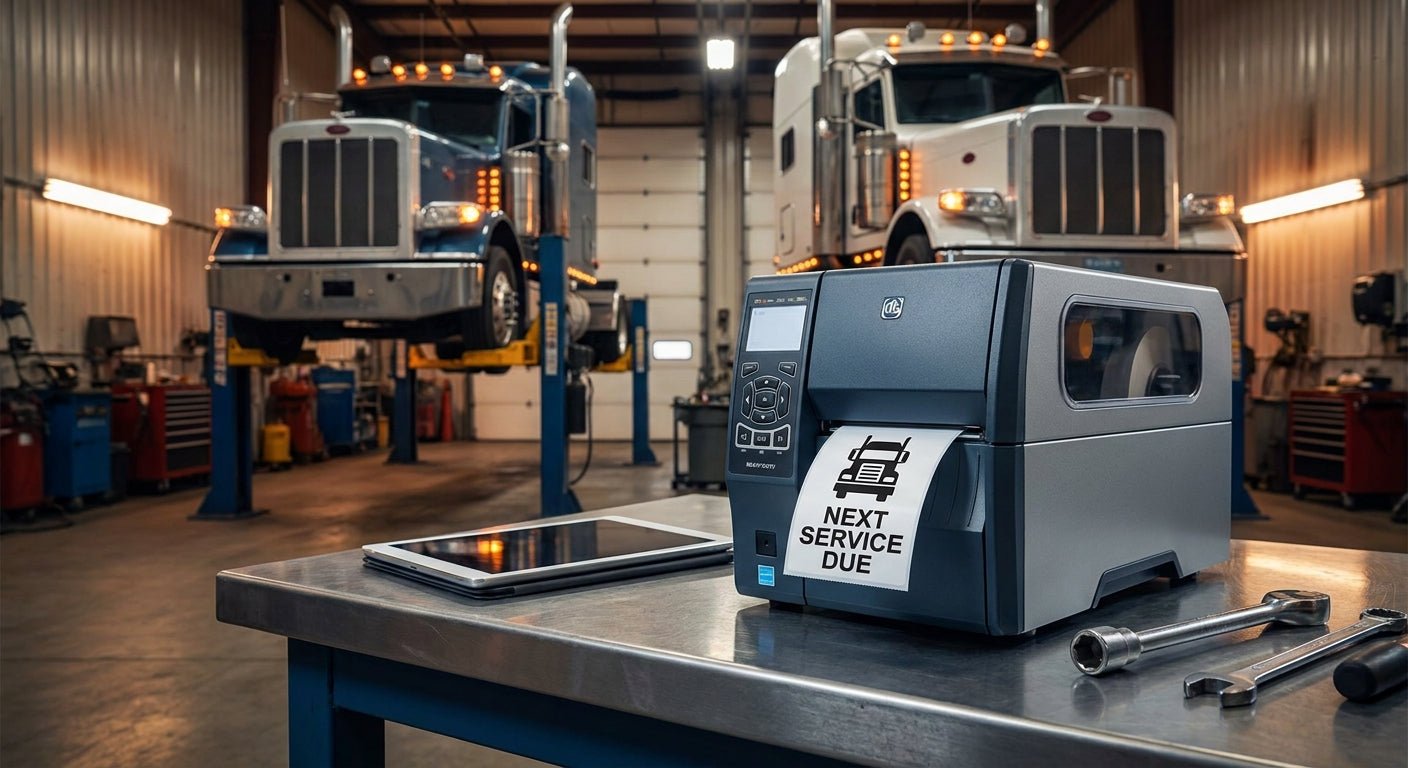
A truck stop service bay runs oil changes back to back, all day, across two, four, sometimes eight lanes at once — the label printer sitting on that counter needs to survive that pace without becoming the bottleneck.
TL;DR
For truck stop service bays running multiple lanes, the GoDEX RT230i 300 DPI printer is the safe buy for 2026: standalone operation, no PC tether at every bay, and resolution sharp enough for barcodes and small mileage text on a curved windshield sticker. Pair it with the oil change sticker printer system if you're outfitting a bay from zero, and stock custom logo oil change stickers for repeat fleet customers who want their shop name on every windshield. Skip consumer desktop printers rated for occasional home use — truck stops print hundreds of stickers a week, not a few a month.
Why this matters
A truck stop bay doesn't do 15 oil changes a week like an independent shop down the street — it can do that many in a single shift when a fleet rolls through. The printer sitting at that counter either keeps up or becomes the reason a driver waits an extra 10 minutes. Sticker durability matters more here too: a Class 8 windshield sees more heat, more UV, and more vibration than a passenger car's, and a sticker that peels or fades in 60 days isn't doing its job as a service reminder.
The printer and the sticker stock are one decision, not two. Buy them as a mismatched pair and you'll fight smearing, jamming, or stickers that won't hold an oil-change-in-4,000-miles reminder past the first fill-up.
Who this is for
This guide is for truck stop operators and travel center service managers running two or more bays, printing oil change reminders for both company vehicles and independent owner-operators, who need a printer that survives high daily volume without a dedicated IT setup per lane. If you're running a single-bay independent garage doing a dozen oil changes a week, the sizing below is overkill — look at a lighter desktop setup instead.
What to look for in an oil change sticker printer for truck stops
Standalone operation, not PC-tethered
Every extra PC per bay is another point of failure and another login screen between a tech and the next customer. A standalone unit with its own keypad lets a tech key in mileage and print without touching a keyboard mounted three feet away. In a truck stop running four or more bays, that difference adds up to real minutes across a shift.
Print speed that matches bay throughput
A single bay doing an oil change every 20-30 minutes doesn't stress a printer. A truck stop running four bays simultaneously, each turning a truck every 25-40 minutes, can generate a sticker every few minutes across the floor. The printer needs a duty cycle built for that, not a home-office spec sheet.
Sticker material rated for windshield heat and vibration
A static cling sticker or a low-grade adhesive holds up fine on a sedan parked in a garage overnight. On a truck cab windshield sitting in direct sun for hours at a highway stop, heat and UV exposure are constant. Adhesive-backed stock built for exterior exposure survives that; a bargain static cling often doesn't make it to the next service interval.
Resolution sharp enough for barcodes and fine text
A 203 DPI printer handles bold mileage numbers fine, but barcodes, QR codes, and small VIN-adjacent text get fuzzy at lower resolution. 300 DPI is the practical floor for a shop that wants scannable stickers, and it's the resolution most truck stop operators land on once they've run a 203 DPI unit for a season and hit legibility complaints.
Ribbon and consumable availability
A printer that runs out of ribbon on a Friday afternoon with no local restock option costs you a bay for the weekend. Confirm ribbon and sticker stock ship fast and in bulk quantities before committing to a printer line — high-volume locations burn through consumables faster than the spec sheet implies.
QR code support for fleet service history
Fleet accounts and owner-operators increasingly want a scannable record tied to the sticker, not just a printed mileage number. A printer and sticker combination that supports QR codes lets a driver or dispatcher scan the windshield sticker and pull up service history instead of calling the shop.
Top picks for truck stop service bays
The safe pick: GoDEX RT230i 300 DPI printer — standalone keypad operation, 300 DPI resolution, built for continuous desktop duty rather than occasional home printing. This is the unit most multi-bay shops settle on after outgrowing a 203 DPI model. Verdict: Buy. See the GoDEX RT230i 300 DPI printer.
The complete-kit pick: oil change sticker printer system — bundles the printer with sticker stock so a new bay can be running stickers the same week it opens, without sourcing printer and stock separately. Verdict: Buy for anyone standing up a new lane in 2026. Check the oil change sticker printer system.
The reorder staple: custom logo oil change stickers — adhesive stock printed with a shop's own branding, built for repeat runs rather than one-off jobs. Fleet accounts notice a branded sticker; it reads as a real service record instead of a handwritten note. Verdict: Buy for any location with repeat fleet traffic. View custom logo oil change stickers.
The budget-tier option: GoDEX RT200i 203 DPI printer — lower resolution, lower cost, fine for a single slow bay printing mileage-only reminders without barcodes. Once volume climbs past a couple bays or QR codes enter the picture, the resolution ceiling shows fast. Verdict: Consider only for the smallest single-lane setups, otherwise Skip in favor of the 300 DPI tier.
What to avoid
- Consumer desktop label printers marketed for home offices. They print a beautiful test sticker on day one and jam by week three under truck-stop volume.
- Static cling stickers for windshield use in high-heat locations. They look identical to adhesive stock on the shelf but release from the glass faster once a cab sits in direct sun for a full shift.
- Any printer requiring a dedicated PC login per bay. It looks like a minor step in the demo and turns into a daily friction point once techs are keying in mileage between trucks.
Verdict comparison
| Pick | Resolution | Standalone | Best for | Verdict |
|---|---|---|---|---|
| GoDEX RT230i | 300 DPI | Yes | Multi-bay, barcode/QR use | Buy |
| Oil change sticker printer system | 300 DPI (bundled) | Yes | New bay setup | Buy |
| Custom logo oil change stickers | N/A (sticker stock) | N/A | Repeat fleet branding | Buy |
| GoDEX RT200i | 203 DPI | Yes | Single slow lane | Consider |
FAQ
What's the best oil change sticker printer for truck stops in 2026? The GoDEX RT230i 300 DPI printer is the top pick for 2026 because it runs standalone at each bay and prints barcode-legible resolution without needing a dedicated PC per lane.
Is a standalone printer better than a PC-connected one for multi-bay shops? Yes, for locations running two or more bays. A standalone unit with its own keypad lets a tech key mileage and print without walking to a separate workstation, which matters when a bay is turning a truck every 25-40 minutes.
How much does an oil change sticker printer system cost? Pricing varies by configuration and volume; check current figures on the oil change sticker printer system page directly, since bundled printer-plus-sticker setups price differently than a printer alone.
Do oil change stickers need to be waterproof for truck windshields? Adhesive stock rated for exterior exposure holds up to sun, heat, and vibration far better than static cling, which is the bigger factor on a truck cab windshield than water resistance alone.
Can one printer serve multiple service bays? A single unit can serve one bay reliably during a shift; shops running four or more simultaneous bays typically run one standalone printer per lane rather than sharing a single unit across the floor.
What DPI do I need for oil change stickers with barcodes? 300 DPI is the practical floor for legible barcodes and QR codes; 203 DPI works for mileage-only text but gets fuzzy on scannable codes.
Static cling or adhesive — which holds up better on truck windshields? Adhesive-backed stock holds up better under sustained heat and UV exposure typical of a truck cab parked outdoors for hours, which is the standard condition at a truck stop.
How fast can these printers keep up with a busy shift? A 300 DPI standalone unit is built for continuous desktop duty rather than occasional printing, so it holds up across a full shift of back-to-back oil changes without the slowdown a home-office printer would show.
One last thing
Most truck stop operators buy the printer first and treat the sticker stock as an afterthought — then wonder why complaints roll in about peeling labels three weeks later. The sticker material is doing half the job; a 300 DPI printer paired with the wrong adhesive still fails on a hot windshield. Match the two from day one and the complaints stop.