
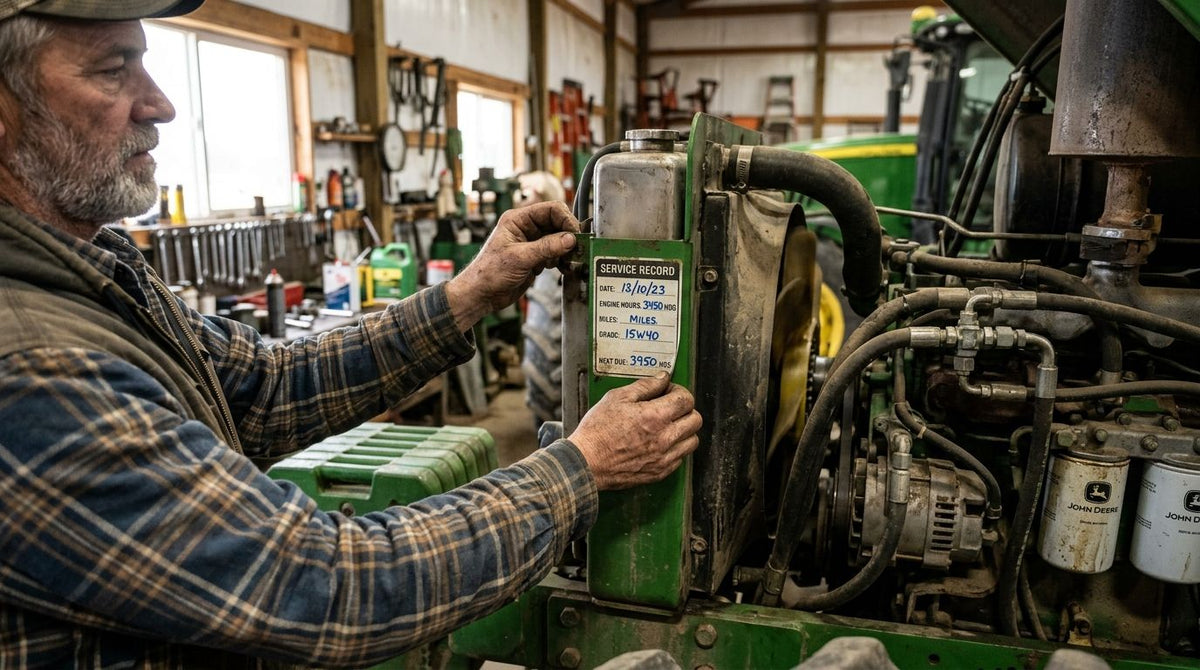
Farm and tractor equipment service depends on tracking hours, not mileage, so oil change stickers built for a cab windshield or dash need different fields than the ones you'd slap on a sedan. A tractor logs 8-10 hour days during planting and harvest, and a service interval missed by 300 hours can mean a scored cylinder wall, not a warning light.
- Oil change stickers for farm and tractor equipment need an hour-meter field, not just a date or mileage line.
- Static cling holds up better than adhesive on tinted or curved cab glass exposed to dust and grease.
- McAuley Labels' oil change sticker printer system prints in-house so shops aren't waiting on reorders mid-harvest.
- QR code stickers let a farm manager pull service history from a phone in the field, no office callback needed.
- Branding every sticker with a shop logo is the cheapest repeat-business tool a service department has in 2026.
Why oil change stickers matter for farm and tractor equipment service
Tractors, combines, and skid steers run on hour meters. Most diesel tractor manuals call for engine oil changes somewhere between 100 and 250 hours, and hydraulic fluid intervals often stretch to 500 hours or more depending on the model. A sticker template built for automotive mileage doesn't have a field for any of that, so techs either leave it blank or cross out the word miles by hand — both look sloppy on a customer's equipment and both create a service department that can't answer when the next one is due without pulling a paper file.
The equipment itself works against standard labels too. Cab windshields sit at steep angles, catch direct sun for hours, and get coated in field dust and hydraulic grease that adhesive labels don't shrug off as well as static cling. Oil change stickers for farm and tractor equipment service have to survive worse conditions than a passenger car windshield ever sees, and that changes which stock and format actually make sense.
Set your service interval trigger point in hours, not just calendar dates
A date-only sticker is close to useless on equipment that might run 40 hours one week and 2 hours the next during the off-season. Build the habit before you touch a printer:
- Record the hour meter reading at the time of service, not just the date
- Calculate the next-due hour figure based on that specific machine's interval, not a shop-wide default
- Note the calendar date as a backup for equipment that sits idle over winter
- Flag any machine running unusually high hours per week so the interval gets checked more often
- Cross-reference the hour reading against the owner's manual interval range for that model
Standardize the fields every technician fills in
Inconsistent stickers across a service bay make every one of them harder to trust. Lock the format down:
- Service date and hour-meter reading at time of service
- Next service due, expressed in hours, with the date as a secondary check
- Oil type and filter part number used
- Technician initials for accountability
- Shop name and phone number for the next call
The oil change sticker printer system prints these fields consistently every time, which matters once you've got three bays and five techs each filling stickers out by hand differently.
Pick stock built for cab dust, grease and UV, not a passenger car windshield
Static cling and adhesive behave differently once grease and field dust get involved. Static cling sits on the inside of clean, smooth glass and peels off without residue — good for equipment that changes hands or gets traded in. Adhesive bonds harder and survives grime better but leaves adhesive behind on removal. Neither is universally right for every cab, which is exactly what the comparison further down breaks out.
Print in-house instead of waiting on pre-printed batch orders
Seasonal shops that only order stickers twice a year run out mid-harvest when service volume triples. McAuley Labels' oil change sticker printer system prints one sticker or one thousand on demand, so a service writer isn't stuck telling a customer the shop is out of stickers this week. That's the faster path once the manual process above is dialed in — it doesn't replace deciding what goes on the sticker, it just removes the reorder lag.
- Print one sticker per completed service instead of batching a week's worth
- Keep blank stock and ribbon on hand instead of a pre-printed run tied to one shop's branding
- Switch oil type or interval language on the fly without waiting on a new print order
- Reprint a damaged or misprinted sticker in seconds instead of writing it off
Add QR codes for equipment you need to track long-term
A combine or a large tractor is worth tracking beyond a windshield sticker. A QR code on the label lets a farm manager scan with a phone and pull up service history instead of calling the shop or digging through a filing cabinet.
- Link the QR code to a service record, not just a phone number
- Use QR stickers on higher-value equipment where repeat service revenue matters most
- Keep the underlying record updated every time the machine comes in
- Pair QR stickers with a printed hour and date field as a backup when there's no signal in the field
Brand every sticker with your shop logo
A plain white sticker with handwritten numbers does nothing for repeat business. A branded sticker sits on the customer's equipment for months and reminds them who did the last service every time they climb into the cab. Custom logo oil change stickers put your shop name in front of the customer on every start-up until the next service is due.
- Include the shop logo and phone number, not just a generic template
- Keep the color scheme legible against both light and dark cab interiors
- Reprint with updated branding if the shop rebrands or changes locations
- Use the same branded format across every technician's stickers for consistency
Track equipment fleet-wide, not just sticker by sticker
A dealership or co-op servicing dozens of tractors, balers, and utility vehicles needs more than a windshield sticker to know what's been serviced and what's overdue. Farm equipment asset tracking with a durable asset tag on the frame or hitch gives a fleet manager a scannable record independent of the windshield sticker, which matters once equipment gets moved between fields, operators, or even locations.
Comparison: sticker options for farm and tractor equipment service
| Option | Best for | Key limitation |
|---|---|---|
| Static cling windshield stickers | Cabs with smooth glass and equipment that gets traded or sold | Doesn't adhere well to textured or heavily tinted interior glass |
| Adhesive windshield stickers | Permanent service records on owned equipment | Leaves residue on removal, harder to update |
| QR code stickers with logo | Higher-value machines needing digital service history | Requires a phone or scanner in the field |
| In-house printed stickers (printer system) | Shops running variable volume through the season | Requires upfront printer setup and ribbon stock |
| Pre-printed batch orders | Low-volume shops with predictable, steady service counts | Reorder lag during peak season |
Verdict: shops servicing more than a handful of tractors a week are better off printing in-house; shops doing occasional oil changes on a few machines can stick with pre-printed batches.
Common mistakes farm and tractor service shops make
- Using a mileage-only sticker on hour-metered equipment — the tech has to cross out fields by hand, and the customer can't read the next-due point at a glance.
- Applying the same adhesive stock to every cab regardless of glass type — tinted or curved cab windshields shed adhesive stickers faster than flat glass does.
- Skipping the shop logo to save on a template swap — a blank sticker is a missed reminder every time that machine starts up for the next six months.
- Not syncing the windshield sticker with a fleet tracking system — a co-op running 40 or more pieces of equipment can't manage service intervals off windshield stickers alone.
- Waiting until stock runs out to reorder — pre-printed batch orders that run dry mid-harvest cost a shop the sticker on every job until the next shipment arrives.


FAQ
What is the best oil change sticker for tractors and farm equipment?
A static cling or adhesive windshield sticker with an hour-meter field, not just a date, is the right format for tractors in 2026. Static cling works better on smooth cab glass, while adhesive holds up on rougher or curved surfaces.
Do oil change stickers work on equipment with hour meters instead of odometers?
Yes, as long as the sticker template includes an hour-reading field instead of only mileage. Most diesel tractor manuals set intervals in hours, commonly 100 to 250 hours for engine oil, so the sticker needs to match that unit.
Is a QR code oil change sticker better than a plain windshield sticker?
A QR code sticker adds a digital service history a farm manager can scan from a phone, which a plain sticker cannot provide. For low-value equipment serviced once or twice a year, a plain branded sticker is usually enough.
How much does an oil change sticker printer system cost?
Check the current pricing on the McAuley Labels site, since the printer system bundles the printer, ribbon, and preloaded labels together. Shops printing daily typically recover the setup cost faster than shops printing only a few stickers a week.
Can oil change stickers be branded with a shop logo?
Yes, custom logo oil change stickers print the shop name and logo directly on the windshield sticker. This keeps the shop's name visible on the customer's equipment until the next service is due.
Static cling or adhesive for farm equipment windshields?
Static cling suits smooth, untinted cab glass and equipment likely to be resold, since it removes without residue. Adhesive holds up better against dust and grease but leaves residue when peeled off.
How do you track service history across a whole farm equipment fleet?
Pair windshield oil change stickers with durable asset tags mounted on the frame or hitch of each machine for fleet-wide tracking. This gives a fleet manager a record independent of the windshield sticker, which matters once equipment moves between operators or locations.
One last thing
The detail most farm service shops miss in 2026 is not the sticker material — it is the interval unit. A sticker printed with a mileage field on an hour-metered machine forces every tech to cross it out by hand, and a crossed-out field is the first thing a customer notices when they climb back into the cab. Fix the field, not just the sticker stock.