
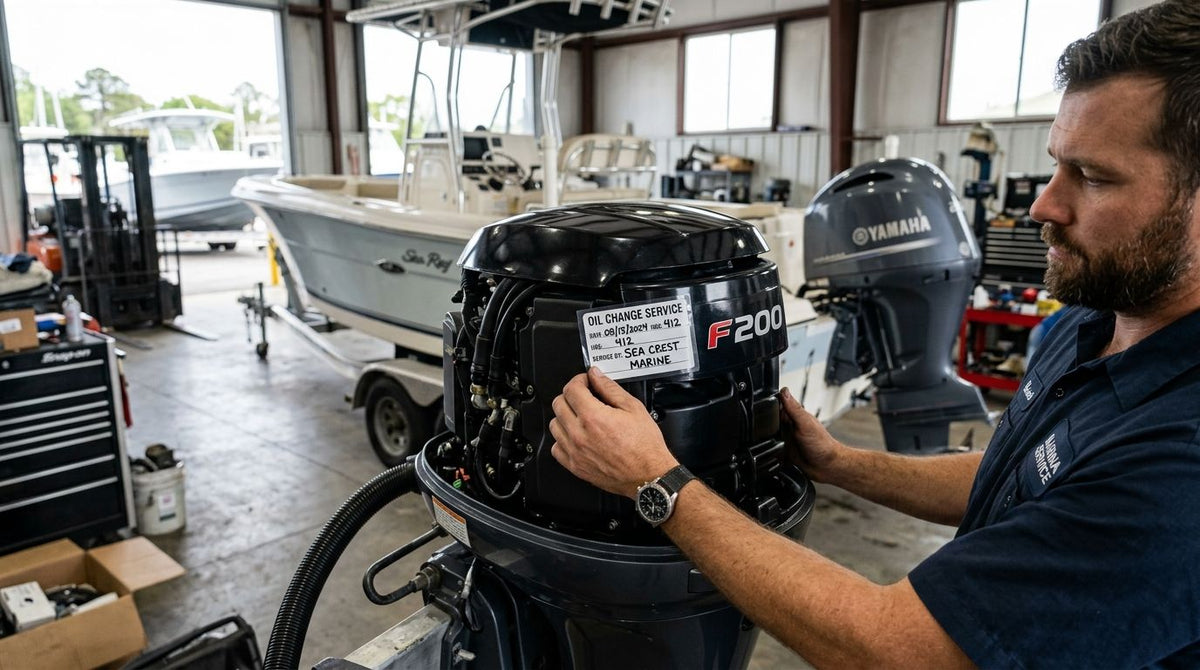
Marine and boat service center oil change stickers are windshield or console decals that log the date, engine hours, and oil type after every service, so the next tech or owner knows exactly when the boat is due back on the lift. Cars run on mileage; boats run on engine hours, and most outboard and inboard engines call for service at 100-hour intervals rather than a fixed date. A sticker built for a marine shop has to survive saltwater spray, UV exposure at the dock, and a curved windshield or console surface that a flat automotive label won't sit flat on.
- Oil change stickers for boat service centers track engine hours, not mileage, and need marine-grade adhesive to survive saltwater spray.
- Static cling works on flat glass; adhesive vinyl holds better on curved consoles and gelcoat surfaces common on boats.
- A shop that prints its own custom oil change stickers with a logo turns a routine service into a repeat-visit reminder.
- QR code stickers link a scan to full service history, which matters more on boats serviced seasonally by different techs.
- In-house thermal printing at 203 DPI costs pennies per sticker once the printer is paid for, versus reordering pre-printed pads.
Why oil change stickers matter for marine and boat service centers
A boat that gets serviced once a season, sometimes at a different marina each time, has no consistent maintenance trail unless the sticker on the windshield or console carries it. Automotive shops can lean on mileage and a national reminder network; marine techs can't, because most boats never see a dashboard odometer. The engine-hour meter is the only reliable interval marker, and it has to be written down at the point of service or it gets forgotten by spring.
Salt air and direct sun also break down cheap paper labels faster than anything a car windshield sees. A sticker that fades or peels by mid-season defeats the purpose entirely — the next mechanic has no record, and the shop loses the branding impression it paid for. Getting the material and the data fields right up front saves a callback.
Log engine hours, not mileage
Most outboard motors need oil and filter service every 100 hours, with inboard diesels often stretching to 200-250 hours depending on the manufacturer. A sticker template built for cars that only has a mileage field is the wrong tool here.
- Print a dedicated "Engine Hours" field instead of "Miles"
- Add a secondary date field for shops that also do a seasonal winterization service
- Include engine model or serial number space for multi-engine boats
- Leave room for the tech's initials so warranty questions have a paper trail
- Print in bold, high-contrast ink so hours are legible in direct sunlight
Choose a label material rated for marine exposure
Standard paper oil-change stickers made for quick lubes aren't built for a boat that sits at a slip in salt spray for months. Custom oil change stickers with a logo printed on synthetic vinyl stock hold up better against UV and moisture than plain paper.
- Adhesive vinyl for gelcoat, fiberglass, and painted console surfaces
- Static cling for flat interior glass where residue-free removal matters
- Fade-resistant thermal transfer ink instead of inkjet, which smears when wet
- A laminate or overcoat layer on stickers going on exterior-facing glass
- Rounded corners so edges don't catch and start peeling in wind
Print stickers in-house with a compact thermal printer
Ordering pre-printed pads from a supplier means waiting on reorders and getting stuck with whatever engine-hour ranges the pad already has printed. An oil change sticker printer system that prints on demand lets a marine shop put the exact hours, date, and shop logo on every sticker at the counter.
- 203 DPI thermal printers handle standard sticker text and barcodes fine
- 300 DPI models sharpen small logo detail and QR codes
- A standalone keyboard model lets front-desk staff print without a connected PC
- Wax/resin ribbon stock resists smudging from wet hands at the dock
- A printer with a 3-year warranty avoids downtime during peak boating season


Add a QR code for digital service history
A boat serviced by three different shops over its life has no shared record unless the sticker links to one. A QR code sticker that opens a service form or history page solves that gap without extra hardware.
- Link the QR code to a simple form the next tech fills in after service
- Use a URL shortener so the printed code stays small and scans reliably
- Test the scan on a phone camera in direct sunlight before printing a batch
- Keep a paper fallback field next to the code in case a customer has no signal at the dock
- Reprint annually if the linked form or page changes
Place the sticker where it survives the season
A sticker stuck to the wrong spot on a boat gets scraped off by a bimini top, a cushion, or a winter cover within weeks.
- Interior windshield corner, out of the wiper's sweep path
- Inside a helm compartment door on center-console boats with no windshield
- Engine hatch lid for inboard boats serviced from below deck
- Avoid spots that get direct hose spray during regular washdowns
- Skip areas that flex, like soft-top frames or canvas
Brand every sticker with the shop's logo
A plain white sticker with handwritten numbers gets thrown away mentally the moment the boat leaves the lift. A logo turns the same sticker into a repeat-visit prompt every time the owner opens the hatch.
- Print the shop name and phone number, not just a logo mark
- Keep contrast high — dark ink on light stock reads better in direct sun
- Reserve one line for a QR code if the shop tracks service digitally
- Test one proof sticker before running a full batch to check logo clarity at 203 DPI
Compare the sticker options for marine service work
| Option | Best for | Key limitation |
|---|---|---|
| Static cling sticker | Flat interior windshields, residue-free swaps | Doesn't hold on curved gelcoat or console surfaces |
| Adhesive vinyl sticker | Consoles, hatch lids, exterior-facing spots | Harder to remove without adhesive residue |
| QR code sticker | Shops tracking service history digitally | Needs a phone signal or offline fallback at some marinas |
| Pre-printed generic pad | Very low-volume shops with no printer | No engine-hour field, no logo, no customization |
A marine shop printing its own logo'd, engine-hour stickers in-house wins on both durability and repeat-visit branding — a pre-printed generic pad loses on both.
Common mistakes marine and boat service centers make
- Using a mileage field instead of engine hours — the sticker becomes useless the moment the boat leaves, since most owners never see an odometer.
- Choosing paper stock rated for cars — it fades or peels within one season of saltwater exposure and sun.
- Sticking labels where wash-down spray hits directly — the sticker lifts at the edges within weeks.
- Skipping the shop logo to save a step — the sticker gets treated as disposable instead of a reminder to come back.
- Not testing QR code scans in bright sunlight — a code that scans fine indoors can fail against glare on a dock.
If the sticker can't survive spray from a hose, it doesn't belong on a boat.
FAQ
What's the best oil change sticker for boat service centers?
A vinyl adhesive or static cling sticker with an engine-hours field, printed with the shop's logo, works best for marine use in 2026. Static cling suits flat glass; adhesive vinyl holds on curved consoles and hatch lids.
Do boat oil change stickers need to track hours or mileage?
Engine hours, not mileage. Most outboards call for service every 100 hours and boats rarely have an odometer, so a mileage field is the wrong template for marine work.
Are QR code oil change stickers worth it for marinas?
Yes, when a boat gets serviced by different shops over its life. A QR code links to a shared service history so the next tech isn't guessing at what was done last.
Can I print oil change stickers in-house for a boat service shop?
Yes. A compact thermal printer running at 203 or 300 DPI prints custom stickers on demand with the shop's logo, engine hours, and next-service date, avoiding reorders on pre-printed pads.
What material holds up best on a boat windshield or console?
Fade-resistant vinyl with thermal transfer ink handles UV and saltwater exposure better than standard paper stock made for car service counters.
Is static cling or adhesive better for marine oil change stickers?
Static cling suits flat interior glass and removes without residue. Adhesive vinyl is the better call for curved gelcoat consoles and exterior hatch lids where static cling won't hold.
How often should a marine shop reorder or reprint oil change stickers?
Shops printing in-house reprint only when the template changes, since blank stock and ribbon get used on demand rather than sitting as a pre-printed batch.
Where should the sticker go on a boat with no windshield?
Center-console boats without a windshield should place the sticker inside the helm storage compartment door, out of direct spray and sun.
One last thing
The detail that separates a marine shop's sticker from an automotive one isn't the logo — it's the field label. Swap "Miles" for "Engine Hours" on the template before the first print run, and every sticker after that actually does its job on a boat that will never see an odometer.