
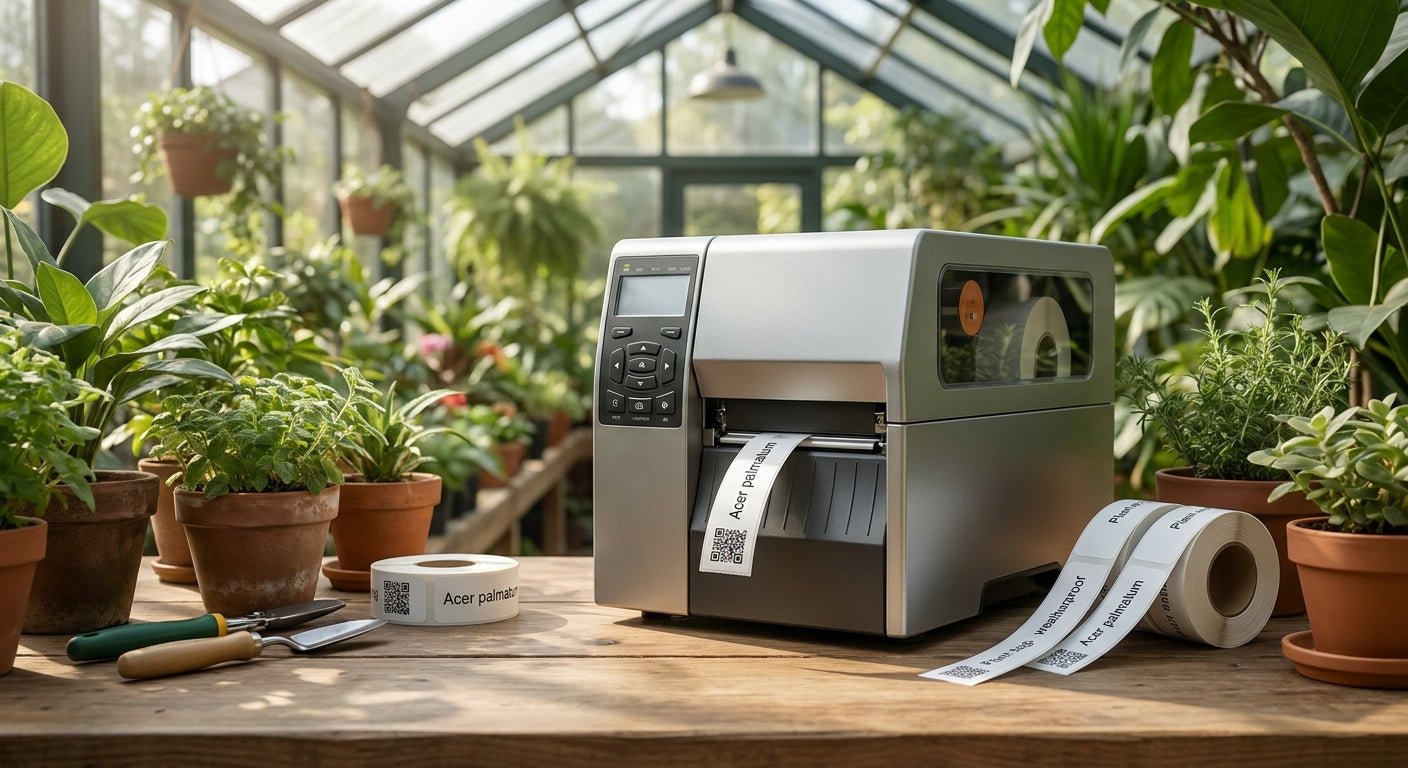
Botanical gardens and arboretums need plant tags that survive sprinkler cycles, freeze-thaw seasons, and full UV exposure while staying legible enough to print italicized Latin binomials — most desktop label makers can't do that, and picking the wrong plant tag printer for botanical gardens means reprinting labels every season.
- GoDEX ZX430i+ at 300 DPI is the best plant tag printer for botanical gardens printing Latin binomials in 2026 — buy it.
- Skip direct-thermal-only tags for outdoor stakes; UV fades legibility inside one growing season without thermal transfer ribbon.
- GoDEX GE330 at 203 DPI covers large-format seasonal bed signage at a lower price point.
- Polyester label stock with thermal transfer ribbon outlasts paper tags through irrigation cycles and winter freeze-thaw.
Why this matters
A living collection lives or dies on accurate identification. Lose a tag or let one fade and you've broken the link between a specimen and its accession record, its provenance, and its conservation status. Consumer label printers built for shipping labels or pantry jars max out around 203 DPI and lean on direct thermal stock that darkens in direct sun inside a single season.
A collections manager printing hundreds of accession tags a year for a botanical garden needs a machine built for small, dense text on materials rated for outdoor exposure — that's a different tool than whatever prints a shipping label at the front desk. The GoDEX ZX430i+ sits at 300 DPI, the resolution point where italicized genus-species pairs under 8pt stay readable at arm's length in 2026.
Who this is for
This guide is for collections managers, horticulturists, and garden operations staff at public botanical gardens, arboretums, and university plant collections who print accession tags, interpretive stakes, and seasonal bed labels in volume — not a home gardener labeling a dozen tomato starts.
What to look for in a plant tag printer for botanical gardens
Print resolution for botanical nomenclature
Plant tags carry italicized binomial names, cultivar names in single quotes, and sometimes author citations in tiny type. 203 DPI blurs serifs at 6-8pt; 300 DPI holds them clean. Any garden printing tags under 2 inches wide should treat 300 DPI as the floor, not a nice-to-have.
Thermal transfer, not direct thermal
Direct thermal labels darken from heat and UV exposure — the same mechanism that prints the label eventually erases it. Thermal transfer bonds a wax/resin ribbon to the label face, and that image holds through a full growing season instead of fading by August. A real plant tag printer for botanical gardens headed outdoors needs a ribbon path.
Polyester stock rated for outdoor exposure
Paper tags absorb moisture, curl, and tear at the mounting hole within a season. White polyester label stock resists tearing, sprinkler spray, and UV yellowing across multiple growing seasons on the same stake.
QR or barcode support for accession tracking
Gardens tying physical tags to a collections database — BG-BASE, IrisBG, or an internal spreadsheet — need a printer that renders small barcodes or QR codes cleanly at the same resolution as the text. A blurry code that won't scan defeats the point of digitizing accession records.
Batch printing speed for seasonal turnover
Annual beds and seasonal displays get relabeled every planting cycle, typically spring and fall for temperate gardens. A printer rated for 4-6 inches per second cuts a 200-tag batch from an afternoon down to under 20 minutes.
Standalone operation near the potting bench
Some crews print tags at a desk; others need a printer that runs off a keyboard or handheld interface near the greenhouse, away from a computer. Not every operation needs this, but a print station near the potting bench saves the walk back to an office during a spring relabeling push.


Top picks
GoDEX ZX430i+ — the standard pick
300 DPI, color display, thermal transfer ribbon compatible, priced at $945 in 2026. This is the printer most mid-size botanical gardens land on for accession tags and interpretive stakes because it holds small italicized text without smearing and runs both paper and polyester stock. Buy — it's the resolution-to-price balance point for a garden printing a few hundred to a few thousand tags a year.
GoDEX GE330 — the budget pick
Linked here: the GoDEX GE330 runs 203 DPI at a 4-inch print width with no color display. It's fine for larger interpretive signs and bed labels above 10pt type where 203 DPI doesn't blur, and it costs less up front than the ZX430i+. Skip it for accession tags under 2 inches carrying genus-species pairs — the resolution isn't there. Consider for large-format seasonal signage, skip for fine accession tags.
GoDEX RT700i+ — the volume pick
203 DPI, color display, priced at $581 in 2026. Gardens printing thousands of tags a year for a large arboretum benefit from the color display's menu navigation when swapping templates between accession tags, plant sale tags, and event signage. Consider for high-volume operations that don't need 300 DPI on most runs.
GoDEX RT200i — the skip
203 DPI at entry pricing looks tempting for a small garden, but the ribbon path is limited and direct-thermal-leaning models like this fade outdoor tags inside a growing season. Skip it for anything mounted outside.
“If a tag can't survive a sprinkler cycle and a winter freeze-thaw, it's not a plant tag printer for botanical gardens — it's a party favor.”
What to avoid
- Direct-thermal-only printers marketed for garden labels. No ribbon slot means the tag fades under full sun inside one season, and there's no fix once the stock is printed.
- Consumer label makers without a thermal transfer ribbon path. Wax/resin ribbon is what lets the printed image survive UV and moisture; a printer that can't take ribbon can't produce a durable outdoor tag no matter the DPI claimed on the box.
- Laminated paper stock sold as "weatherproof." It still tears at the mounting hole after a freeze-thaw cycle. Polyester survives that stress; laminate over paper does not. See the full waterproof plant label printer buying guide for the material breakdown.
Verdict comparison
| Printer | Resolution | Ribbon slot | Best for | Verdict |
|---|---|---|---|---|
| GoDEX ZX430i+ | 300 DPI | Yes | Accession tags, fine botanical text | Buy |
| GoDEX GE330 | 203 DPI | Yes | Large-format seasonal signage | Consider |
| GoDEX RT700i+ | 203 DPI | Yes | High-volume tag runs | Consider |
| GoDEX RT200i | 203 DPI | Limited | Indoor tags only | Skip (outdoor use) |
McAuley Labels stocks the GoDEX lineup behind every row in that table, along with the polyester and paper stock and ribbon that actually determine whether a tag survives outside past August 2026.
FAQ
What's the best plant tag printer for botanical gardens in 2026?
The GoDEX ZX430i+ at 300 DPI is the best plant tag printer for botanical gardens in 2026 for most collections, priced at $945. It holds small italicized botanical text and takes thermal transfer ribbon for outdoor durability.
Is 300 DPI necessary for plant tags?
Yes, if the tag carries italicized genus-species names under 8-10pt type. 203 DPI printers blur fine serifs at that size, while 300 DPI keeps binomial names legible at arm's length.
Is direct thermal or thermal transfer better for outdoor plant tags?
Thermal transfer wins for anything mounted outdoors. Direct thermal print darkens and fades under UV and heat within a single growing season, while thermal transfer ribbon bonds an image that holds through multiple seasons.
How much does a plant tag printer cost?
Thermal transfer printers suited to botanical gardens run from roughly $554 for a GoDEX G530 up to $945 for a GoDEX ZX430i+ in 2026, depending on resolution and display features.
Can I print QR codes on plant tags for accession tracking?
Yes, any thermal transfer printer at 203 DPI or higher renders QR codes cleanly enough to scan reliably, which lets a physical tag link straight to a database accession record.
What label material lasts longest outdoors on plant stakes?
White polyester stock printed with thermal transfer ribbon lasts longest outdoors. It resists tearing, UV yellowing, and sprinkler exposure across multiple growing seasons where paper stock curls and fades.
How fast can a thermal printer produce a batch of seasonal tags?
Printers rated at 4-6 inches per second, like the GoDEX GE330 or ZX430i+, print a 200-tag batch in under 20 minutes, which matters for spring and fall relabeling pushes.
Do I need a standalone printer for greenhouse use?
Only if the print station sits away from a desk computer. A standalone keyboard interface lets greenhouse staff print tags at the potting bench without walking back to an office.
One last thing
Most botanical gardens don't replace their printer over resolution complaints — they run out of ribbon mid-batch during a spring relabeling push and nobody stocked a spare roll. Order an extra thermal transfer ribbon before the season starts, not after the first blank tag comes out of the printer in 2026.