
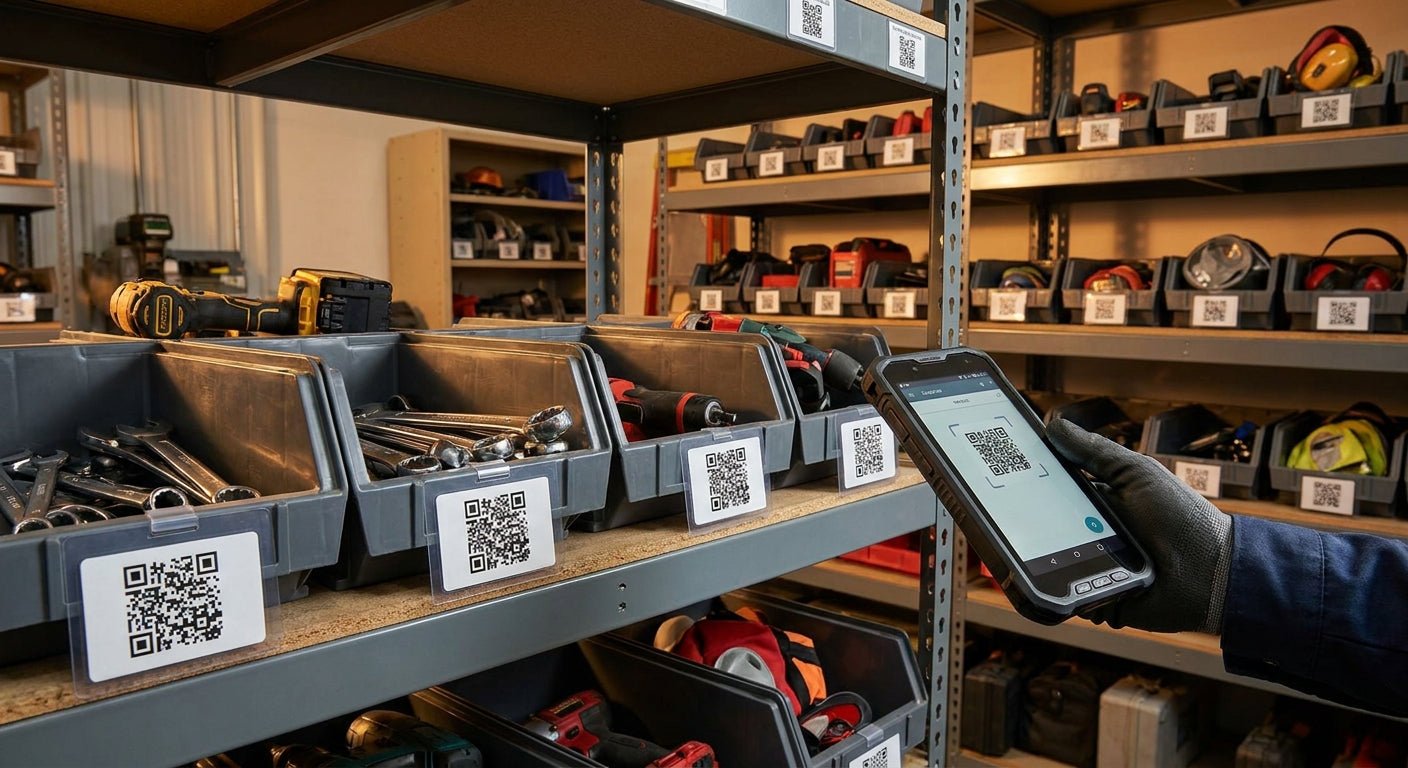
Tool cribs lose track of wrenches, torque guns, and calibration gear because paper tags fade, adhesive lifts under oil, and nobody scans a barcode that's been through six months of handling. QR code inventory labels for tool crib operations fix the scan-rate problem and the durability problem at the same time, if you buy the right label stock.
TL;DR
For a tool crib in 2026, the safe buy is a semi-gloss white QR code inventory label with sequential numbering for indoor check-out stations, and a heavy-duty metalized or 3M polyester QR tag for tools that leave the building or sit near coolant and grease. McAuley Labels' numbered QR code inventory labels cover the first case; the heavy-duty metalized stock covers the second. Skip generic laser-printed barcode sheets — they don't survive a shop floor past week three. Pair either label with a 203 or 300 DPI thermal printer so QR modules stay scannable at check-out speed.
Why this matters
A tool crib with no reliable ID system runs on trust and memory, and both run out. Lost tools get re-ordered instead of found, audits take a full shift instead of an hour, and nobody can prove who had the calibrated torque wrench last Tuesday. QR codes solve this cheaper than RFID and faster than barcode scanners that need line-of-sight and clean symbology — a smartphone camera reads a QR tag through smudged grease in under a second where a 1D barcode reader often can't.
The catch: the label has to survive the environment it's tagging. A tool crib in 2026 isn't a retail stockroom — tags get gripped, dropped, degreased with solvent, and cycled through hundreds of check-outs a year. Buy for that environment, not for the spec sheet.
Who this is for
This guide is for maintenance supervisors, tool crib attendants, and facilities managers running a check-out system for hand tools, power tools, or calibrated equipment — anywhere from a 40-tool crib in a machine shop to a 2,000-item inventory across a manufacturing plant. If you're tagging fixed equipment instead of hand-held tools, a different asset tag spec applies; check the heavy-duty silver barcode line built for stationary machinery instead.
What to look for in QR labels for a tool crib
Adhesive rated for handled, not fixed, surfaces
Tools get picked up, gripped, and set down on metal benches dozens of times a day, which is harder on adhesive than a machine that sits still. A tag rated for handled equipment needs an adhesive that resists edge-lifting from repeated flexing, not just initial bond strength.
Scan reliability under oil and grime
A QR code is only useful if it scans on the first try, every time, at the check-out window. Matte or semi-gloss finishes cut glare from overhead shop lighting, which matters more in a tool crib than the printed resolution number on the label spec sheet.
Sequential numbering built into the label run
Check-out systems run faster when the QR code and a human-readable sequence number are printed together — the attendant can verify visually while the scanner reads the code. Buying pre-numbered label rolls saves the labor of hand-numbering hundreds of tags one at a time.
Chemical and abrasion resistance
Solvent, cutting fluid, and hand oils degrade cheap paper labels within weeks. Polyester or metalized polyester face stock holds up to the wipe-downs and light chemical contact that paper labels can't survive past a month on a shop floor.
Print resolution matched to code density
A QR code crammed into a half-inch tag needs finer print resolution than a barcode on a two-inch label. 300 DPI printing keeps small QR modules crisp enough to scan reliably; 203 DPI works fine for larger tags but starts to blur tight QR grids under an inch.
Printer and ribbon compatibility
The label stock and the printer have to match — thermal transfer ribbon for polyester or metalized labels, direct thermal only for the paper-based runs. Buying labels without confirming ribbon compatibility is the single most common reason a tool crib's first label order gets wasted.
Top picks for tool crib QR labels
The default pick — semi-gloss white numbered QR labels. This is the label most tool cribs should start with: semi-gloss face stock, sequential numbering, and a QR code sized for a standard smartphone scan at arm's length. It's rated for indoor handling and holds up to daily check-out cycling without curling at the corners. Buy for any indoor crib doing under 500 check-outs a week.
The heavy-duty pick — heavy-duty silver barcode asset tags. Built on a tougher face stock than the standard silver line, this tag holds a barcode and QR pairing that survives repeated handling on metal tool bodies. The verdict here is Buy for cribs tagging power tools and equipment that gets gripped by the same surface every check-out — the extra durability margin pays for itself inside a year.
The rugged/outdoor pick — heavy-duty metalized QR code asset tags. Metalized polyester face stock resists solvent exposure and holds print integrity in temperature swings, which matters for tools that move between a heated shop and an unheated trailer. Buy if any portion of your tool inventory leaves the building — fleet tool kits, jobsite boxes, service trucks.
The printer pick — Godex GE330 asset tag printer. A 203 DPI thermal transfer printer built to run asset tag stock at volume, without the higher per-unit cost of a 600 DPI unit that a tool crib doesn't need. Buy if you're printing more than 200 tags a month in-house; Consider a lower-volume desktop unit if your crib reorders tags quarterly instead of monthly.
What to avoid
- Laser-printed paper barcode sheets. They look fine on day one and delaminate by week three once oil and repeated handling get to the adhesive.
- Glossy label stock under harsh shop lighting. Glare defeats the scan before the code quality does — matte or semi-gloss wins every time on a shop floor.
- Undersized QR codes at 203 DPI. A quarter-inch QR code printed at 203 DPI often loses enough resolution to fail a scan; either size the code up or move to 300 DPI printing.
Verdict comparison
| Criteria | Semi-gloss white numbered | Heavy-duty silver barcode | Heavy-duty metalized QR |
|---|---|---|---|
| Best for | Indoor daily check-out | Handled power tools | Tools that leave the building |
| Adhesive durability | Good | Very good | Best |
| Chemical resistance | Fair | Good | Best |
| Cost per tag | Lowest | Mid | Highest |
| Verdict | Buy for standard cribs | Buy for heavy handling | Buy for mobile/outdoor tools |
FAQ
What's the best QR code label for a tool crib? For most indoor tool cribs, a semi-gloss white numbered QR label is the best starting point in 2026 — it balances cost, scan reliability, and durability for daily check-out cycles. Tools that leave the building need a heavy-duty metalized upgrade instead.
Is QR code better than barcode for tool tracking? QR codes scan faster from odd angles and through light grease than 1D barcodes, which need a clean, straight line-of-sight read. Most tool cribs upgrading in 2026 pair a QR code with a printed sequence number for dual verification.
How much does a tool crib labeling system cost to set up? Costs scale with tool count and label stock choice — semi-gloss labels run cheaper per unit than heavy-duty metalized stock, and printer cost depends on volume. A custom quote is the fastest way to price out a specific crib size.
Do QR code labels work on oily or greasy tools? Yes, if the face stock is polyester or metalized polyester rather than plain paper — paper labels fail fast under oil contact, while polyester-based stock resists it.
Can I print my own QR code tool tags in-house? Yes, with a thermal transfer printer like the Godex GE330 and matched ribbon, in-house printing is standard for tool cribs running more than a couple hundred tags a month.
What DPI do I need for small QR codes on tool tags? 300 DPI is the safer choice for QR codes under an inch square; 203 DPI works fine for larger tags but risks blur on tight QR grids.
How long do QR code asset tags last on handled tools? Heavy-duty metalized and polyester tags typically outlast paper-based labels by a wide margin under daily handling — paper labels often fail within a month on a shop floor, while polyester-based stock holds up for years of cycling.
Do I need sequential numbering on tool crib tags? Sequential numbering speeds up manual verification at check-out and makes physical audits faster, since an attendant can cross-check a number against a log without scanning every item.
One last thing
The detail most tool cribs miss isn't the label — it's the ribbon. A polyester or metalized QR tag printed with the wrong ribbon type smears within days of handling, and the failure looks like a bad label when it's actually a mismatched thermal transfer ribbon. Confirm ribbon compatibility before the first print run, not after the first batch fails in the field.
For construction crews tagging tools that move between jobsites, the numbering scheme matters as much as the label stock — see how numbered asset tags for construction tools handle multi-site tracking in 2026.