
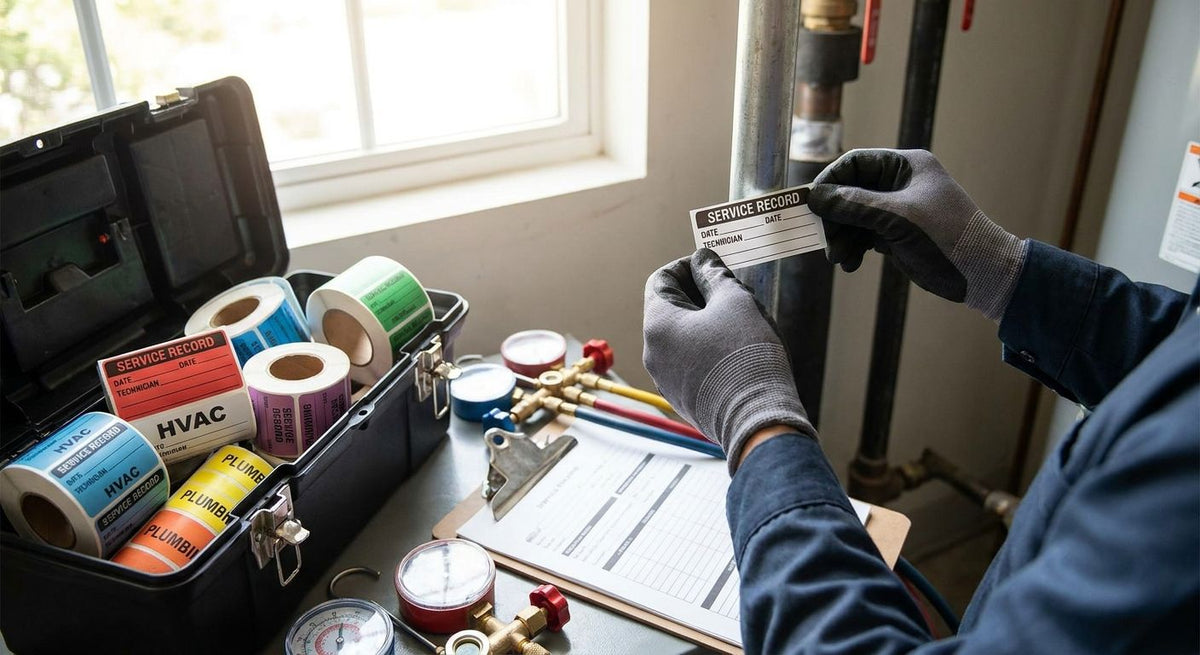
Labels for HVAC technicians identify equipment, document service history, and track tools across job sites, with the goal of cutting callback time and proving compliance on every unit you touch in 2026. Rooftop condensers, crawlspace shutoffs, and boiler rooms punish standard labels in ways an office never will — HVAC and plumbing crews need stock built for heat, UV, and standing moisture, not paper pulled off an office laser printer.
- 3M heavy-duty polyester tags survive rooftop UV and condensation where standard labels for HVAC technicians peel within a season.
- QR code asset tags let a tech scan a unit on-site and pull full service history instead of calling dispatch.
- In-house GoDEX thermal printers cut per-label cost for shops tagging units daily instead of ordering pre-printed batches.
- McAuley Labels' heavy-duty silver barcode tags are built for outdoor mechanical equipment, not indoor office use.
Why this matters
Technicians lose time three ways: retyping serial numbers into service software by hand, arguing with a customer over whether the last visit actually happened, and replacing labels that peeled off after one summer on a rooftop unit. A tagged fleet fixes all three on a single service call in 2026, without adding a step to the job.
Untagged rooftop condensers and buried access panels turn every recall into a manual serial-number hunt through old invoices. Asset tags for HVAC equipment fix that by putting a scannable ID directly on the unit, not on a clipboard back at the shop. That single change is why more HVAC and plumbing shops are moving off paper stickers this year.
Why labels matter for HVAC and plumbing technicians
HVAC and plumbing work happens outdoors, underground, and in mechanical rooms — three environments that punish adhesive and ink differently than a warehouse or retail stockroom does. A condenser label needs to survive direct sun and freeze-thaw cycles. A crawlspace shutoff tag needs to survive standing water. A boiler room tag needs to survive heat that would curl a standard paper sticker in a week.
Multiple technicians touch the same equipment across a service contract, often months apart. Without a consistent tag on the unit itself, whoever shows up second has to reconstruct the service history from memory or a call to the office. A tag that survives the environment and carries a scannable ID solves the handoff problem, not just the durability problem.
Standardize your numbering system before you tag anything
Decide how units get identified before a single label goes on equipment. This costs nothing and prevents duplicate IDs once you scale past one truck.
- Assign a prefix by trade (HVAC vs. plumbing) so techs can sort at a glance
- Number sequentially per customer site, not per truck, so records don't fragment
- Match the ID format to whatever field your dispatch or CRM software already tracks
- Reserve a block of numbers per crew to avoid two techs issuing the same tag
- Write the scheme down — a system only one person remembers isn't a system
Audit what condition each label actually has to survive
Walk a few recent jobs and note where labels failed, faded, or never got applied. This step is free and tells you exactly what material spec to buy next.
- Rooftop units: direct UV, temperature swings, condensation
- Crawlspaces and basements: standing moisture, low light for scanning
- Boiler and mechanical rooms: ambient heat, occasional chemical exposure
- Outdoor gas lines and meters: freeze-thaw cycles, salt air in coastal regions
- Customer-facing panels: needs to stay legible for warranty and insurance audits
Choose label material by attachment surface, not by habit
Once you know the environment, match the material instead of defaulting to whatever's already in the truck. Galvanized sheet metal, PVC, and painted enclosures all hold adhesive differently.
- Metalized silver polyester for standard indoor and semi-outdoor equipment
- Heavy-duty silver barcode asset tags for rooftop condensers and outdoor mechanical equipment
- Semi-gloss white stock for indoor panels where a clean, printable surface matters more than ruggedness
- 3M-backed heavy-duty adhesive where the tag has to outlast the equipment's service life
- Barcode over plain text if your dispatch software already scans codes
Add QR codes so a tech can pull service history on-site
A barcode confirms identity. A QR code goes further — link it to a service form or maintenance log and a tech scans the unit instead of digging through old invoices or calling the office mid-job.
- Link the code to a maintenance log, warranty record, or service form
- Print a fresh code at every major service if the unit gets swapped or upgraded
- Keep codes large enough to scan from arm's length on a rooftop or in a crawlspace
- Use a heavy-duty metalized or polyester stock so the code stays scannable outdoors
- Test the scan on-site before the crew leaves the job, not after the invoice goes out
Print labels in-house instead of ordering per job
Ordering pre-printed batches from a shop works for low volume, but it adds days of lead time and forces you to guess quantities in advance. A desktop thermal printer removes both problems for shops tagging units weekly.
- Print exact quantities the day you need them — no minimum order guesswork
- Reprint a damaged or lost tag in minutes instead of waiting on a reorder
- The GoDEX RT730i thermal printer handles barcode and QR labels at 300 DPI, sharp enough for small serial numbers
- Keep blank stock in the truck and print on-demand from a laptop at the job site
- Match ribbon type (wax, wax-resin, resin) to how much abrasion the label will see
Track tools and van inventory with the same barcode system
Labels aren't just for customer equipment. Tools and van stock walk off jobs constantly, and a barcode tag makes recovery and reorder tracking possible.
- Tag high-value tools (manifold gauges, recovery machines, cameras) individually
- Scan tools in and out of the van at the start and end of each shift
- Use the same numbering prefix scheme as equipment tags to avoid a second system
- Flag consumable stock (fittings, refrigerant cylinders) with reorder-point codes
Set a labeling SOP your crew will actually follow
The best material and printer setup fails if only the office manager knows the process. Put the steps in writing and make it part of the job checklist, not an afterthought.
- One page: what gets tagged, what material, where the code links
- Assign who prints and who applies — don't leave it ambiguous
- Review failed or missing tags monthly, not annually
- Restock blank labels before the truck runs out, not after
Compare your labeling options
| Option | Best for | Key limitation |
|---|---|---|
| Standard paper labels | One-off indoor jobs, short-term use | Fades and peels outdoors within weeks — Skip for field equipment |
| 3M heavy-duty polyester/metalized tags | Rooftop condensers, outdoor lines, boiler rooms | Costs more per tag than paper — Buy for anything outdoors |
| QR code asset tags | Multi-visit service history, warranty tracking | Needs a phone or scanner to read on-site — Buy for repeat-service accounts |
| In-house GoDEX thermal printer | Crews tagging units weekly or daily | Upfront hardware cost before per-label savings kick in — Buy past a few hundred labels a year |


Common mistakes HVAC and plumbing crews make
- Using laser-printed paper labels on rooftop units. UV and condensation strip the adhesive within one season, and the serial number goes with it.
- Skipping labels on buried or crawlspace access panels because "no one sees them anyway," then losing time relocating shutoffs during an emergency call.
- Matching material to the job, not the surface. Galvanized sheet metal, PVC pipe, and painted enclosures hold adhesive differently — one stock does not fit all three.
- Ordering one-off batches per job from a print shop instead of stocking blank labels in the truck, which adds days of lead time to a same-day fix.
- Running two numbering schemes across trucks or technicians, which creates duplicate IDs the moment a second crew starts tagging the same customer site.
FAQ
What's the best label for HVAC technicians?
3M heavy-duty polyester or metalized asset tags hold up best for HVAC technicians because they survive rooftop UV, condensation, and freeze-thaw cycles that destroy paper labels within months. QR code versions add the ability to pull service history from a scan.
Are paper labels okay for outdoor HVAC units?
No. Standard paper labels fade and peel within weeks of rooftop or outdoor exposure. Reserve paper stock for indoor panels and use 3M heavy-duty or metalized polyester tags for anything exposed to weather.
How do QR code asset tags work for service history?
A QR code asset tag links to a maintenance log, warranty record, or service form online, so a technician scans the unit on-site instead of calling the office or digging through old invoices. The code itself just points to a record you control.
Should plumbing technicians use the same tags as HVAC crews?
Yes, the same heavy-duty or metalized stock works for both trades — the deciding factor is the surface and environment, not the trade. Use a shared numbering prefix (HVAC vs. plumbing) to keep records sorted.
Is it cheaper to print labels in-house or order pre-printed batches?
In-house thermal printing costs less per label once you're tagging equipment weekly, because you print exact quantities on demand instead of guessing batch sizes. Low-volume shops ordering a handful of tags a year may still find pre-printed batches simpler.
What DPI do I need for barcode and QR labels on equipment?
300 DPI handles most equipment barcodes and QR codes cleanly, including small serial numbers on compact units. Drop to 203 DPI only for larger, simpler labels where fine detail doesn't matter.
Can I reprint a damaged tag on the same job?
Yes, if you carry a portable or desktop thermal printer and blank stock in the truck, you can reprint a lost or damaged tag in minutes instead of waiting on a reorder from a print shop.
Do asset tags need a barcode, a QR code, or both?
A barcode is enough for basic identification and inventory counts. Add a QR code when you want a technician to pull up service history, warranty details, or a maintenance form directly from the label.
One last thing
The highest-ROI move for a two- or three-truck HVAC or plumbing shop in 2026 isn't the printer or the label material — it's the numbering scheme. Material and printers get replaced. A numbering system that survives a technician quitting, a new dispatch tool, or a second truck getting added is what keeps service history usable five years from now.