
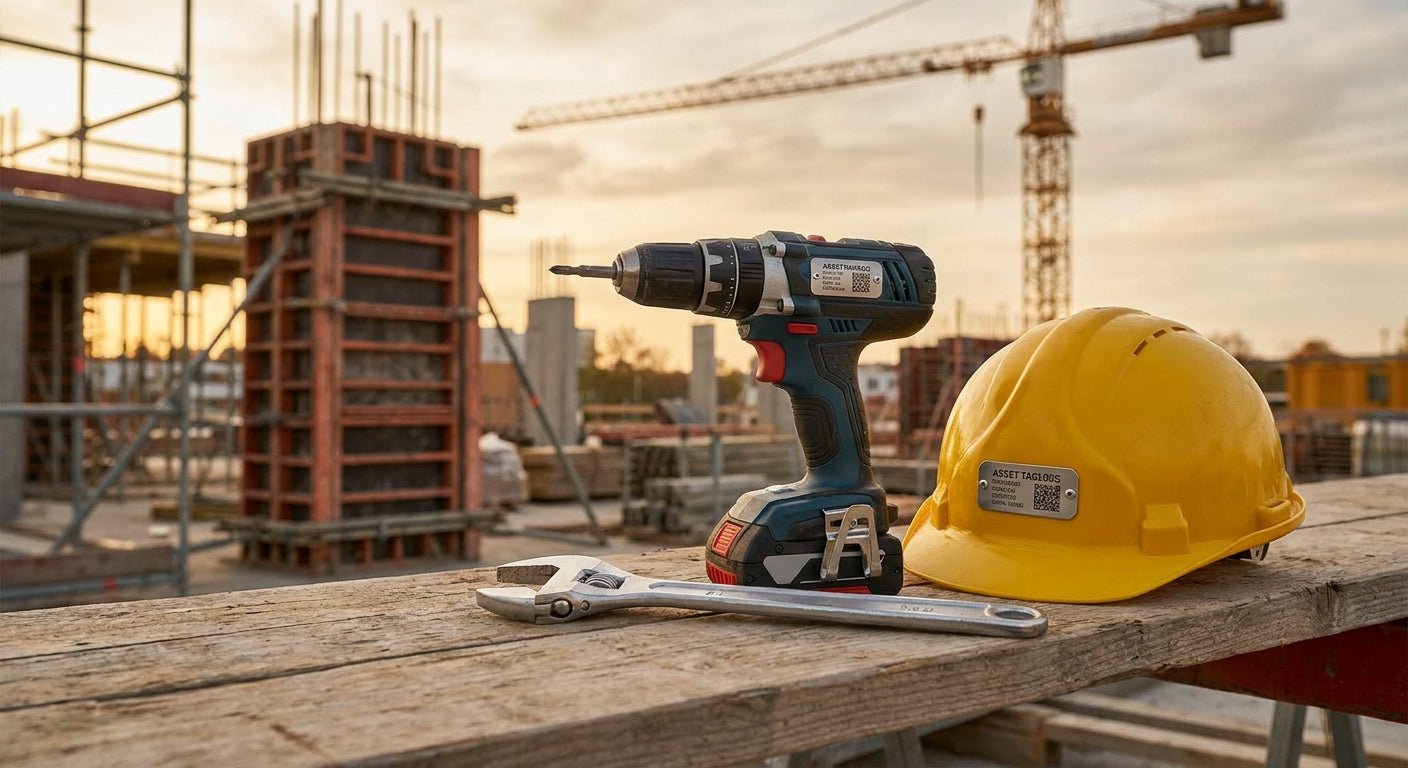
Construction crews lose tools to job-site chaos, not theft alone — a drill left on a truck bed, a laser level buried in debris, a generator that walked off with a subcontractor. Asset tags for construction site tools give every piece of equipment a scannable identity that survives concrete dust, rain, and daily abuse.
- Heavy-duty silver barcode asset tags from McAuley Labels survive outdoor job sites through 2026 and beyond — Buy for daily-use power tools.
- Metalized silver ID tags cost less but lack barcode scanning — Consider only for low-turnover fixed equipment.
- QR code asset tags link straight to a maintenance log on a phone camera — Buy for rental fleets and crews with high tool turnover.
- Skip paper or vinyl tags with no adhesive rating for outdoor exposure — they peel within one season.
Why this matters
A typical mid-size contractor carries $50,000 to $250,000 in portable tools and equipment across active sites, and industry loss studies routinely put annual tool theft and misplacement losses at 1-3% of that inventory value. Untagged tools have no chain of custody — nobody can prove which crew had a specific compactor last, and insurance claims stall without a serial record.
Asset tags for construction site tools solve a narrow, specific problem: identification that holds up outdoors. This isn't office asset tagging with laminated paper stock. Job sites mean grease, mud, UV exposure, and tools getting tossed into truck beds instead of gently placed on a shelf. The tag has to survive conditions the equipment survives.
Who this is for
This guide is for facilities and equipment managers, site supervisors, and small-to-midsize general contractors who need to track drills, saws, generators, compactors, and hand tools across multiple active job sites in 2026. If your crew shares tools between sites or hands equipment off to subcontractors, tagging isn't optional overhead — it's the only record you have when something goes missing.
What to look for in asset tags for construction site tools
Adhesive rated for outdoor exposure
A tag that lifts at the corner in humid weather is worthless within a month. Look for adhesive backing rated for outdoor temperature swings and moisture, not standard office-label adhesive that's built for indoor climate control.
Metalized or heavy-duty polyester material
Paper and vinyl tags crack and fade under UV within a single season on an exposed job site. Metalized silver polyester and 3M heavy-duty backing resist abrasion from being dropped, kicked, or dragged across concrete.
Barcode or QR code scannability at distance and angle
A tag you can only scan when it's perfectly clean and flat under a warehouse scanner fails on a muddy toolbox. Barcode tags printed at 203 DPI or higher stay readable even with light grime, and QR codes scan reliably from a phone camera at an angle — useful when a foreman is checking in equipment one-handed.
Tamper resistance
Tools change hands often on shared sites, and a tag that peels cleanly off invites someone to move it to different equipment. Tamper-evident backing that fractures or leaves residue when removed protects your chain-of-custody record.
Sequential or custom numbering
Manual tag assignment on a growing fleet turns into a spreadsheet nightmare fast. Pre-printed sequential numbering means every tool gets a unique ID without your team hand-writing numbers in a shed.
Print-your-own capability for growing fleets
If your tool count grows every quarter, ordering a new batch of pre-printed tags every time is slow. A thermal printer paired with blank stock lets you generate new tags on demand as equipment arrives.
Top picks for construction site tool tagging
The daily-use workhorse. Heavy-duty silver barcode asset tags use 3M-grade adhesive built for outdoor abrasion. These are built for tools that leave the truck every day — drills, saws, and impact drivers that get tossed in a bag and hauled between sites. Buy for any tool crew members carry daily.
The scan-from-a-phone option. Custom QR code asset tags on heavy-duty metalized stock let a foreman scan a tool's history with a phone camera instead of a dedicated barcode reader. That matters on sites where crews rotate weekly and nobody wants to carry a scanner. Buy for rental fleets or high-turnover crews.
The budget-conscious fixed-asset pick. Metallized silver ID asset tags skip barcode scanning in favor of a printed ID number, which cuts cost for equipment you rarely audit — generators parked on-site, scaffolding, or fixed compressors. Consider for low-turnover gear, skip for anything that changes hands weekly.
The wildcard for fleet growth. A print-on-demand setup lets you tag new equipment the day it arrives instead of waiting on a bulk order. Pairing blank asset tag stock with an in-house thermal printer means a tool bought on a Tuesday gets tagged before it ever leaves the shop. Consider if your equipment count grows faster than quarterly.
What to avoid
- Standard paper labels marketed as "asset tags." They look identical to heavy-duty stock in a product photo but crack and fade within one outdoor season — the adhesive isn't rated for temperature swings or moisture.
- Tags with no numbering system. A blank barcode with no visible ID number forces every check-in to involve a scanner, which fails the moment your scanner battery dies mid-site.
- Generic office asset tags sized for laptops. They're too small to read at arm's length on a dusty generator and rarely carry adhesive strong enough for a textured metal surface.
Verdict comparison
| Option | Material | Scan method | Best for | Verdict |
|---|---|---|---|---|
| Heavy-duty silver barcode | 3M heavy-duty | Barcode scanner | Daily-carry power tools | Buy |
| QR code metalized | Heavy-duty metalized | Phone camera | Rental fleets, high turnover | Buy |
| Metallized silver ID | Metalized polyester | Visual ID only | Fixed, low-turnover equipment | Consider |
| Standard paper label | Paper/vinyl | Barcode | Nothing outdoors | Skip |
For detailed numbering strategies once tags are ordered, the guide on numbered asset tags for construction tools covers how to structure IDs so audits stay simple as the fleet grows.
FAQ
What are the best asset tags for construction site tools in 2026?
Heavy-duty silver barcode tags with 3M-grade adhesive are the top pick for daily-use tools in 2026 because they resist abrasion, moisture, and UV fade that standard labels can't handle. QR code tags on metalized stock are a close second for crews that need phone-camera scanning instead of a dedicated reader.
How much do asset tags for construction equipment cost?
Pricing depends on material, quantity, and whether tags are barcode, QR, or plain ID stock, with heavier-duty materials priced above standard metalized options. Requesting a custom quote is the fastest way to get an exact number for your fleet size.
Do asset tags survive outdoor job site conditions?
Heavy-duty and metalized silver polyester tags are built specifically for outdoor exposure and hold up through rain, mud, and direct sun in 2026 conditions. Standard paper or vinyl tags are not rated for this and typically fail within one season outdoors.
Is QR code or barcode better for tool tracking?
QR codes scan reliably from any smartphone camera at an angle, which suits crews without a dedicated barcode scanner. Barcodes read faster with a dedicated scanner and remain the standard for larger fleets with existing scanning infrastructure.
Can asset tags be tamper-evident for shared job sites?
Yes, tamper-evident backing fractures or leaves visible residue if someone tries to peel and move the tag to different equipment. This matters most on sites where tools rotate between crews or subcontractors.
How do I number asset tags for a growing tool fleet?
Sequential numbering assigned at order time keeps every tool's ID unique without manual tracking in a spreadsheet. Custom QR code or barcode tags can carry both a visible sequential number and a scannable code on the same label.
What size asset tag works best on hand tools versus generators?
Smaller heavy-duty barcode tags fit compact power tools like drills and saws, while larger metalized ID tags suit generators, compactors, and scaffolding where surface space isn't a constraint. Matching tag size to surface area keeps the barcode or QR code fully legible for scanning.
Do I need a printer to order asset tags, or can I buy them pre-printed?
Pre-printed sequential tags work fine for a one-time fleet tagging project, but a thermal printer setup lets you generate new tags the same day equipment arrives. Most contractors with growing fleets end up wanting both options available.
One last thing
The detail crews miss most often: tag placement matters as much as tag material. A heavy-duty barcode tag applied to a curved drill housing or a textured generator frame peels within weeks if it's placed on a seam or a vibration point — flat, smooth surfaces near the tool's serial plate hold adhesive far longer through 2026's full range of job-site conditions.
Related guides
- Heavy-duty silver asset tags for outdoor equipment
- Custom 3M asset tags for IT equipment tracking
- Asset tags for rental equipment companies
- How to track fixed assets with barcode labels
Need exact pricing for your tool count? A custom quote gets you a number matched to fleet size and material choice.