
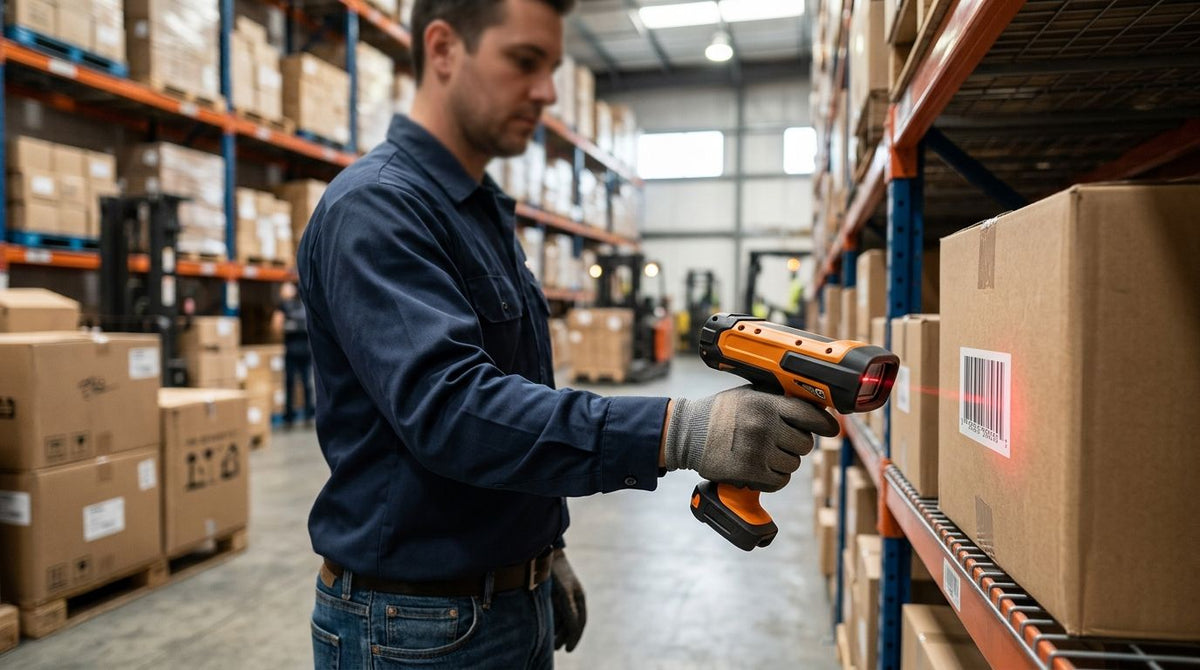
Best overall barcode scanner IP rating for wet, dusty work in 2026: IP67. Best for dust and water jets: IP65. Best for occasional splashes in a mostly dry workspace: IP54. These are protection classes, not endorsements of a particular scanner; an IP rating does not establish drop resistance.
- For a barcode scanner IP rating in wet, dusty work, IP67 is the strongest protection class compared here.
- Choose IP65 for dust and water jets; choose IP54 for dust exposure and occasional splashes.
- An IP rating measures enclosure protection against solids and water, not survival after a drop.
- McAuley Labels lists a GoDEX GS220 USB 1D scanner, but its supplied details do not establish an IP rating.
Why this matters
A warehouse scanner can encounter dust, splashes and falls during the same shift. Its IP code addresses the first two hazards, not the third. Buying by the highest-looking number alone leaves you without an answer to the question that matters when a scanner hits concrete: has that model passed a documented drop test?
The barcode must remain readable, too. For equipment identification, McAuley Labels offers 3M heavy-duty silver barcode asset tags. The label and scanner serve different jobs: a durable tag does not protect the scanner, and a protected scanner does not fix a damaged barcode. Check both sides of the scanning task before specifying equipment for 2026.
What makes the best barcode scanner IP rating?
The IP code, defined by IEC 60529, uses two digits after the letters IP. The first digit describes protection against solid objects and dust; the second describes protection against water. A higher digit on one side does not replace a lower digit on the other. Compare both positions, then assess drop claims separately.
- Dust exposure: A first digit of 5 means dust protection with limited ingress permitted under the standard's test conditions. A first digit of 6 means dust-tight protection under its test conditions.
- Water exposure: A second digit of 4 addresses splashing water. 5 addresses water jets. 7 addresses temporary immersion under the specified test conditions. None of these digits promises that every cleaning method is safe.
- Documented model rating: The rating must apply to the exact scanner configuration you plan to use. Do not transfer a rating from another model in the same product family.
- Drop-test evidence: Ask for the model's stated drop-test height, landing surface and test conditions. An IP67 marking cannot substitute for those results.
- Scanning fit: Confirm that the scanner reads your barcode type and works with your host device. Protection against dust does not tell you whether a scanner reads QR codes or connects to your system.
In 2026, choose the lowest protection class that covers the exposure you can identify, then verify the exact model's drop specification. An indoor checkout counter and a wash area do not call for the same enclosure.
Barcode scanner IP ratings at a glance
| Rank | Protection class | Best for | Standout protection | Key limitation |
|---|---|---|---|---|
| 1 | IP67 | Dusty work with a credible immersion risk | Dust-tight enclosure and temporary-immersion test | Does not establish drop resistance or a general washdown approval |
| 2 | IP65 | Dusty areas exposed to water jets | Dust-tight enclosure and water-jet test | Does not establish immersion resistance or drop resistance |
| 3 | IP54 | Mostly dry areas with dust and occasional splashes | Dust protection and splash protection | Not dust-tight; no water-jet or immersion claim |
The table ranks protection classes, not scanner models. No IP certification or drop-test result for a named scanner was supplied for this comparison. The ranking therefore makes no claim that a specific model carries one of these ratings.
Read the table as an exposure checklist
Start with the water the scanner actually encounters. A splash near a workbench is different from a directed jet during cleaning, and both differ from temporary immersion. Then check whether airborne dust makes a dust-tight enclosure necessary. In 2026, that sequence gives you a defensible minimum rating before you compare individual devices.
Treat the table's water descriptions as test categories, not instructions to clean a scanner. Check the manufacturer's handling and cleaning directions for the exact device. Seals, covers and accessories also need to be in the configuration covered by the stated rating.
1. IP67: best barcode scanner protection class for dusty, wet work
Best for: Sites with substantial dust exposure and a credible risk of temporary immersion. IP67 combines a dust-tight first digit with a second digit covering temporary immersion under IEC 60529 test conditions. For the exposures in this guide, it is the strongest default when the consequences of water ingress matter.
IP67 is not shorthand for indestructible. It does not tell you whether a scanner survives a fall, tolerates cleaning chemicals or reads a damaged code. Those questions need separate specifications and a test with your actual labels.
IP67 pros:
- Dust-tight classification addresses the higher dust-protection requirement compared with IP54.
- The water digit covers temporary immersion under the standard's specified conditions.
- The two-digit code makes dust and water claims easier to compare across documented models.
IP67 cons:
- The rating supplies no drop-test height or impact result.
- An immersion rating does not automatically establish suitability for water jets or every cleaning process; check the model's stated test claims.
- The rating says nothing about barcode formats, connectivity or scan performance.
Verdict: Buy an IP67-rated model for this use case only after its documentation confirms both the rating and the separate drop requirement. If immersion cannot occur, compare IP65 instead of treating the higher water digit as an automatic purchase decision.
2. IP65: best barcode scanner protection class for water jets
Best for: Dusty locations where directed water jets are the relevant exposure and immersion is not. IP65 has a dust-tight first digit and a water-jet second digit. That pairing gives you a clearer match than IP67 alone when your requirement is specifically a water-jet test.
In 2026, write the cleaning exposure into your purchasing requirement rather than asking vaguely for a waterproof scanner. If staff use a directed stream of water, request the exact model's documented IP rating and cleaning instructions. A code on a listing is not a substitute for those documents.
IP65 pros:
- Dust-tight classification addresses airborne-dust exposure.
- The water digit identifies a water-jet test rather than a splash-only test.
- It creates a specific requirement you can put on a procurement checklist.
IP65 cons:
- IP65 does not claim temporary-immersion protection.
- It does not establish resistance to drops or impacts.
- It does not, by itself, approve detergents, pressure-washing or a particular cleaning procedure.
Verdict: Buy a documented IP65-rated model when dust and water jets define the job, then check its drop-test statement separately. Skip treating IP65 as evidence that a scanner can be submerged.
3. IP54: best barcode scanner protection class for occasional splashes
Best for: Mostly dry work areas that still expose a scanner to dust and occasional splashing water. IP54 specifies dust protection in its first digit and splash protection in its second. It is a narrower requirement than the two classes above, which is useful when the work environment does not call for dust-tight or water-jet protection.
The distinction between dust-protected and dust-tight matters. An IP54 enclosure permits limited dust ingress under the standard's test conditions; an IP6X first digit is the dust-tight class. If fine dust is central to the task, set a higher dust requirement rather than assuming IP54 means sealed.
IP54 pros:
- States separate dust and splash protections you can verify in a model specification.
- Fits a requirement based on occasional splashes rather than directed jets.
- Prevents you from using the word waterproof without defining the exposure.
IP54 cons:
- It is not the dust-tight class.
- It provides no water-jet or immersion claim.
- It says nothing about whether a scanner survives a drop onto a hard floor.
Verdict: Buy a documented IP54-rated model for the stated dry-area use case if its barcode and connection specifications also fit. Skip IP54 where your requirement includes water jets, immersion or a dust-tight enclosure.
Where the GoDEX GS220 fits
Best for: Evaluating a USB 1D scanner for a retail or warehouse workflow where a documented environmental rating is not part of the purchase requirement. McAuley Labels lists the GoDEX GS220 as a USB 1D barcode scanner. The supplied product details do not give an IP code or drop-test result, so the GoDEX GS220 cannot be assigned a place in the IP54, IP65 or IP67 ranking.
GoDEX GS220 pros:
- The listed USB connection gives you a defined interface to check against your host device.
- The listed 1D format identifies the barcode type to evaluate with your labels.
- It provides a named scanner to assess alongside barcode asset tags.
GoDEX GS220 cons:
- No IP rating is established by the supplied details.
- No drop-test result is established by the supplied details.
- A listed 1D scanner is not evidence of QR-code scanning capability.
Verdict: Hold if your purchasing specification requires a documented IP rating or drop result. Ask for the exact GoDEX GS220 specification before approving it for dust, splashes or repeated handling in 2026.


How we ranked the protection classes
The 2026 order follows the exposures identified in the table: dust, splashes, water jets and temporary immersion. IP67 leads for combined dust and immersion exposure; IP65 takes the water-jet slot; IP54 takes the occasional-splash slot. This is not a tested ranking of scanner hardware, and it is not a ranking by drop survival.
That separation matters when you compare supplier listings. A scanner with a documented drop result but no IP rating answers a different question from a scanner with an IP rating but no drop result. Put both requirements on your checklist, with the intended barcode format and connection, before choosing a model.
Which barcode scanner IP rating should you choose?
Choose IP67 when the scanner faces dust and a credible temporary-immersion risk. Choose IP65 when dust and directed water jets are the defined hazards. Choose IP54 for a mostly dry area with dust and occasional splashes. If your workplace has none of those documented environmental requirements, do not assign an IP class to a scanner whose rating you have not verified.
For drops, make a separate decision: require a published test for the exact model and compare its stated conditions with where staff use it. In 2026, the strongest buying specification is not the biggest IP number. It is a match between the environment, the model's evidence and the barcode you need to scan.
FAQ
What does a barcode scanner IP rating mean?
A barcode scanner IP rating describes tested enclosure protection against solids and water under IEC 60529. The first digit addresses solids and dust; the second addresses water.
Is IP67 better than IP65 for drops?
No. IP67 and IP65 are enclosure-protection codes, not drop-test results. Check the exact scanner model's separate impact or drop documentation.
Is IP67 better than IP65 for water jets?
IP65 specifically identifies a water-jet test, while IP67 identifies a temporary-immersion test. Do not infer approval for a particular cleaning method from either code alone; check the model documentation.
What is the difference between IP54 and IP65?
IP54 describes dust protection and splash protection; IP65 describes a dust-tight enclosure and water-jet protection. Neither code establishes drop resistance.
Does an IP67 scanner survive being dropped on concrete?
An IP67 rating does not answer that question. Require the scanner model's documented drop-test conditions, including the landing surface, before specifying it for falls.
What IP rating should a warehouse barcode scanner have?
Choose the rating for the warehouse's actual dust and water exposure. IP54 addresses dust and splashes, IP65 addresses dust and water jets, and IP67 addresses dust and temporary immersion under their respective tests.
What is the GoDEX GS220 IP rating?
The supplied GoDEX GS220 details do not establish an IP rating. Obtain the exact model specification before relying on it for dust or water protection.
One last thing
Test the full scanning task, not just the scanner enclosure. A documented IP rating cannot tell you whether the device reads your chosen barcode on the label material you use. In 2026, confirm the code format, connection, environmental rating and drop evidence as separate items before placing an order.