
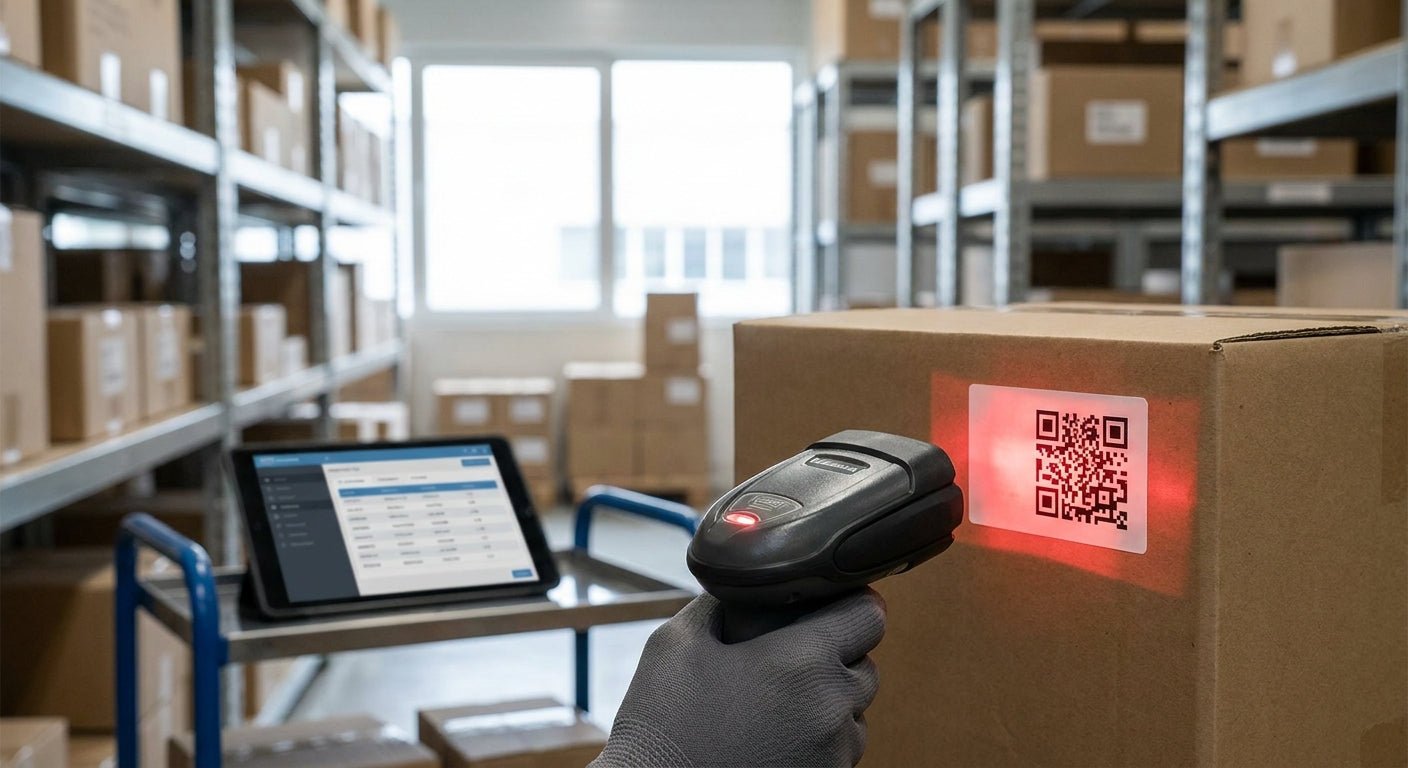
Picking the best 2D barcode scanner for QR codes on inventory in 2026 comes down to one distinction most buyers skip past: 2D imagers decode QR codes, 1D laser scanners don't. This guide ranks the scanner categories that actually work for QR-based stockrooms, tells you which type to buy for your setup, and flags the one that looks like a scanner but won't read a single QR label you print.
- The best 2D barcode scanner for QR codes on inventory in 2026 is a 2D imager, not a 1D laser unit.
- GoDEX GS220 lists at $86 in 2026 but reads only 1D barcodes — Skip it for QR-code stockrooms.
- Bluetooth 2D imagers win for multi-aisle picking; corded USB imagers win for single-station counters.
- Print QR codes at 300 DPI minimum or scanners will misread small or damaged codes.
- Fixed-mount 2D scanners only pay off on conveyor lines — Skip them for shelf-based inventory.
Why this matters
Most inventory teams buy a barcode scanner the way they buy a stapler — grab whatever shows up first in search, plug it in, move on. That works fine until someone switches part of the stockroom to QR codes for asset tracking, and the scanner that handled UPC codes for two years suddenly returns nothing but a blank beep.
2D imagers use a camera sensor to capture the whole code in one frame, which is why they read QR codes, Data Matrix codes, and damaged or angled labels that a 1D laser scanner simply can't see. If your inventory system uses QR codes anywhere — asset tags, shelf labels, service reminders — the scanner has to be a 2D imager, full stop. Check the 1D barcode scanner buying guide if part of your stock still runs on linear codes, because mixing both formats in one stockroom is common and the two scanner types aren't interchangeable.
The cost of guessing wrong isn't small. A scanner that can't read your QR labels means manual entry, mis-shelved stock, and staff re-typing serial numbers off a printed tag — the exact busywork barcode systems exist to eliminate.
How the picks were ranked
Each category below is ranked on four things: whether the scan engine is a true 2D imager (not a 1D laser rebadged as "barcode capable"), connectivity fit for the environment, durability rating for the floor it's used on, and compatibility with the print resolution of the labels it needs to read. A scanner that aces speed but can't decode a QR code printed at 203 DPI is a Skip regardless of price. Pricing referenced is current 2026 list pricing where a specific model is named; category-level picks are ranked on capability, not a single SKU.
The ranked list
1. The single-station workhorse — corded USB 2D imager
The cheapest way into real QR-code scanning is a wired 2D imager plugged straight into a stockroom PC. It reads codes at any angle without the operator rotating the box, which matters more than it sounds on a busy receiving dock. No battery to charge, no pairing to troubleshoot — it just works every time the unit is powered.
This is the right call for a single check-in station handling one item at a time. Buy for small stockrooms and single-counter setups.
2. The cordless picker — Bluetooth 2D imager
A battery-powered 2D imager frees staff to walk the aisles instead of carrying items back to a fixed terminal. In 2026, most Bluetooth imagers hold a charge through a full shift and re-dock in a charging cradle overnight, which keeps downtime near zero on multi-aisle picking runs.
The tradeoff is battery management discipline — someone has to actually put it back on the dock. Buy for warehouses running QR-tagged picking across more than one zone.
3. The rugged option — sealed 2D imager for cold storage and yards
A 2D imager rated for drops and sealed against dust and moisture costs more upfront but survives environments that kill consumer-grade scanners in weeks. This is the category to buy for outdoor equipment yards, cold storage, or any floor where a scanner regularly hits concrete.
Skip the sealed housing if your stockroom is a climate-controlled office — you're paying for protection you don't need. Buy only where the environment genuinely demands it.
4. The smartphone shortcut — camera-based QR apps
Every employee already carries a 2D imager in their pocket: a phone camera running a QR scanning app. It costs nothing to start and works fine for spot-checks or low-volume verification.
It falls apart at volume — no trigger button, slower focus lock, and no integration with a real inventory database. Consider it as a backup, Skip it as your primary system for daily counts of more than a few dozen items.
5. The line-side option — fixed-mount 2D scanner
A fixed-mount 2D imager bolted above a conveyor reads every QR-tagged box as it passes, no operator required. That automation only pays for itself where product volume justifies a conveyor line in the first place.
For shelf-based or manual-pick inventory, a fixed-mount unit is dead weight sitting on a mounting bracket. Buy for conveyor operations, Skip for everything else.
6. The one to skip for QR codes — 1D-only scanner
The GoDEX GS220 USB Barcode Scanner lists at $86 in 2026 and reads linear 1D barcodes cleanly and fast. It has no 2D imaging sensor, so it will not decode a QR code, a Data Matrix code, or anything two-dimensional — no firmware update fixes that.
If every label in your stockroom stays 1D — Code 128, UPC — this is a solid, inexpensive pick. The moment a single QR-coded heavy duty metalized QR code asset tag enters the mix, this scanner can't read it. Buy for 1D-only stock, Skip for any QR-code inventory.


Comparison table
| Category | Best For | Connectivity | Verdict |
|---|---|---|---|
| Corded USB 2D imager | Single check-in station | Wired | Buy |
| Bluetooth 2D imager | Multi-aisle picking | Wireless | Buy |
| Rugged sealed 2D imager | Cold storage, yards | Wired or wireless | Buy (situational) |
| Smartphone QR app | Spot-checks, backup | App-based | Consider |
| Fixed-mount 2D scanner | Conveyor lines | Wired | Buy (situational) |
| 1D-only scanner (GoDEX GS220) | Linear barcodes only | Wired | Skip for QR |
Where to buy
- Confirm the listing explicitly says "2D imager" or "QR code capable" — "barcode scanner" alone is not proof it reads two-dimensional codes.
- Match the scanner to your label print quality: labels printed under 300 DPI produce QR codes dense enough to confuse budget imagers, so check QR code inventory labels for warehouses before ordering a print run.
- Test-scan an actual printed sample under your warehouse lighting before buying more than one unit — fluorescent glare and glossy label stock both affect read rates in ways a spec sheet won't show.
FAQ
What's the best 2D barcode scanner for QR codes on inventory in 2026?
A Bluetooth or corded 2D imager is the best 2D barcode scanner for QR codes on inventory in 2026, since only 2D imagers decode QR codes at all. Pick corded for a single fixed station and Bluetooth for multi-aisle picking.
Can a 1D barcode scanner read QR codes?
No, a 1D barcode scanner cannot read QR codes because it lacks the camera sensor needed to capture a two-dimensional pattern. The GoDEX GS220, for example, reads linear barcodes only at $86 in 2026 and has no QR decoding capability.
Is a Bluetooth 2D scanner better than a corded one for warehouses?
Bluetooth 2D scanners are better for warehouses covering multiple aisles or picking zones, since staff aren't tethered to one terminal. Corded 2D imagers still make sense for a single fixed check-in counter where mobility isn't needed.
How much does a 2D barcode scanner cost in 2026?
Entry-level corded 2D imagers sit at the low end of the barcode scanner market in 2026, with Bluetooth and rugged sealed models priced higher for added mobility and drop protection. Exact pricing varies by retailer and durability rating.
What print resolution do I need for QR codes to scan reliably?
Print QR codes at 300 DPI minimum for reliable scans, and step up to 600 DPI for small or dense codes packed with more data. Labels printed below 300 DPI often produce blurred modules that 2D imagers misread.
Do I need a separate 2D scanner if I already own a 1D scanner?
Yes, if any part of your inventory uses QR codes, a 1D-only scanner cannot read them regardless of firmware or settings. Running both formats means owning a 2D imager alongside any existing 1D unit.
Can a smartphone camera replace a dedicated 2D scanner?
A smartphone camera works as a backup or for low-volume spot-checks but isn't built for daily high-volume scanning. It lacks a trigger button, scans slower, and rarely integrates directly with an inventory database.
What's the real difference between an imager and a laser scanner?
An imager captures the entire code as an image using a camera sensor, which is how it reads two-dimensional codes like QR and Data Matrix. A laser scanner only reads a single line across a barcode, which limits it to 1D formats.
One last thing
The GoDEX GS220 lists at $86 in 2026 and handles 1D barcodes without complaint — but the moment one QR-coded asset tag lands on the floor, that $86 scanner becomes dead weight sitting next to the register. Buy the 2D imager first if there's any chance QR codes show up in your workflow this year; retrofitting a 1D-only fleet later costs more than starting with the right scan engine.