
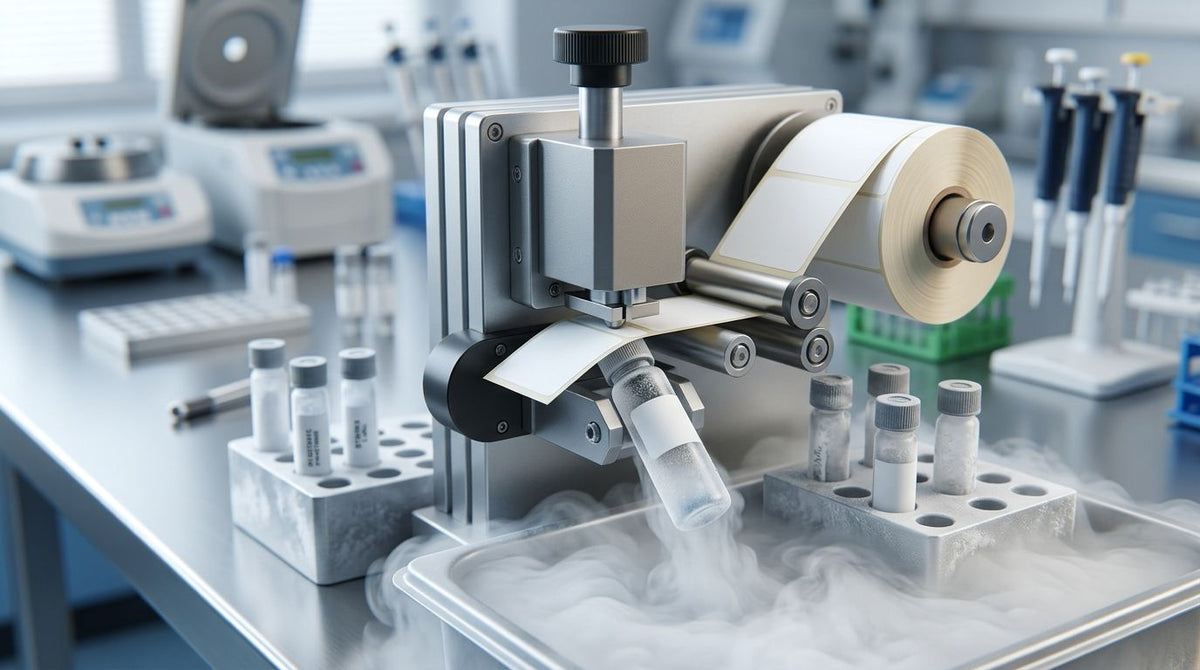
Best overall for cryogenic storage in 2026: a thermal-transfer printer paired with label stock qualified for the complete storage cycle. Best for labels prepared before collection: preprinted, cryogenic-rated tube labels. Best for samples that never enter cryogenic storage: a direct-thermal printer with stock qualified for the actual conditions. These are workflow rankings, not verified temperature ratings for specific printer models: test tube labeler cryogenic resistance depends on the printed label, adhesive, tube surface and handling process—not the printer alone.
- Best overall for test tube labeler cryogenic resistance: qualified thermal-transfer stock matched to the tube and storage cycle.
- Preprinted cryogenic-rated labels suit fixed IDs; direct thermal suits only conditions its specific stock is qualified to withstand.
- McAuley Labels offers an automated test tube labeler, but no cryogenic rating is supplied for its labels or printer.
- Test adhesion and barcode readability after storage and retrieval before approving a 2026 lab workflow.
Why this matters
A printer can produce a sharp barcode at room temperature while the applied label fails later. Adhesive can lift from a curved tube, print can become unreadable, or a label applied to a cold surface can fail to bond. A printer specification is not a cryogenic label qualification.
For 2026 purchasing, write down the full route a sample takes: labeling, cooling, storage, retrieval and scanning. Liquid nitrogen is approximately −196°C; dry ice is approximately −78.5°C; and −80°C is a common ultra-low freezer setpoint. Those numbers describe environments, not approved operating temperatures for any item ranked here. The difference matters: a claim about freezer storage does not establish suitability for liquid-nitrogen exposure.
If you need the practical application sequence rather than a buying comparison, see how to print cryogenic labels for lab samples. Keep the qualification record for the exact label construction you approve, including its adhesive and print method.
What makes the best cryogenic test tube labeler setup
Use these criteria before comparing printers. In 2026, the strongest choice is the setup whose finished label survives your defined process, not the device with the most appealing printer specification.
- Documented temperature scope. Ask for a rating or test evidence covering the temperature and exposure your tubes actually encounter. Separate vapor-phase storage, immersion, freezer storage and transport rather than treating cold resistance as one specification.
- Adhesion to your tube. Test the label on the tube material and curvature you use. Check whether your procedure applies labels to dry, room-temperature tubes or to surfaces that have already cooled.
- Print durability. Verify that text and machine-readable codes remain legible after storage, retrieval, handling and any condensation your process creates.
- Label fit. Check the printable area, tube diameter, cap clearance and overlap. A label that wrinkles over itself is harder to scan consistently.
- Workflow fit. Decide whether identifiers are generated at collection, printed in batches or assigned before samples arrive. This determines whether you need on-demand printing at all.
- Traceability. Confirm that staff can associate the printed identifier with the correct tube and record at the point of application. Cryogenic survival cannot fix a mislabeled sample.
Ask vendors to identify the tested label stock, adhesive, ribbon where relevant, tube surface, application conditions and storage conditions. A printer model alone cannot answer those questions. If documentation describes only the media before printing, test the finished barcode as well.
Cryogenic labeler options at a glance
The order below ranks configurations by suitability for the stated use case. It does not rank verified temperature resistance: the inputs provide no comparable cryogenic test results for these options.
| Option | Best for | Standout feature | Key limitation |
|---|---|---|---|
| Thermal transfer plus qualified cryogenic stock | Variable IDs generated in the lab | Prints identifiers on demand using a ribbon | Neither the printer nor generic stock proves cryogenic performance |
| Preprinted cryogenic-rated tube labels | Fixed IDs prepared before collection | No printing step at the labeling station | Cannot create a new variable ID at the tube without another process |
| Direct thermal plus condition-qualified stock | Tubes that do not enter cryogenic storage | Prints without a ribbon | Do not treat it as cryogenic-ready without evidence for the finished label |
These are distinct decisions, not interchangeable products. A lab that assigns a new sample ID at collection needs an on-demand method. A lab that receives already-assigned IDs can evaluate preprinted labels instead. If a tube remains in a standard refrigerated workflow, do not buy against a cryogenic requirement it will never face.
How to read this ranking
Rank the complete label construction, not the hardware. Thermal transfer leads for variable IDs because it supports an on-demand workflow; it does not receive an automatic cryogenic rating. Preprinted stock can remove the printer from the point of application, but its supplier must still support the claimed storage conditions. Direct thermal stays on the list for labs separating ordinary refrigerated samples from genuinely cryogenic samples.
A useful 2026 comparison sheet has a row for each proposed combination of tube, label, adhesive and print method. Record the claimed conditions separately from what your lab has observed. When two suppliers describe different test conditions, their temperature claims are not a like-for-like ranking.
1. Thermal transfer: best for variable sample IDs
Thermal transfer uses a ribbon to put an identifier onto compatible label stock. It is the strongest workflow choice when your lab creates a different ID for each tube and requires printing near collection or processing. Select the ribbon and stock as a system, then verify the finished label on your own tubes.
McAuley Labels lists thermal-transfer printers and thermal-transfer printer labels in polyester white. That product-page description identifies a material and printing category; it does not establish a cryogenic rating. Ask for the precise stock and adhesive specifications before treating any catalog label as suitable for cryogenic storage.
Thermal-transfer pros:
- Prints changing IDs and barcodes when your workflow generates them.
- Allows you to evaluate ribbon, stock and layout together.
- Keeps label creation at the point where the tube receives its identifier.
Thermal-transfer cons:
- Adds ribbon selection and loading to the process.
- Requires a qualified label-and-ribbon combination; the print method alone proves nothing about cryogenic survival.
- Poor placement on a narrow tube can make an otherwise clear barcode hard to scan.
Best for: Labs producing variable tube IDs that need an on-demand printer and have a plan to qualify the finished labels. Verdict: Buy only after a specific stock, ribbon and tube combination passes your storage-and-retrieval test; otherwise, Wait.
Where an automated tube labeler fits
McAuley Labels offers an automated test tube labeler for laboratory workflows. Automation addresses label application, while cryogenic resistance remains a separate media-and-process requirement. McAuley Labels is best suited to labs assessing automated tube labeling alongside a separately qualified cryogenic label construction. No cryogenic temperature rating for that labeler or its media is provided here.
If automation is part of your 2026 decision, run two checks rather than one. First, confirm that the machine applies the selected label consistently to the tubes you use. Second, test those labeled tubes through the real storage cycle. A clean application before freezing is not evidence of adhesion after retrieval.
2. Preprinted cryogenic-rated labels: best for fixed IDs
Preprinted labels arrive with identifiers already printed, so the labeling station does not need to generate each code. This fits a workflow that assigns tube IDs before collection or distributes prepared sets to staff. Specify the expected storage conditions to the supplier and request evidence for the finished printed label, not just unprinted stock.
Preprinted-label pros:
- Removes printer setup from the point of labeling.
- Lets you inspect code placement before distributing labels.
- Matches workflows with identifiers assigned in advance.
Preprinted-label cons:
- Does not solve unexpected, on-demand ID creation by itself.
- Requires controls to prevent staff from applying an identifier to the wrong tube.
- A cryogenic claim still needs to match the actual tube and exposure conditions.
Best for: Labs with fixed identifiers prepared before tubes are labeled. Verdict: Buy when the supplier's documentation and your own application test cover the complete workflow; otherwise, Hold.
The key trade-off is operational. Removing a printer from the bench simplifies one step but moves responsibility for ID assignment earlier. In 2026, document who issues the labels, how unused IDs are handled and where the label is checked against the sample record. Those controls matter whether the label survives a freezer or not.
3. Direct thermal: best for noncryogenic tube workflows
Direct thermal produces an image on heat-sensitive stock without a ribbon. It can be appropriate when a tube's documented route stays within conditions supported by the selected media. It is not the default choice for a cryogenic requirement: no direct-thermal stock or finished-label cryogenic qualification is supplied in these inputs.
McAuley Labels lists direct-thermal printing among its business label-printer categories. That identifies a printing method, not a lab-storage approval. Keep direct-thermal labels in a separate evaluation from cryogenic tubes unless a specific stock has evidence for the latter.
Direct-thermal pros:
- Does not require a ribbon.
- Supports IDs printed at the point of use.
- Gives labs a separate option for tubes outside the cryogenic workflow.
Direct-thermal cons:
- Its heat-sensitive image needs validation against the handling conditions you specify.
- A general-purpose direct-thermal label has no implied cryogenic rating.
- Using one stock across unlike storage routes can hide a qualification gap.
Best for: Tubes that do not enter cryogenic storage and whose printed labels pass the lab's actual handling test. Verdict: Skip for cryogenic tubes unless the exact finished label is qualified for their full exposure cycle.
How we ranked the 2026 options
This is a use-case ranking, not a claim that one listed item withstands a lower temperature than another. No supplier test report, media temperature range or head-to-head cryogenic result was provided for these configurations. The order follows the criteria above: ability to produce the required ID, evidence needed for the finished label, fit on a curved tube and the controls required at application.
Start by eliminating any option that cannot produce IDs in the way your lab assigns them. Then request documentation for the proposed label construction. Finally, apply and scan labels on the actual tubes before and after the relevant storage cycle. Compare failures by cause: adhesion, print legibility, barcode readability and ID-to-sample matching require different fixes.
Do not substitute a −80°C freezer check for a liquid-nitrogen requirement. Likewise, passing a dry-ice transport check does not verify storage at approximately −196°C. In 2026, a useful purchasing record states which conditions were tested, not merely that a label was called cryogenic.
Which cryogenic test tube labeling option should you choose?
Choose thermal transfer with specifically qualified stock if you need variable IDs at the bench. It is the default workflow pick, subject to evidence for the completed label. Choose preprinted, cryogenic-rated labels if IDs exist before collection and the supplier's tested conditions match yours. Reserve direct thermal for noncryogenic tubes unless its exact printed stock passes the cryogenic qualification your process requires.
Do not use printer resolution, print speed or automation as a substitute for a media rating. Those specifications answer different questions. The purchasing decision is complete only when your team knows what prints the ID, what bonds the label to the tube and what happens after storage.
FAQ
What is the best setup for test tube labeler cryogenic resistance in 2026?
A thermal-transfer workflow with label stock qualified for the exact tube and storage cycle is the best choice for variable IDs. The printer itself does not determine cryogenic resistance.
Does McAuley Labels have a cryogenic-rated test tube labeler?
McAuley Labels offers an automated test tube labeler, but no cryogenic rating for its printer or label media is supplied here. Request specifications for the exact media before selecting it for cryogenic samples.
Is thermal transfer better than direct thermal for cryogenic tubes?
Thermal transfer is the better starting workflow for variable IDs when paired with qualified cryogenic stock. Neither method is cryogenic-ready without evidence for the finished label and its application conditions.
Can a label rated for a −80°C freezer go into liquid nitrogen?
A −80°C rating alone does not establish suitability for liquid nitrogen at approximately −196°C. Check the supplier's exposure conditions and test the applied label through your actual storage cycle.
Do preprinted cryogenic labels need a test?
Yes. Verify the printed label on your tube through application, storage, retrieval and scanning, even when the supplier describes the stock as cryogenic-rated.
What should a lab check after retrieving a labeled tube?
Check that the label remains attached and that both text and codes are readable. Confirm that the scanned identifier still matches the tube's sample record.
Can an automated applicator make a label cryogenic-resistant?
No. An applicator places the label; the stock, adhesive, print and handling conditions determine whether the finished label survives the required exposure.
One last thing
Test retrieval, not just storage. A tube label can appear intact while cold, then reveal an adhesion or scanning problem during handling. For your 2026 approval test, record the identifier before storage, retrieve the tube using your normal procedure and scan it at the point where staff actually need the result.