
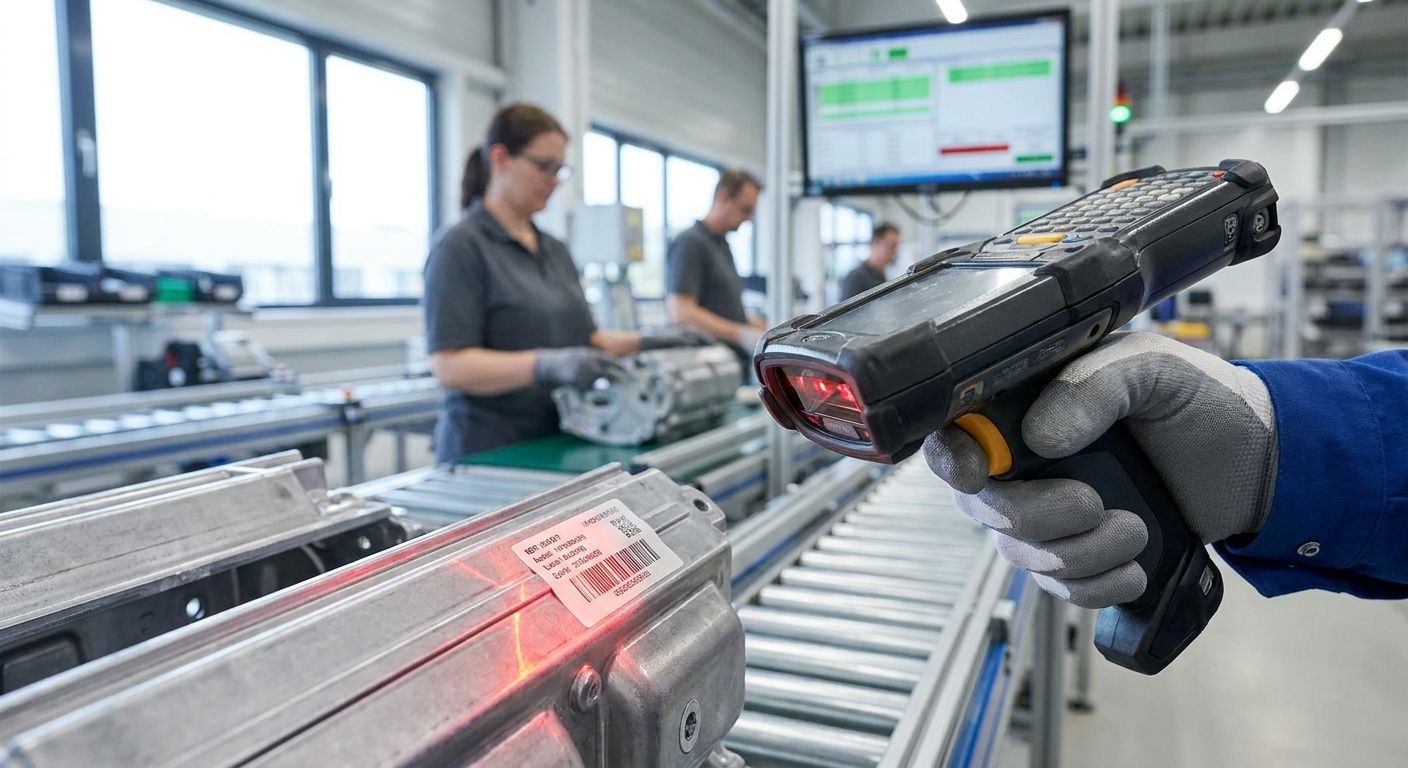
A barcode scanner for manufacturing quality control has one job: read the code on the part, the traveler, or the asset tag every time, without forcing the QC tech to rescan three times before it beeps. This guide ranks scanner types by manufacturing use case for 2026, from general 1D scanning at inspection stations to automated inline reads on conveyor lines, and calls out the one variable most buying guides skip: whether the label under that barcode can actually hold up to daily scanning.
- GoDEX GS220 USB Barcode Scanner wins for general 1D QC scanning at $86 in 2026 - buy it for standard part and lot codes.
- 2D imager scanners are the pick when parts carry QR or DataMatrix marks instead of linear barcodes.
- Wireless Bluetooth scanners fit multi-station floor audits; fixed-mount inline scanners wait until line volume justifies the setup.
- Scan failures on manufacturing floors trace back to faded or peeling labels more often than to the scanner itself.
Why this matters
Quality control scanning breaks in one of two places: the scanner can't decode the symbol, or the symbol itself has degraded past readability. Most buying guides only talk about the first problem. On a manufacturing floor running through 2026, oil, heat, and abrasive handling wear labels down faster than they wear down scanners.
McAuley Labels manufactures the thermal printers and heavy-duty labels that print the barcodes QC stations scan every shift, which is why this ranking treats the scanner and the label as one system instead of two separate purchases. A $2,000 industrial scanner paired with a paper label that fades after a week of handling still produces failed reads.
The scanners below are ranked by manufacturing use case, not by brand marketing. Each carries an honest limitation, because a barcode scanner for manufacturing quality control that only gets praised in a review isn't a scanner you can plan a QC line around.
What makes the best barcode scanner for manufacturing quality control
- Scan technology matched to the code - 1D linear scanners read standard barcodes only; 2D imagers add QR and DataMatrix
- Read range and depth of field - matters more at fixed inspection stations than most spec sheets suggest
- Durability rating for the shop floor - dust, oil, and drop resistance separate office scanners from plant-floor scanners
- Interface fit - USB plug-and-play, Bluetooth wireless, or integration with existing QC software
- Decode speed - throughput lines need sub-second reads, not a second attempt on every fifth part
- Total cost per station - scanner price plus cables, cradles, or mounting hardware
Barcode scanners for manufacturing QC at a glance
| Scanner type | Best for | Standout feature | Starting price | Key limitation |
|---|---|---|---|---|
| GoDEX GS220 USB Barcode Scanner | General 1D QC scanning | Plug-and-play, no driver install | $86 | 1D codes only, no QR or DataMatrix |
| 2D imager scanner | QR/DataMatrix on small parts | Omnidirectional imaging | Price varies by model | Costs more than a 1D scanner |
| Wireless Bluetooth handheld | Mobile floor audits | Untethered range, charging cradle | Price varies by model | Battery needs daily charging |
| Rugged industrial-rated scanner | Harsh shop-floor conditions | Sealed, drop-rated housing | Price varies by model | Bulkier and heavier in hand |
| Fixed-mount inline scanner | Automated conveyor-line QC | No operator required per scan | Price varies by model | Needs line integration and setup |
1. GoDEX GS220 USB Barcode Scanner: best 1D scanner for general QC stations
The GoDEX GS220 is a USB-connected 1D barcode scanner built to plug into a workstation and start reading without driver setup. It handles standard linear barcodes on part labels, work orders, and 3M heavy-duty barcode asset tags at the speed most manual QC checkpoints need. It's the scanner McAuley Labels ships most often to buyers setting up a first or second inspection station.
GoDEX GS220 pros:
- Plug-and-play USB connection, no software license required
- Comes with a 3-year warranty
- Priced under $100, low cost per additional station
- Reads reliably off matte and semi-gloss labels at close range
GoDEX GS220 cons:
- 1D only - can't decode QR codes or DataMatrix marks
- Corded, so it's fixed to one workstation
- No stand included for hands-free scanning
GoDEX GS220 pricing: $86 per unit as a standalone corded scanner.
Best for: manufacturing QC stations scanning standard 1D barcodes on parts, travelers, or asset tags.
Verdict: Buy. For general inspection stations reading standard barcodes, this is the default purchase in 2026 - cheap enough to put one at every station without a budget fight.
2. 2D imager scanner: best for QR and DataMatrix part marking
A 2D imager scanner reads everything a 1D scanner reads plus QR codes and DataMatrix symbols, which matters when parts are direct-marked or when travelers carry QR-encoded work instructions. It captures the code as an image rather than a single laser line, so it can decode symbols printed at odd angles or on curved surfaces.
2D imager scanner pros:
- Reads QR codes and DataMatrix in addition to standard barcodes
- Omnidirectional - doesn't need the code lined up straight
- Handles smaller code sizes than most 1D scanners
2D imager scanner cons:
- Costs more per unit than a 1D scanner
- Overkill if every part on the line only carries linear barcodes
- Some models need configuration software before first use
2D imager scanner pricing: price varies by model; budget for a premium over a basic 1D corded scanner.
Best for: manufacturing lines using QR or DataMatrix marking on small or direct-marked parts.
Verdict: Buy if any part on your line carries a 2D code - a 1D scanner simply can't read it, no matter how good the label is.
3. Wireless Bluetooth handheld scanner: best for mobile floor audits
A wireless Bluetooth scanner untethers the QC tech from a fixed workstation, which matters when quality checks happen at multiple points along a line or across separate work cells. It pairs with a tablet, laptop, or mobile QC app and stores scans in a cradle when not in use.
Wireless scanner pros:
- Free movement across multiple inspection points on one line
- Typically pairs with existing QC software over Bluetooth
- Useful for spot audits away from a fixed desk
Wireless scanner cons:
- Battery needs daily charging, adds a maintenance step
- Costs more upfront than a corded 1D scanner
- Can be misplaced more easily than a desk-mounted unit
Wireless scanner pricing: price varies by model; expect a premium over corded options for the radio and battery.
Best for: QC teams auditing multiple stations or cells with one roaming tech instead of a fixed operator per station.
Verdict: Buy if your QC process moves between stations. Skip it if one tech scans at one desk all shift - a corded scanner is cheaper and never needs charging.
4. Rugged industrial-rated scanner: best for harsh shop-floor conditions
A rugged, sealed scanner is built for environments with dust, cutting oil, coolant mist, or regular drops onto a concrete floor. These units use reinforced housings and sealed ports instead of the consumer-grade plastic on office scanners.
Rugged scanner pros:
- Built to survive drops onto concrete
- Sealed against dust and liquid exposure common in machine shops and foundries
- Longer service life in harsh environments than standard scanners
Rugged scanner cons:
- Heavier and bulkier than a standard handheld
- Priced above general-purpose scanners
- Unnecessary expense for a clean assembly floor or lab environment
Rugged scanner pricing: price varies by model; the durability rating drives the premium over a standard scanner.
Best for: foundries, machine shops, and plants with heavy oil, dust, or drop exposure on the QC floor.
Verdict: Buy for harsh environments where a standard scanner would fail within months. Wait if your QC station sits in a clean, climate-controlled area.
5. Fixed-mount inline scanner: best for automated conveyor-line QC
A fixed-mount inline scanner reads barcodes automatically as parts pass on a conveyor, without a person holding a trigger. It's the step up from manual scanning once a line runs enough volume that a dedicated operator per scan point stops making sense.
Fixed-mount scanner pros:
- No operator needed for each individual scan
- Keeps pace with continuous conveyor speed
- Reduces missed scans caused by operator fatigue on long shifts
Fixed-mount scanner cons:
- Requires integration work with the line and existing QC software
- Highest setup cost and complexity of any option here
- Needs consistent code placement and label quality to hit read rates
Fixed-mount scanner pricing: price varies by model and integration scope; this is a line-investment purchase, not a per-station add.
Best for: high-volume manufacturing lines where manual scanning has become the bottleneck.
Verdict: Wait. Most QC stations reading a few hundred parts per shift don't have the volume to justify the integration cost yet.


“A scanner that can't read a scratched or faded barcode isn't a scanner problem - it's a label problem.”
How we ranked
Each scanner type is scored against the six criteria above: code compatibility, read range, durability, interface fit, decode speed, and cost per station. The GoDEX GS220 ranks first because it covers the most common manufacturing QC scenario - standard 1D codes at a fixed station - at the lowest cost per unit. The remaining categories are ranked by how far they solve a problem the GS220 can't: 2D marking, mobility, harsh environments, and full automation, in that order.
Which barcode scanner should you choose?
For most manufacturing QC stations scanning standard 1D barcodes printed on 3M heavy-duty barcode asset tags or paper labels, the GoDEX GS220 is the default buy at $86 per station in 2026. Move to a 2D imager only when parts carry QR or DataMatrix marks. Add a wireless scanner if your tech audits multiple stations, a rugged unit if the floor is dusty or oily, and hold off on fixed-mount inline scanning until line volume actually justifies the integration work. Whatever scanner you land on, pair it with print quality built for repeated handling - an industrial label printer for manufacturing floors matters as much as the scanner reading its output.
FAQ
What's the best barcode scanner for manufacturing quality control?
The GoDEX GS220 USB Barcode Scanner is the best overall pick for general manufacturing QC in 2026, reading standard 1D barcodes for $86 with no driver setup. Switch to a 2D imager only if parts carry QR or DataMatrix codes.
Is a 2D scanner better than a 1D scanner for QC?
A 2D scanner is only better if your parts or travelers use QR codes or DataMatrix marks, since 1D scanners can't decode those symbols at all. For standard linear barcodes, a 1D scanner like the GoDEX GS220 reads just as reliably at a lower price.
How much does a barcode scanner cost for a manufacturing QC line?
A basic corded 1D scanner like the GoDEX GS220 costs $86 per unit in 2026. Wireless, 2D imager, rugged, and fixed-mount models cost more, with the exact price varying by model and features.
Is a wireless or corded scanner better for manufacturing QC?
A corded scanner works best for a single fixed inspection station since it never needs charging. A wireless Bluetooth scanner is better when one tech audits multiple stations or work cells across a shift.
Why does my barcode scanner fail to read some labels?
Most scan failures on a manufacturing floor come from the label, not the scanner - faded print, peeling edges, or low-contrast printing all cause misreads. Heavy-duty barcode labels rated for industrial handling reduce failed scans more than upgrading the scanner alone.
Do I need a rugged industrial barcode scanner?
You need a rugged, sealed scanner if your QC floor has regular dust, oil, coolant, or drop exposure, common in machine shops and foundries. A clean assembly floor or lab environment doesn't need the added durability or cost.
When should a manufacturing line use a fixed-mount inline scanner?
A fixed-mount inline scanner makes sense once a conveyor line runs enough volume that a dedicated operator scanning each part becomes the bottleneck. Most QC stations checking a few hundred parts per shift don't have the volume to justify the integration cost yet.
Can a 1D scanner read barcodes printed on metalized silver asset tags?
Yes - a 1D scanner like the GoDEX GS220 reads standard linear barcodes printed on metalized silver or 3M heavy-duty asset tags without issue, as long as the print contrast stays sharp. Faded or scratched print, not the tag material, is usually what causes a failed read.
One last thing
Before buying a second scanner to fix a QC read-rate problem, check the labels first. A scanner upgrade won't fix a barcode that's faded from oil exposure, printed at low contrast on a cheap paper stock, or peeling at the corner where the scan beam hits it. Most manufacturing floors that jump straight to a pricier scanner in 2026 find the read-rate problem was sitting on the label the whole time.