
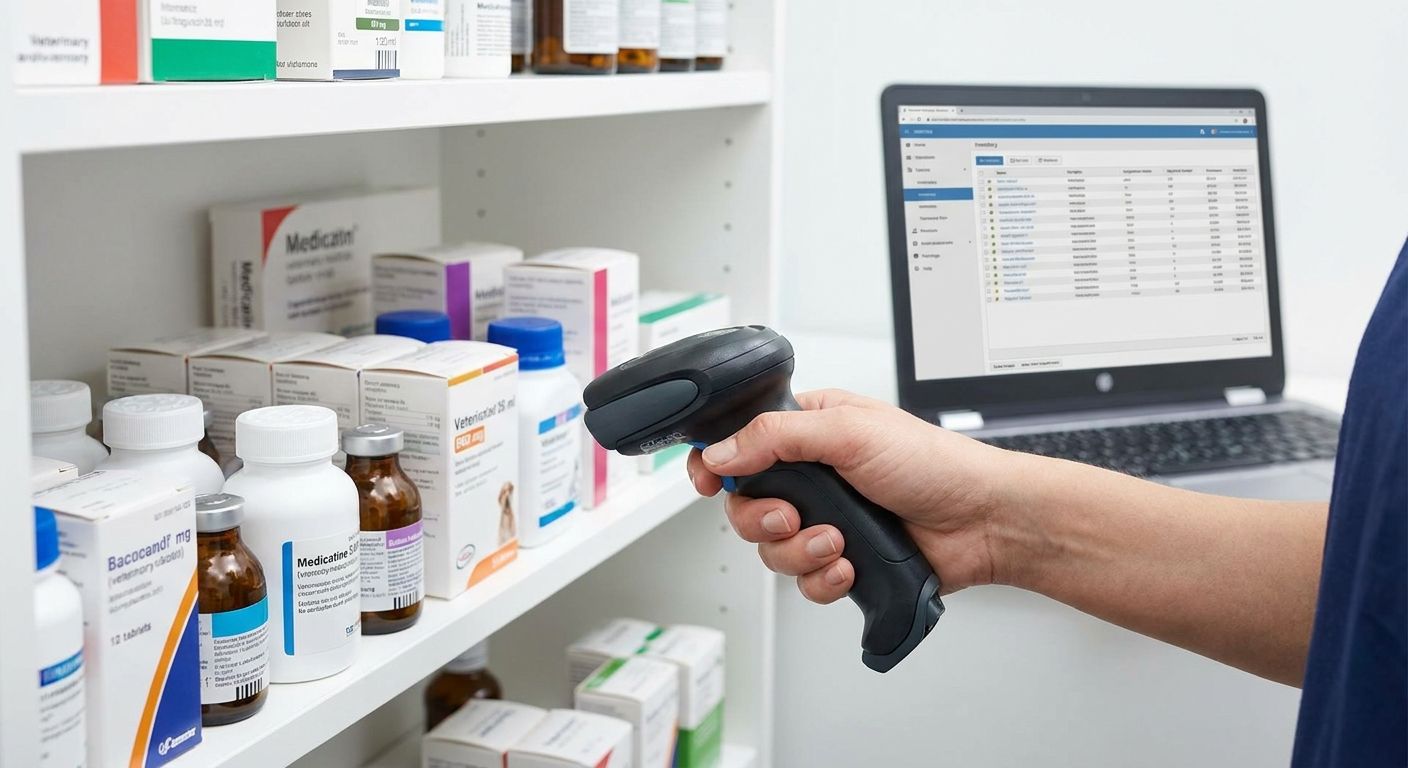
Veterinary clinics track prescription meds, retail food and flea products, lab specimens, and loaner equipment under one roof, and the wrong scanner turns a five-minute stock count into a twenty-minute retype session. This guide ranks the barcode scanners that hold up in a real veterinary clinic inventory workflow in 2026, from front-desk retail counts to specimen tube tracking in the in-house lab.
- GoDEX GS220 wins overall for a barcode scanner for veterinary clinic inventory at $86 — corded, plug-and-play, no driver install.
- Zebra DS2208 is the pick for clinics scanning QR codes on prescription labels and specimen tubes.
- Socket Mobile S740 handles wireless scanning across treatment rooms without running a USB cable.
- Honeywell Voyager 1200g suits high-volume front desk checkout with a wide-angle aimer.
- 1D-only scanners can't read QR-coded specimen labels — check symbology before you buy in 2026.
Why this matters
A veterinary clinic runs three inventory streams at once: retail (pet food, flea and tick product, shampoo), pharmacy (prescription meds with lot numbers), and lab (specimen tubes, in-house diagnostic reagents). A scanner built for a warehouse aisle doesn't automatically work at a treatment table covered in fur and disinfectant residue.
The same logic behind a barcode scanner for healthcare and pharmacy inventory carries over to veterinary practices — lot tracking and controlled substance counts need a scanner that reads a label the first time, not the third. Clinics that also track loaner equipment and diagnostic devices need the scanner to work as cleanly with asset tags for veterinary clinic equipment as it does with a prescription bottle. McAuley Labels supplies both the barcode scanner and the label stock feeding a clinic's inventory system, so the two need to match.
Get the symbology or connection type wrong and staff end up re-keying data by hand — the exact problem a barcode scanner exists to solve.
Best overall: GoDEX GS220 USB Barcode Scanner. Best for 2D and QR code labels: Zebra DS2208. Best for wireless scanning across treatment rooms: Socket Mobile S740. Best for high-volume front desk checkout: Honeywell Voyager 1200g.
What makes the best barcode scanner for a veterinary clinic inventory
- Symbology support — 1D-only scanners miss QR codes on prescription labels and specimen tubes; 2D imagers read both.
- Read reliability on damaged labels — curled tube labels and worn retail tags need a scanner that reads at an angle, not just straight-on.
- Connection type — corded USB suits a fixed front-desk station; Bluetooth suits scanning across multiple treatment rooms.
- Durability against spills and disinfectant — clinics wipe down surfaces constantly, and the scanner housing has to survive it.
- Practice management software compatibility — most scanners work as USB HID keyboard-emulation devices, so confirm no proprietary driver is required.
- Cost relative to scan volume — an $86 corded scanner covers a single-doctor practice; a multi-location group needs wireless units per station.
GoDEX GS220 vs. Zebra DS2208 vs. Socket Mobile S740 vs. Honeywell Voyager 1200g: at a glance
| Scanner | Best for | Standout feature | Starting price | Key limitation |
|---|---|---|---|---|
| GoDEX GS220 | Overall clinic inventory counts | Plug-and-play USB, 3-year warranty | $86 | 1D only — no QR/2D reading |
| Zebra DS2208 | QR codes on specimen tubes & scripts | Reads 1D and 2D barcodes | Not published | Corded, tethered to one station |
| Socket Mobile S740 | Wireless scanning across rooms | Bluetooth pairs to phone or tablet | Not published | Needs charging and a paired device |
| Honeywell Voyager 1200g | High-volume front desk checkout | Wide-angle laser aimer for fast scans | Not published | 1D only, no QR support |
1. GoDEX GS220 USB Barcode Scanner: best barcode scanner for veterinary clinic inventory overall
The GoDEX GS220 is a corded USB 1D barcode scanner built for retail and warehouse-style scanning, and it's the scanner McAuley Labels ships most often to single-location veterinary practices doing front-desk inventory counts. It plugs in as a USB HID keyboard device, so scanned data types straight into whatever field the practice management software has open — no driver install, no configuration software. At $86, it's priced for a clinic that wants a working scanner on day one, not a project.
GoDEX GS220 pros:
- Plug-and-play — works the moment it's plugged into a USB port
- $86 price point keeps a single-station clinic under budget
- 3-year warranty backs the hardware
- Corded design means no charging schedule to manage
GoDEX GS220 cons:
- 1D only — can't read QR codes printed on specimen tubes or prescription labels
- Cord length limits use to one fixed station
- No handheld mobility for treatment-room or kennel scanning
Best for: single-location veterinary clinics running retail and pharmacy counts from one front-desk terminal.
GoDEX GS220 pricing: $86, corded USB, one-time hardware cost.
Verdict: Buy — for straight 1D retail and pharmacy barcode counts, the GoDEX GS220 is the practical barcode scanner choice at this price in 2026.
2. Zebra DS2208: best barcode scanner for scanning QR codes on specimen tubes and prescription labels
Zebra DS2208 is a corded 2D imager that reads standard 1D barcodes and QR/2D codes, which matters once a clinic starts printing QR codes on specimen tubes for its in-house lab or on prescription bottles for refill tracking. Clinics running a test tube labeler for veterinary diagnostic labs print QR-coded specimen labels that a 1D-only scanner simply can't read. If the scanner can't read a QR code on a curled specimen tube label, it's the wrong scanner for a veterinary lab bench.
Zebra DS2208 pros:
- Reads 1D and 2D/QR barcodes in one device
- Handles specimen tube labels and script labels alike
- Widely deployed, so most staff have used one before
Zebra DS2208 cons:
- Corded — tethered to one workstation
- Pricing isn't standardized across resellers, so confirm current cost before ordering
Best for: clinics printing QR-coded specimen or prescription labels that a 1D scanner can't read.
Verdict: Buy — if any part of the clinic's labeling already uses QR codes, this closes the gap the GS220 leaves open.
“If the scanner can't read a QR code on a curled specimen tube label, it's the wrong scanner for a veterinary lab bench.”
3. Socket Mobile S740: best barcode scanner for wireless scanning across treatment rooms
Socket Mobile S740 pairs over Bluetooth to a phone or tablet, which fits a clinic that inventories supplies at the point of use instead of walking items back to a front desk. A tech restocking a treatment room or checking kennel supplies can scan directly into a tablet-based practice management app without running a USB cable across the room.
Socket Mobile S740 pros:
- Bluetooth pairing frees the scanner from a fixed station
- Works with tablet-based practice management systems
- Handheld size fits a scrub pocket between rooms
Socket Mobile S740 cons:
- Needs a charging routine like any battery device
- Requires a paired phone or tablet running compatible software
- Pricing isn't standardized across resellers, so confirm current cost before ordering
Best for: multi-room clinics that want scanning at the point of use, not just at the front desk.
Verdict: Buy — for a clinic already running tablets on the floor, wireless scanning removes a real bottleneck.
4. Honeywell Voyager 1200g: best barcode scanner for high-volume front desk checkout
Honeywell Voyager 1200g is a corded 1D laser scanner built for fast, repetitive scanning — the kind of volume a busy front desk sees during morning checkout when retail products and payment go through back to back. Its wide-angle aimer speeds up scan-to-scan time rather than adding barcode format support.
Honeywell Voyager 1200g pros:
- Fast scan-to-scan time for high checkout volume
- Corded reliability with no battery to manage
- Familiar hardware for staff who've used it in retail before
Honeywell Voyager 1200g cons:
- 1D only, same limitation as the GoDEX GS220
- No wireless option
- Pricing isn't standardized across resellers, so confirm current cost before ordering
Best for: high-traffic front desks doing rapid retail checkout scans.
Verdict: Hold — solid at what it does, but it duplicates the GS220's 1D-only limitation without beating it on price transparency.
The barcode scanner and label combo McAuley Labels stocks most for veterinary inventory:


How we ranked these barcode scanners
Each scanner is scored against the six criteria above: symbology support, read reliability, connection type, durability, software compatibility, and cost relative to scan volume. McAuley Labels ranks GoDEX GS220 first because it hits five of six directly at a published $86 price — the one gap is 2D/QR support, which is why Zebra DS2208 gets its own slot instead of getting buried as a runner-up. Socket Mobile S740 and Honeywell Voyager 1200g fill workflow gaps the first two don't: mobility and raw checkout speed.
Which barcode scanner should you choose for your veterinary clinic?
Most single-location veterinary practices doing standard retail and pharmacy counts should start with the GoDEX GS220 — it's $86, plug-and-play, and backed by a 3-year warranty. Clinics already printing QR codes on specimen tubes or prescription labels need the Zebra DS2208 instead, since a 1D scanner can't read those labels at all. If the clinic runs inventory checks from multiple treatment rooms rather than one front desk, the Socket Mobile S740's Bluetooth connection removes the cable constraint. When in doubt in 2026, buy the cheaper corded barcode scanner first and add a 2D or wireless unit only once a specific workflow proves it's needed. Whichever scanner fits the workflow, McAuley Labels stocks the asset tags and barcode labels that scanner needs to read.
FAQ
What's the best barcode scanner for a veterinary clinic inventory in 2026?
The GoDEX GS220 USB Barcode Scanner is the best overall pick for veterinary clinic inventory in 2026 at $86, since it covers standard 1D retail and pharmacy counts without a driver install. Clinics that also scan QR codes on specimen tubes need a 2D imager like the Zebra DS2208 instead.
Is a 2D barcode scanner necessary for a veterinary clinic?
A 2D scanner is only necessary if the clinic prints or receives QR-coded labels, such as specimen tubes from an in-house lab or QR-coded prescription refill labels. A clinic scanning only standard 1D retail and product barcodes doesn't need to pay for 2D support.
Can a USB barcode scanner work with veterinary practice management software?
Yes — most USB barcode scanners, including the GoDEX GS220, work as keyboard-emulation (USB HID) devices, so they type the scanned code directly into whatever field is active in the practice management software. No special driver or integration is required.
How much does a barcode scanner for a veterinary clinic cost?
A corded 1D barcode scanner built for clinic inventory, like the GoDEX GS220, costs $86. Wireless and 2D imaging models typically cost more, though pricing varies by reseller.
What's the difference between a 1D and 2D barcode scanner?
A 1D scanner reads only linear barcodes like UPC codes on retail products, while a 2D scanner reads both linear barcodes and QR or matrix codes. Veterinary clinics printing QR codes on specimen tubes or prescription labels need a 2D scanner.
Do wireless barcode scanners work well in a veterinary clinic setting?
Wireless Bluetooth scanners like the Socket Mobile S740 work well for clinics that inventory supplies at the point of use across multiple treatment rooms. The tradeoff is a charging routine and dependence on a paired phone or tablet.
Can I use a barcode scanner to track specimen tubes in a veterinary lab?
Yes, as long as the scanner reads the barcode symbology printed on the tube label. QR-coded specimen tubes require a 2D imager such as the Zebra DS2208, while 1D-coded tubes work with a standard corded scanner.
One last thing
Most practice management platforms treat a USB barcode scanner as a keyboard, which means no special software is required — plug it in, click into the SKU or lot number field, and scan. The mistake clinics make in 2026 is buying a 2D scanner for a workflow that's entirely 1D barcodes, paying more for symbology support nobody's printing labels for yet. Match the scanner to the labels already on the shelf, not the labels the clinic might print someday.