
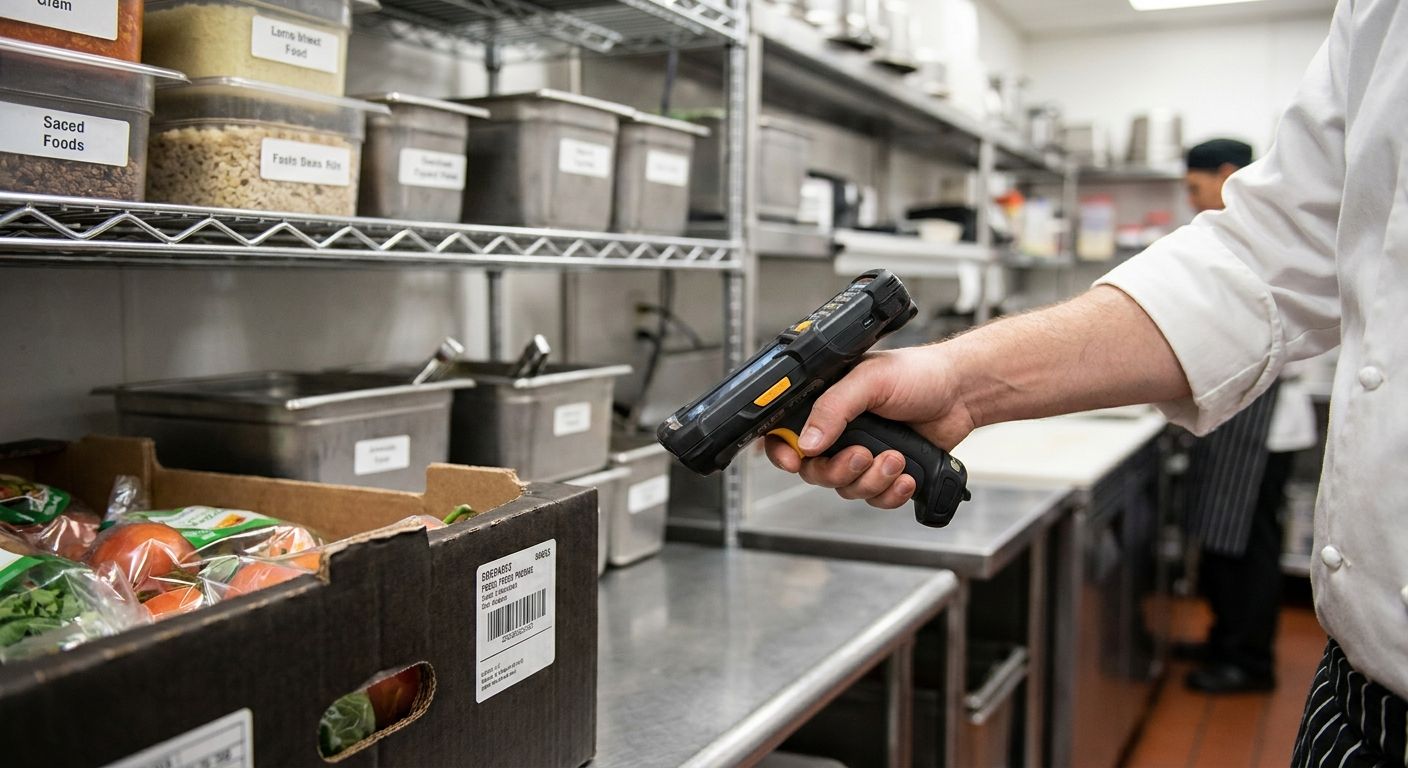
Restaurants scan barcodes for three jobs: ringing up retail add-ons at the counter, checking in vendor deliveries, and counting stock in the walk-in without a clipboard. The best barcode scanner for restaurants in 2026 matches the scan job to the hardware — a 1D reader for straight UPC codes at the register, a 2D imager for QR codes on invoices, delivery apps, and loyalty screens.
- GoDEX GS220 USB Barcode Scanner is the buy for single-location restaurants doing fast 1D counter scanning at $86.
- 2D imager scanners read QR codes on delivery driver phones and loyalty apps — skip 1D-only units if you take mobile orders.
- Wireless Bluetooth scanners suit multi-station kitchens; corded USB units suit a fixed POS counter.
- Back-of-house inventory counts need a scanner paired with real barcode labels, not standalone hardware alone.
- The best barcode scanner for restaurants in 2026 is chosen by station, not by lowest sticker price.
Why this matters
Most restaurant back offices still count walk-in stock by hand at close, which is slow and error-prone compared to a scan-and-log routine. A mismatched scanner is the usual failure point: a 1D-only unit can't read the QR code on a supplier invoice, and a scanner with no labels to pair against is just a toy.
Getting this right in 2026 means picking hardware for the station it lives at — counter, back office, or walk-in — and running it against labels built for repeated scanning, not printer paper taped to a shelf. Asset tags for restaurant and food service equipment cover the equipment side of this; scanners cover the stock and receiving side.
How we ranked
Each entry below is judged on four things: symbology support (1D-only versus 2D imaging), connection type (USB versus Bluetooth), fit for a specific restaurant station, and total cost including support. GoDEX hardware carries a documented 3-year warranty, which matters more in a kitchen environment than in an office — grease, drops, and cold-room condensation shorten the life of cheap unbranded scanners fast. Generic scanner categories are described by what the symbology and connection type actually do, not by invented brand comparisons.
The best barcode scanners for restaurant and food service inventory
The plug-and-play pick: GoDEX GS220 USB Barcode Scanner
This is a 1D CCD scanner that reads straight off USB with no driver install — plug it into the POS terminal and it acts like a keyboard. At $86 with a 3-year warranty, it covers standard UPC and Code-128 barcodes on retail add-ons, packaged goods, and supplier cartons.
For a single-location restaurant scanning straight barcodes at one counter, this is the buy. It won't read QR codes, so skip it if your delivery platform or loyalty program leans on 2D symbols.
Verdict: Buy for single-counter 1D scanning in 2026.
The 2D upgrade for QR-heavy operations
2D imager scanners read both linear barcodes and 2D symbols — QR codes, PDF417, Data Matrix — which matters the moment a delivery driver hands you a QR code on a phone screen or a supplier sends a QR-coded invoice. Best 2D barcode scanner for scanning QR codes on inventory breaks down what separates an imager from a laser scanner.
A 2D imager also reads damaged or low-contrast codes better than a 1D laser, which is common on receipts and thermal-printed invoices that have faded.
Verdict: Consider if any part of your ordering, loyalty, or receiving workflow touches QR codes in 2026.
The wireless pick for multi-station kitchens
Bluetooth scanners cut the cord between the register and the person actually receiving the delivery at the back door. A cordless unit lets one scanner move between the loading dock, the walk-in, and the counter instead of buying three fixed units.
The tradeoff is battery management and a higher price point than a corded USB scanner. For a single small counter, this is overkill.
Verdict: Hold unless you're running multiple stations that need one scanner to move between them.
The back-of-house inventory workhorse
Counting walk-in and dry storage stock only works if the barcode labels on the shelf or bin survive spills, cold, and repeated handling. Pair a USB scanner with 3M heavy-duty barcode inventory labels instead of printing on standard paper stock that peels in a walk-in cooler within weeks.
The scanner is only half the system — the label has to hold a scannable barcode through the same conditions the scanner works in.
Verdict: Buy for kitchens doing weekly or nightly stock counts.
The skip: unbranded marketplace scanners
No-name scanners sold without a stated warranty or documented support are the entry that looks cheapest and costs the most in downtime. When one stops reading mid-shift, there's no support line and no replacement path.
Verdict: Skip for any restaurant that depends on the scanner working every shift in 2026.


Comparison table
| Option | Connection | Best station | Verdict |
|---|---|---|---|
| GoDEX GS220 (1D) | USB | Front counter | Buy |
| 2D imager | USB or Bluetooth | Receiving, delivery QR codes | Consider |
| Wireless Bluetooth | Bluetooth | Multi-station kitchen | Hold |
| Scanner + 3M heavy-duty labels | USB | Walk-in, dry storage | Buy |
| Unbranded marketplace scanner | Varies | Nowhere reliable | Skip |
Where to buy
Buy from a source that states the warranty terms up front — a scanner with a documented 3-year warranty, like the GoDEX GS220, is a different purchase than one with no support path listed at all. Confirm the scanner's connection type matches your POS software before ordering; a USB scanner that isn't recognized as a keyboard input device will need extra configuration.
Order the scanner and the labels it will read together. A 1D CCD scanner needs standard linear barcodes; a 2D imager can read both linear and QR, so match the label print job to the scanner you actually bought. Best barcode scanner for small business inventory covers the same sourcing logic outside food service if you're comparing against a retail setup.
FAQ
What's the best barcode scanner for restaurants in 2026?
The GoDEX GS220 USB Barcode Scanner is the best pick for single-location restaurants scanning standard 1D barcodes at the counter, priced at $86 with a 3-year warranty. Multi-station kitchens or QR-heavy workflows need a 2D imager or wireless unit instead.
Is a 2D scanner better than a 1D scanner for a restaurant?
A 2D imager reads both linear barcodes and QR codes, which matters if delivery drivers, loyalty apps, or supplier invoices use QR symbols. A 1D-only scanner is cheaper but can't read those codes at all.
How much does a barcode scanner for restaurants cost?
A basic USB 1D scanner like the GoDEX GS220 costs $86. Wireless and 2D imager models generally cost more, though exact pricing varies by retailer.
Do I need a wireless barcode scanner for a restaurant?
Only if one scanner needs to move between multiple stations, like the loading dock, walk-in, and counter. A single fixed counter is better served by a corded USB scanner with no battery to manage.
Can a barcode scanner read a QR code on a customer's phone?
Only a 2D imager scanner reads QR codes reliably off a phone screen. A 1D laser or CCD scanner is built for printed linear barcodes and generally can't read screen-displayed QR codes.
What labels work with a restaurant barcode scanner?
Barcode inventory labels rated for the environment they'll live in — heavy-duty 3M stock for walk-ins and stockrooms, semi-gloss for dry storage — keep the printed barcode scannable through repeated handling.
Does a barcode scanner come with a warranty?
GoDEX scanners, including the GS220, ship with a 3-year warranty as of 2026. Confirm warranty terms before buying an unbranded or marketplace-only unit.
What connection type should a restaurant scanner use?
USB is the simplest for a fixed POS counter and needs no battery management. Bluetooth adds mobility for staff moving between stations but costs more and needs charging.
One last thing
The scanner rarely fails first — the label does. A 1D scanner paired with barcode labels that faded or peeled in the walk-in cooler produces the same result as no scanner at all: a manual recount. Match the label stock to the environment before blaming the hardware in 2026.