
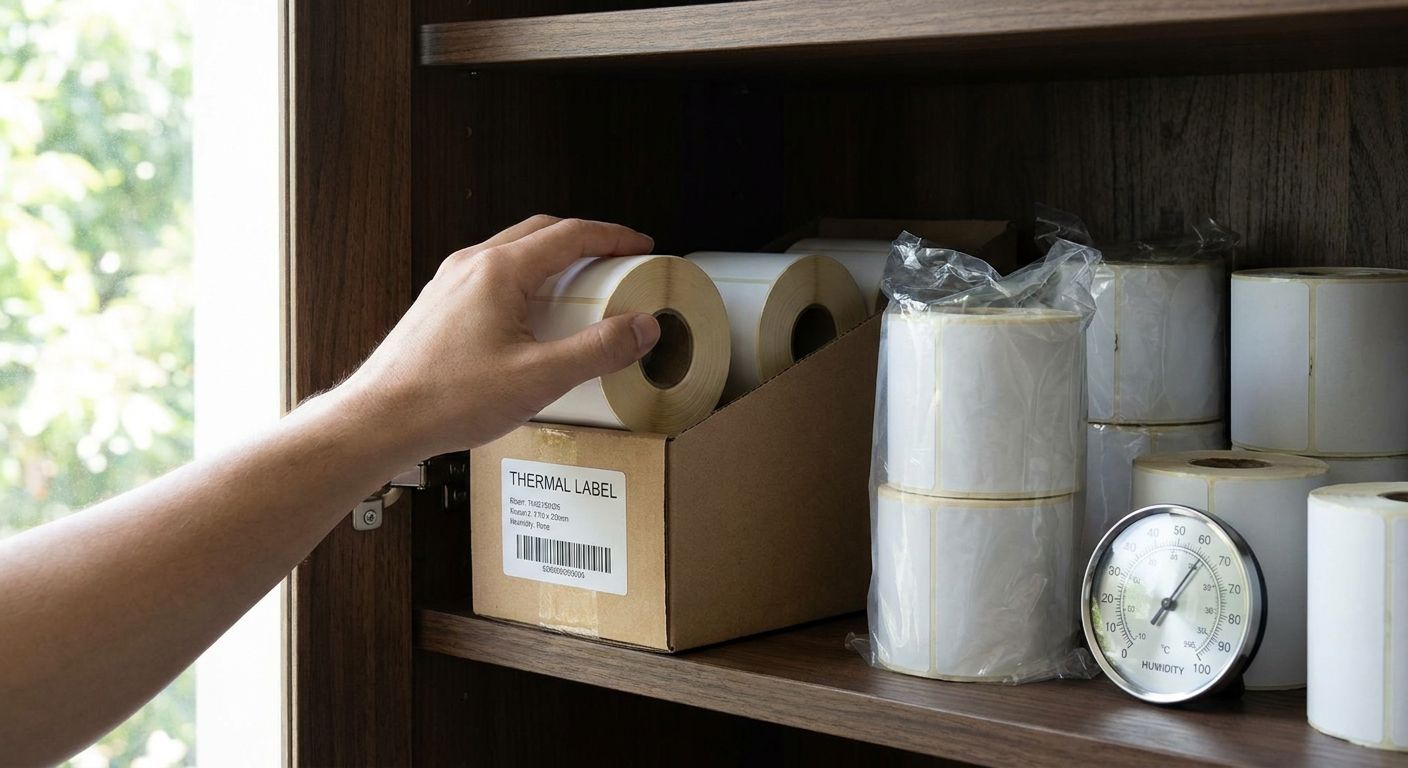
Direct thermal labels fade from heat, light, and time even when the print looks sharp on day one — store them wrong and a six-month-old asset tag or oil change sticker turns unreadable before the job it was tracking is even done.
This guide covers how to store thermal labels so the print survives as long as the label does, and when storage isn't the fix at all. If you're weighing direct thermal vs thermal transfer for a label that needs to last past a few months, that decision matters more than any storage tweak.
- Store direct thermal rolls below 75°F and 65% humidity, away from UV, or expect fading well before the end of 2026.
- Thermal transfer labels resist fade for years because the image is deposited by ribbon, not baked in by heat.
- Keep rolls sealed in original packaging until loaded — open-air exposure cuts usable shelf life fast.
- A faded label usually means bad storage, not a broken printer — check the roll before troubleshooting the printer.
Why This Matters
Direct thermal printing burns an image into a heat-sensitive coating — no ink, no ribbon, nothing between the printhead and the paper. That same coating that makes the technology fast and cheap is what makes it fragile after the fact. Heat, sunlight, and time keep reacting with the coating long after the label leaves the printer.
A parking permit stored in a hot glovebox, an oil change sticker baking under a windshield through summer, a barcode label sitting under a warehouse skylight — all three degrade the same way, just at different speeds. Storage is the variable most shops ignore. They troubleshoot the printer, blame the ribbon, reorder the label stock — when the real problem sat on a shelf for four months next to a space heater.
What You'll Need
- Original sealed packaging or a resealable poly bag for unused rolls
- A storage area that stays below 75°F (24°C) and under 65% relative humidity
- A location away from direct sunlight and high-UV fluorescent light
- A dated inventory sheet so older stock gets used first (FIFO)
- Thermal transfer ribbon and polyester label stock, for anything that needs to survive more than a few months
The Steps
1. Check the label type before you store anything
Direct thermal and thermal transfer labels don't age the same way, and treating them identically is the first mistake most shops make. Direct thermal stock has a heat-reactive coating baked into the paper, so it needs the cool, dark, dry conditions in this guide. Thermal transfer labels get their image from a ribbon depositing wax or resin onto the surface — the print itself doesn't react to ambient heat or light the way direct thermal does. Expected outcome: a five-second check of the roll tells you which storage rules apply.
Common mistake: assuming "thermal label" means one product. It doesn't.
2. Keep rolls sealed until they go in the printer
Every minute a direct thermal roll spends unwrapped is a minute of exposure to ambient UV and airflow, both of which accelerate the coating reaction. Original shrink-wrap or a poly bag with the air pressed out cuts that exposure close to zero. Load only what a shift or job needs, then reseal the rest immediately. Expected outcome: labels loaded three weeks from now look the same as labels loaded today.
Common mistake: leaving an open case of labels next to the printer "for convenience." That box is now an air-exposure test.
3. Control temperature, not just room temperature
75°F (24°C) is the practical ceiling for direct thermal stock kept in storage for more than a few weeks. Go higher and the coating starts reacting even without a printhead ever touching it. That rules out storing rolls in a vehicle, near a loading dock heater, or on a shelf directly above a printer that runs hot. Expected outcome: labels pulled from storage six months later still scan cleanly.
Common mistake: stacking rolls on top of the printer itself — printheads generate real heat, and that shelf is often the warmest surface in the room.
4. Manage humidity as carefully as heat
Moisture swells paper fibers and can trigger the same thermal reaction that heat does, especially in labels stored near loading docks or unconditioned warehouses. Keep relative humidity under 65% and add a desiccant pack to bulk storage bins in humid facilities. Expected outcome: labels feed evenly and don't curl or jam on the next print run.
Common mistake: storing rolls in a sealed but uninsulated metal shed — daily temperature swings inside can spike humidity even when outside air reads dry.
5. Block light, especially UV and fluorescent
Sunlight and certain fluorescent tubes emit enough UV to darken direct thermal coating within weeks, not months. Store rolls in a closed cabinet or opaque tote rather than an open shelf under a skylight or window. Windshield oil change stickers face this worst — printed, applied, and immediately exposed to full sun for months at a stretch. Expected outcome: printed labels hold contrast for the full length of the service interval they're meant to track.
Common mistake: assuming indoor storage is automatically safe. An office under a skylight can do more damage than a shaded outdoor shed.
6. Rotate stock first-in, first-out
Direct thermal rolls have a practical shelf life even in perfect storage — most stock is legible for 6 to 12 months without lamination before contrast starts dropping. Date incoming stock and pull from the oldest batch first so nothing sits past its usable window. Expected outcome: no surprise pallet of faded labels discovered mid-job in 2026.
Common mistake: bulk-buying to save per-roll cost, then storing a year of inventory in conditions that guarantee half of it fades before use.
7. Switch to thermal transfer for anything long-lived
If a label needs to stay legible for a year or more — asset tags, equipment ID, anything outdoors — direct thermal isn't the right technology, no matter how well it's stored. Thermal transfer ribbon paired with polyester or vinyl stock resists fade, moisture, and abrasion in a way no direct thermal storage protocol can match. McAuley Labels sells both the ribbon and the printers built to run it. Expected outcome: labels applied once that read correctly years later, not months.
Common mistake: sticking with direct thermal stock for permanent asset tags because the printer's already set up for it. The printer usually needs a ribbon-compatible model, not just different stock.


Troubleshooting
- Label looks faded straight out of the box: the coating was already stressed before it reached you — check storage history with the supplier, not printer settings.
- Print darkens unevenly across the label width: printhead pressure or heat settings are miscalibrated, not a storage issue — recalibrate before reordering stock.
- Barcode won't scan after 3 months in the field: the application probably needed thermal transfer instead of direct thermal — outdoor or long-duration uses need ribbon-based printing.
- Labels feel brittle or curl at the edges: humidity exposure during storage, most likely near an exterior wall or loading dock — relocate stock and add desiccant.
- New rolls already show a slight yellow tint: the batch spent too long in transit or warehouse heat before reaching the shop — request replacement stock and confirm shipping conditions with the supplier.
- Oil change stickers fade within one service interval: full sun on a windshield accelerates direct thermal fade regardless of storage — that's a technology limit, not a storage failure.
Tools and Resources
- Thermal transfer ribbon sized to the print width of your printer
- Polyester or vinyl label stock rated for thermal transfer, for tags that need to survive daylight and years rather than weeks
- A printer rated for both direct thermal and thermal transfer runs, so switching media doesn't mean buying new hardware
- A dedicated storage cabinet or opaque bin, kept away from exterior walls and windows
- A humidity gauge for any storage room that isn't climate-controlled year-round
What to Do Next
If labels are coming out faded even with clean storage, the problem is usually upstream of the roll — printhead heat settings, pressure, or a mismatched ribbon type. Work through the print settings before reordering stock, and if the issue is fade appearing after weeks in the field rather than in storage, that's a technology mismatch, not a storage mistake — direct thermal wasn't built for that duration.
FAQ
How do you store thermal labels to prevent fading?
Keep direct thermal rolls sealed in original packaging, below 75°F (24°C) and under 65% relative humidity, away from direct sunlight and UV-heavy fluorescent light. Rotate stock first-in, first-out so nothing sits past its usable window.
How long do direct thermal labels last before fading?
Unlaminated direct thermal labels typically stay legible for 6 to 12 months even with good storage. Heat, sunlight, and humidity all shorten that window, sometimes to weeks.
Is thermal transfer better than direct thermal for fading?
Yes — thermal transfer labels resist fade for years because the ribbon deposits wax or resin onto the label rather than relying on a heat-reactive coating. Direct thermal is cheaper per label but degrades with heat, light, and time regardless of storage.
Can you store thermal labels in a hot warehouse?
Not without consequences. Anything above 75°F (24°C) for extended periods accelerates the coating reaction in direct thermal stock, so a hot warehouse corner will fade labels faster than a climate-controlled shelf.
Do oil change stickers fade faster than other thermal labels?
Yes, because they're applied to a windshield and exposed to direct sun immediately after printing. Full sun exposure accelerates direct thermal fade regardless of how the unused roll was stored beforehand.
What causes yellow or brown discoloration on unused thermal rolls?
Discoloration on stock that hasn't been printed yet usually means heat or UV exposure during storage or transit. It signals the coating has already started reacting before the label ever reaches the printer.
Does humidity affect thermal label fading?
Yes. Moisture swells the paper fibers and can trigger the same reaction as heat, especially in labels stored near loading docks. Keep relative humidity under 65% and use desiccant packs in humid storage areas.
Should asset tags use direct thermal or thermal transfer?
Asset tags meant to last a year or more should use thermal transfer with polyester or metalized stock. Direct thermal works for short-term labels but isn't built for long-term legibility on equipment tracked for years.
One Last Thing
The fade problem most shops fight isn't a storage problem at all — it's a technology mismatch. Direct thermal was built for receipts and short-lived shipping labels, not two-year asset tags or windshield stickers baking in July sun. Store it perfectly and it still has a ceiling. Thermal transfer doesn't have that ceiling, which is why McAuley Labels pairs its ribbon-compatible printers with polyester and vinyl stock for anything meant to outlast a season.