
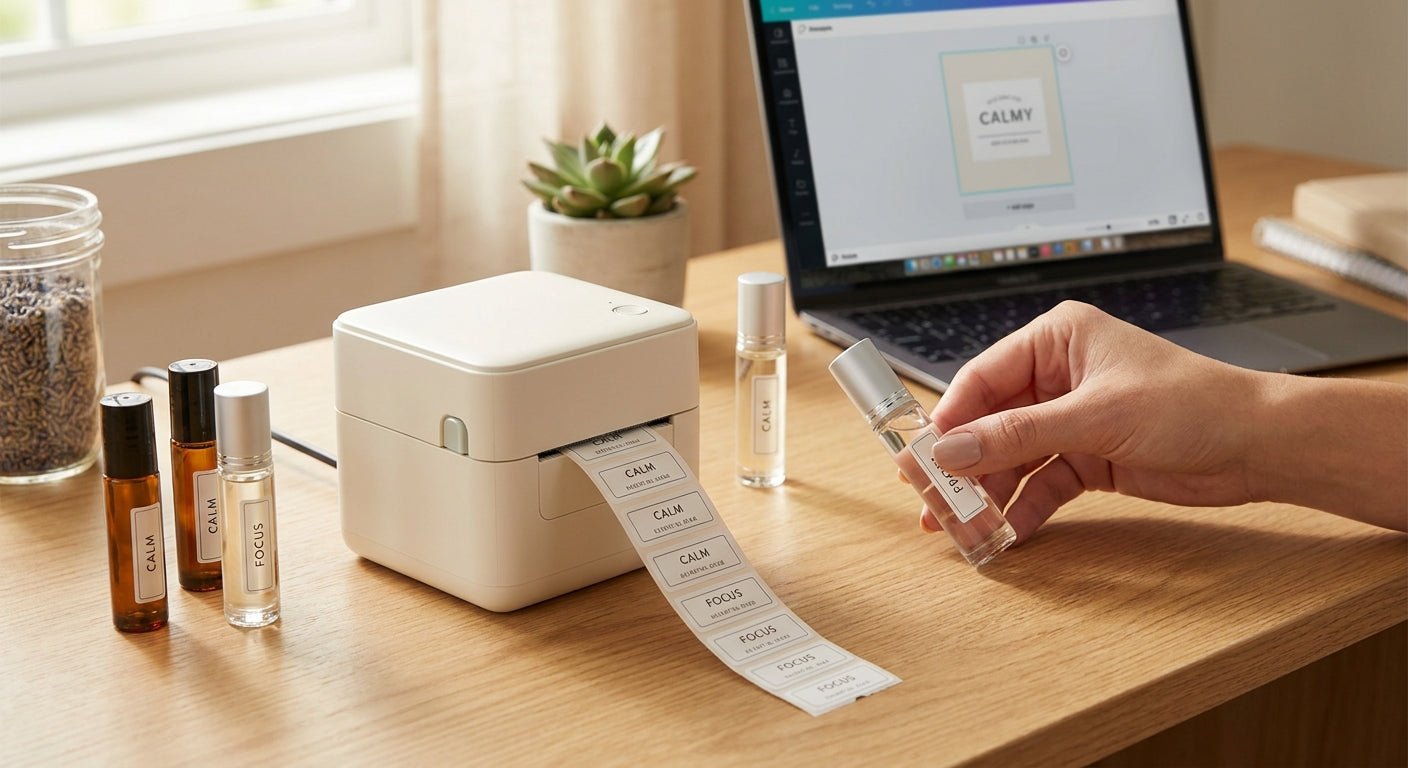
Essential oil roller bottles measure roughly 10ml, and the label wrapping that barrel has about 1.75 inches of usable width before text turns into a smear. Picking the right label printer for roller bottles in 2026 comes down to resolution, label material, and whether the machine can handle small-batch runs without choking on 0.5-inch labels.
TL;DR
The GoDEX RT863i (600 dpi) is the Buy for anyone printing ingredient lists, batch codes, or QR codes on roller bottle labels smaller than 1 inch tall — its resolution renders 5-point text and dense barcodes cleanly where 203 dpi machines turn letters into blobs. The GoDEX RT230i (300 dpi) is the Buy for shops that need speed and lower cost per label and don't require microscopic text. Skip 203 dpi desktop printers for roller bottles unless your labels are logo-only with no fine print. Pair either printer with polyester thermal transfer stock, not direct thermal paper, because essential oils degrade direct thermal coatings within weeks.
Why This Matters
Roller bottle labels fail two ways: the print smears from oil contact, or the resolution is too low to fit compliance text (net contents, batch number, safety statement) into a half-inch label. A 203 dpi printer prints at roughly 8 dots per millimeter — fine for a shipping label, rough for a label that needs six lines of copy in a 1-inch square.
Most small-batch essential oil brands underestimate this until their first print run comes back with unreadable ingredient lists. The fix isn't a bigger label — bottle real estate is fixed — it's higher print resolution and label stock that resists oil migration. McAuley Labels sees this pattern across the essential oil bottle labeling guide: brands that start with a 203 dpi machine almost always upgrade within a year.
How We Ranked
This list weighs four factors that matter specifically for roller bottles: print resolution relative to label size, ribbon/material compatibility with oil-exposed surfaces, throughput for batch runs of 50-500 units, and cost per label at small-batch volume. Rankings draw on published GoDEX spec sheets (dpi, print speed, ribbon width) and known material behavior for polyester versus paper stock under oil exposure — not lab testing claims. Every pick below gets a verdict: Buy, Consider, Hold, or Skip, based on how well it fits the roller bottle use case specifically, not general labeling.
The Ranked List
1. GoDEX RT863i — the detail king
Resolution: 600 dpi. This is the highest-resolution printer in the GoDEX lineup and the only one that renders 6-point ingredient text legibly on a label under 1 inch tall. If your roller bottle labels carry a QR code linking to batch info or a full INCI ingredient list, 600 dpi is the difference between scannable and blurred. Print speed runs slower than 300 dpi models, which matters if you're doing 1,000+ units a week but not for typical small-batch runs of 50-300 bottles. Verdict: Buy for any brand printing dense text or QR codes on roller bottle labels — check the GoDEX RT863i thermal printer spec sheet before ordering ribbon width.
2. GoDEX RT230i — the balanced pick
Resolution: 300 dpi. This hits the sweet spot for most roller bottle brands: sharp enough for standard 8-10 point label text, fast enough for batch runs, and priced below the 600 dpi tier. 300 dpi handles brand name, scent, volume (10ml), and a basic barcode without issue. Where it falls short is dense multi-line ingredient text packed into a half-inch label — that's when you step up to 600 dpi. Verdict: Buy for standard roller bottle labeling; the GoDEX RT230i thermal printer is the default recommendation for 2026 unless your label design is text-heavy.
3. GoDEX GE300 — the budget entry
Resolution: 203 dpi. This is a genuinely useful printer for shipping labels and general inventory tags, but 203 dpi struggles once you shrink text below 8 points, which is common on roller bottle labels once you add ingredients, a batch code, and a barcode. Fine for logo-only labels with minimal copy. Verdict: Consider only if your label design is sparse; otherwise Skip for roller bottles.
4. GoDEX RT700i — the shop-floor screen
This model adds a 4-inch color display for on-machine template selection, useful if multiple staff print different SKUs during a shift. Resolution sits at standard desktop tier, adequate for mid-complexity labels but not a resolution upgrade over the RT230i. The display is the differentiator, not the print quality. Verdict: Consider for multi-operator setups; Skip if a single person handles all printing.
5. GoDEX G500 — the workhorse
A straightforward desktop unit built for consistent daily runs rather than peak resolution. It handles standard barcode and text labels reliably but won't outperform the RT230i on roller bottle detail work. Good as a secondary printer for shipping and outer-box labels once your roller bottle line scales. Verdict: Hold — better suited to shipping labels than the bottle labels themselves.
6. Polyester white thermal transfer labels — the material that survives oil contact
Printer choice only solves half the problem. Direct thermal paper labels react to oil, heat, and skin contact by fading or lifting within weeks — a known failure mode for anything applied to a bottle that gets handled daily. Polyester white thermal transfer labels resist oil migration and stay legible past the 6-12 month mark that direct thermal paper typically fails at. Verdict: Buy — pair this stock with a thermal transfer ribbon, not a direct thermal printer.
7. GoDEX RT200i — the legacy option
An older-generation 203 dpi model still in circulation. It works, but offers no resolution advantage over the GE300 and no speed advantage over the RT230i. There's no scenario in 2026 where this beats the other options on this list for roller bottle labeling. Verdict: Skip.
Comparison Table
| Printer/Material | Resolution | Best For | Verdict |
|---|---|---|---|
| GoDEX RT863i | 600 dpi | Dense text, QR codes, compliance labels | Buy |
| GoDEX RT230i | 300 dpi | Standard roller bottle labels | Buy |
| GoDEX GE300 | 203 dpi | Logo-only, sparse copy | Consider/Skip |
| GoDEX RT700i | Standard | Multi-operator shop floors | Consider |
| GoDEX G500 | Standard | Shipping labels, not bottle detail | Hold |
| Polyester white TT labels | N/A | Oil-resistant label stock | Buy |
| GoDEX RT200i | 203 dpi | Legacy setups only | Skip |
Where to Buy
- Buy the printer, ribbon, and label stock together as a matched set — mismatched ribbon width or material causes most print-quality complaints, not the printer itself.
- Confirm the label size in your design file matches the roller bottle's usable print area (commonly 0.5" x 1.75" for standard roller bottles) before ordering a print run.
- Avoid unauthorized resellers for GoDEX hardware — driver support and calibration files matter more for small-batch printing than for high-volume operations, and mismatched firmware is a common source of alignment errors.
FAQ
What's the best label printer for roller bottles in 2026? The GoDEX RT863i at 600 dpi is the best choice for dense ingredient text or QR codes; the GoDEX RT230i at 300 dpi covers standard labels with less text at a lower cost per unit.
Is 300 dpi enough for essential oil roller bottle labels? Yes, for most standard labels with brand name, scent, and a basic barcode. Once you add multi-line ingredient lists or fine print under 8 points, move to 600 dpi.
Do I need thermal transfer or direct thermal for roller bottles? Thermal transfer, paired with polyester stock. Direct thermal paper fades from oil and handling contact within weeks to a few months.
How much does a label printer for roller bottles cost? Pricing varies by model and resolution tier — check current pricing on the specific GoDEX model pages, since 600 dpi units cost more than 300 dpi units.
Can I use a regular office printer for roller bottle labels? No. Inkjet and laser printers don't produce labels durable enough for oil contact, and most lack the resolution for text under 8 points at label sizes this small.
What size are roller bottle labels usually printed at? Most roller bottle labels run around 0.5" x 1.75", which is why resolution matters more here than on standard 4x6 shipping labels.
Is the GoDEX RT863i overkill for a small essential oil brand? Not if your label includes an ingredient list or QR code. It's overkill only if your label design is logo and scent name with nothing else.
How often do roller bottle labels need to be reprinted due to fading? With direct thermal paper, expect fading within a few months of regular handling. Thermal transfer on polyester stock holds up significantly longer.
One Last Thing
Most brands assume the printer is the whole decision — it's actually the smaller of two variables. A 600 dpi GoDEX RT863i loaded with the wrong ribbon-to-label combination will still smear on contact with essential oils within weeks. Match the printer resolution to your label copy first, then match the ribbon and stock to the oil exposure, and the label problem disappears for good in 2026.