
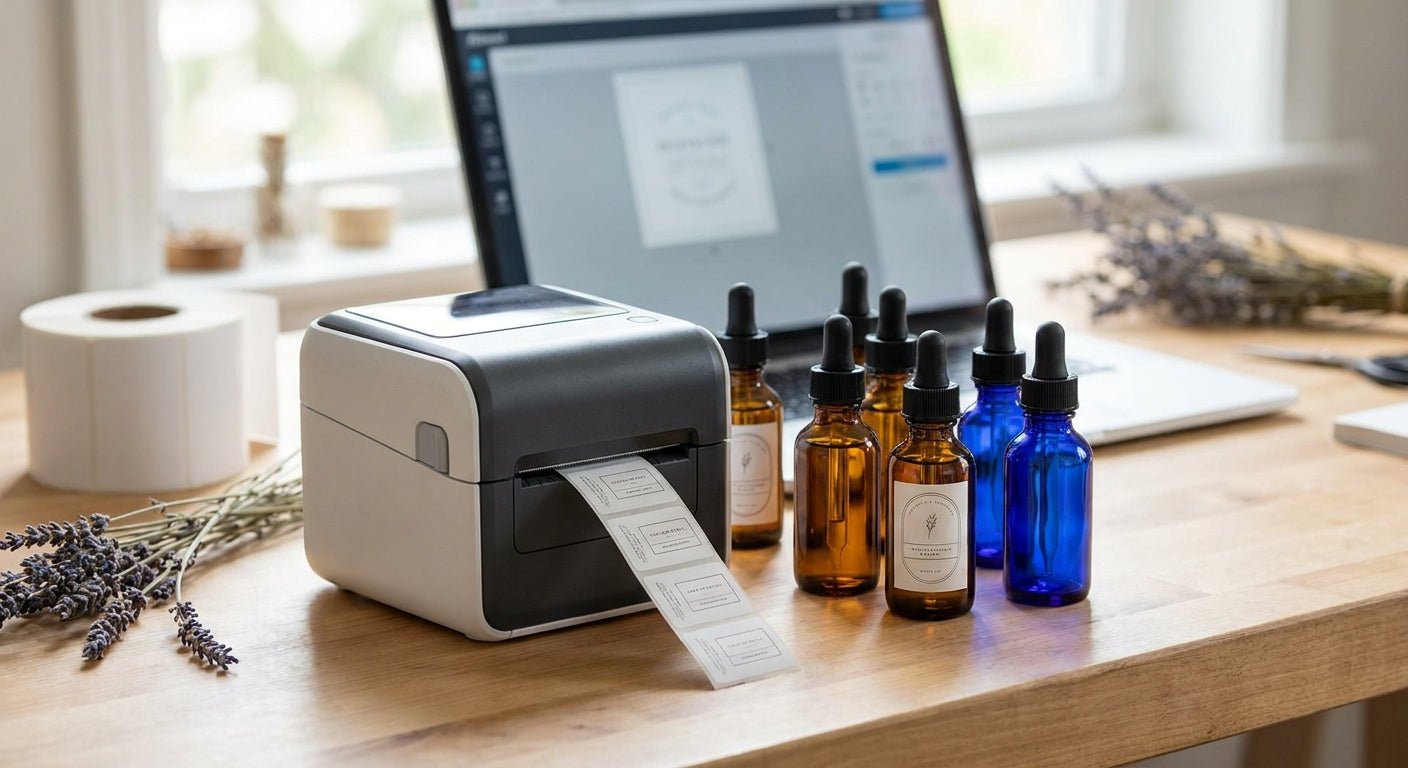
Dropper bottles and tincture bottles need labels that wrap tight around a small barrel, resist alcohol-based tinctures and MCT oil, and stay legible at 8-point font for dosage text. Here's the printer that gets that right in 2026, and the two that don't.
- GoDEX RT230i (300 DPI) is the best label printer for dropper bottles in 2026 for shops printing 0.5 to 1.5-inch labels with dosage text — Buy.
- GoDEX RT863i (600 DPI) is the pick for sub-6pt ingredient panels and compliance text — Buy if your labels carry full supplement facts.
- GoDEX DT230 (300 DPI direct thermal) works for short-shelf-life batches but fades under alcohol contact within weeks — Consider only for internal-use labels.
- Skip 203 DPI industrial printers like the GE330 for dropper bottles; the resolution blurs small serif fonts at that label size.
Why this matters
A tincture label is small and dense: brand name, dosage, ingredient list, batch code, sometimes a QR code, all inside an inch or two of barrel space. Print that at low resolution and the text turns to mush the moment a customer squints at the dropper.
Most general-purpose thermal printers are built for 4x6 shipping labels, not 0.75-inch tincture wraps. The GoDEX RT230i thermal printer (300 DPI) solves the density problem without the price jump of a 600 DPI unit, which is why it tops this list for most CBD, tincture, and essential oil brands printing in-house in 2026.
Alcohol-based tinctures also chew through direct thermal coatings. If your bottle gets handled with wet hands or splashed during dosing, thermal transfer with a proper ribbon holds up. Direct thermal alone does not, and that distinction decides half the picks below.
How this list was ranked
Each printer here is evaluated against three factors specific to dropper bottle labeling: print resolution relative to typical 0.5 to 2-inch label sizes, resistance to alcohol and oil exposure via direct thermal vs. thermal transfer printing, and real-world throughput for small-batch runs common to tincture producers. Specs come from published GoDEX hardware documentation as of 2026. Ranking excludes printers built primarily for 4x6 shipping or pallet-tag use, since those trade small-label sharpness for speed on large formats.
The ranked list
1. GoDEX RT230i (300 DPI thermal transfer) — the safe pick
The GoDEX RT230i 300 DPI printer is a 300 DPI thermal transfer unit built for exactly this label size. Thermal transfer means it runs a ribbon against the label stock instead of relying on heat-reactive paper, so text and barcodes survive alcohol wipe-downs and warehouse handling that would smear a direct thermal label within days.
Most tincture brands run 0.75 to 1.5-inch labels with an 8 to 10-point ingredient panel. At 300 DPI, that text prints clean without the printer cost of a 600 DPI machine. Pair it with polyester stock for bottles that see moisture or oil contact.
Verdict: Buy. This is the default recommendation for any brand printing tincture or dropper bottle labels in-house in 2026.
2. GoDEX RT863i (600 DPI thermal transfer) — the sharp-text pick
The GoDEX RT863i thermal printer runs at 600 DPI, roughly double the resolution of the RT230i. That matters when labels carry supplement facts panels, sub-6pt regulatory text, or dense QR codes that need to scan reliably at small sizes.
If your dropper bottle label includes a full ingredient deck with milligram dosing per compound, 300 DPI starts to look soft under a loupe. 600 DPI does not.
Verdict: Buy if your labels carry compliance-heavy text; otherwise the RT230i covers most tincture use cases at lower cost per unit.
3. GoDEX DT230 (300 DPI direct thermal) — the budget pick
The GoDEX DT230 direct thermal printer skips the ribbon entirely and heat-activates the label stock directly. That cuts consumable cost and simplifies setup, and the 300 DPI resolution matches the RT230i for text sharpness.
The catch: direct thermal labels degrade under UV exposure and heat, and they do not hold up to alcohol contact the way thermal transfer does. A tincture label that gets handled by a hand with alcohol residue on it will start fading within weeks, not months.
Verdict: Consider for short-shelf-life internal labels or samples. Skip for retail-facing dropper bottles that need to stay legible for the product's full shelf life.
4. GoDEX GE330 (203 DPI thermal transfer) — the wrong tool for this job
The GE330 is a solid workhorse for 4x6 shipping labels and asset tags, where 203 DPI is plenty of resolution at a larger label footprint. Drop it down to a 1-inch tincture label and that same resolution starts blurring serif fonts and thin barcode bars.
It is not a bad printer — it is built for a different label size than dropper bottles need.
Verdict: Wait. Fine for warehouse labeling, wrong resolution class for tincture work.
5. GoDEX RT200i (203 DPI thermal transfer) — the entry-level compromise
The RT200i shares the same 203 DPI resolution ceiling as the GE330 but in a smaller desktop footprint more suited to low-volume tincture shops. It handles basic text-only labels fine but struggles once you add fine-print ingredient panels or small QR codes.
Verdict: Consider only if your dropper bottle labels are large-format (1.5 inches or bigger) with minimal small text. Otherwise, step up to 300 DPI.
Comparison table
| Printer | Resolution | Print method | Best for | Verdict |
|---|---|---|---|---|
| GoDEX RT230i | 300 DPI | Thermal transfer | Standard tincture labels, dosage text | Buy |
| GoDEX RT863i | 600 DPI | Thermal transfer | Compliance panels, sub-6pt text | Buy |
| GoDEX DT230 | 300 DPI | Direct thermal | Short-shelf-life, internal labels | Consider |
| GoDEX GE330 | 203 DPI | Thermal transfer | Shipping labels, not tincture-scale | Wait |
| GoDEX RT200i | 203 DPI | Thermal transfer | Large-format, low-detail labels | Consider |
Where to buy
- Buy the printer and matching ribbon together — thermal transfer resolution only holds up with a ribbon rated for the resin or wax-resin blend the label stock calls for.
- Match label stock to bottle contact: polyester white thermal transfer labels resist oil and alcohol better than paper stock for tincture and dropper applications.
- Confirm DPI before ordering die-cut label rolls sized for dropper bottles — a 300 DPI printer and a label designed for 600 DPI density will produce blurrier output than either spec alone suggests. The 300 DPI vs 600 DPI guide breaks down which resolution matches which label density.
“A 203 DPI printer built for shipping labels is the wrong tool for a 1-inch tincture wrap — the resolution doesn't scale down.”
FAQ
What's the best label printer for dropper bottles in 2026?
The GoDEX RT230i, a 300 DPI thermal transfer printer, is the best label printer for dropper bottles for most tincture and CBD brands in 2026. It balances print sharpness for small dosage text with alcohol and oil resistance from thermal transfer ribbon.
Is 300 DPI enough for tincture bottle labels?
Yes, 300 DPI covers standard dropper bottle labels with dosage text and barcodes at 0.75 to 1.5 inches. Step up to 600 DPI only if the label carries a full supplement facts panel or sub-6pt regulatory text.
Can I use a direct thermal printer for dropper bottle labels?
Direct thermal works for short-shelf-life or internal-use labels, but the printed image fades under alcohol contact and UV exposure within weeks. Thermal transfer holds up better for retail-facing tincture labels.
What label material resists alcohol tinctures best?
Polyester label stock printed with thermal transfer ribbon resists alcohol, oil, and moisture better than paper stock or direct thermal paper. Paper stock softens and smears when handled with alcohol residue on hands.
How much does a thermal transfer printer for dropper bottles cost in 2026?
Pricing varies by model and DPI tier — check current listings for the GoDEX RT230i and RT863i, since 600 DPI units generally cost more than 300 DPI units. Ribbon and label stock are ongoing consumable costs on top of the printer itself.
Is 203 DPI good enough for CBD tincture labels?
203 DPI is built for larger-format shipping and warehouse labels, not small tincture wraps. Text and barcodes at 1-inch label size print noticeably softer at 203 DPI than at 300 DPI.
Do I need a QR code on a dropper bottle label?
QR codes for batch tracking or lab results are common on tincture labels but need at least 300 DPI to scan reliably at small sizes. Lower resolution printers can produce QR codes that fail to scan consistently.
One last thing
The resolution spec gets all the attention, but ribbon match matters just as much: a wax-resin ribbon on a polyester label outlasts a straight wax ribbon by a wide margin under alcohol contact, and that's the detail most tincture brands skip when they first set up a label printer for dropper bottles. Get the ribbon chemistry right and the 300 DPI GoDEX RT230i outperforms printers twice its price running mismatched consumables.