
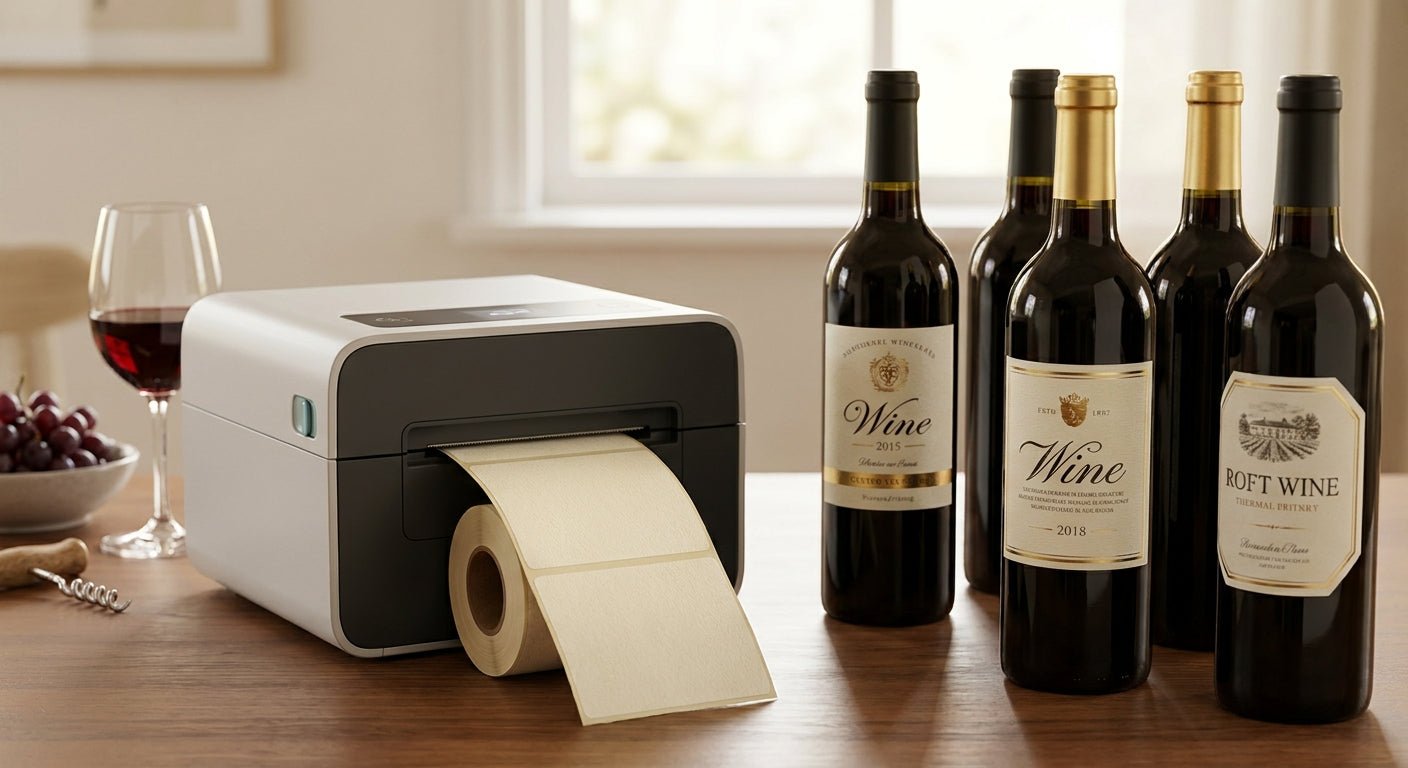
Choosing the right label printer for wine bottle labels means picking hardware that survives condensation, chills, and repeat handling without shedding print — not just a printer that looks the part on a shelf.
The GoDEX RT863i (600 dpi) is the strongest overall pick for wine bottle labels in 2026, and the GoDEX RT230i (300 dpi) is the budget-conscious runner-up for small-batch producers who don't need photo-grade resolution. Both handle thermal transfer ribbon, which matters more for wine labels than direct thermal because bottles get wet, cold, and handled repeatedly before they ever reach a table. If you're printing fewer than 500 labels a month, skip the 600 dpi option — you're paying for resolution you won't use.
Why this matters
Wine bottle labels take on water condensation from ice buckets, temperature swings from cellar to shelf, and friction from repeated pickup at retail. A direct thermal label without ribbon protection fades within weeks under those conditions — the print darkens, smears, or disappears entirely if it sits near a heat source. Thermal transfer printing, where a ribbon melts pigment onto the label surface, is the baseline requirement for anything going on a bottle that customers will touch more than once.
Resolution matters too, but not the way most buyers assume. A 203 dpi printer handles bold text and simple barcodes fine. A wine label with fine serif fonts, a vintage year in small type, or a QR code linking to tasting notes needs 300 dpi minimum — and 600 dpi if the label includes gradient artwork or a logo with fine linework. The best label printer for craft breweries and wineries breaks down resolution needs by label complexity if you're printing across multiple product lines with different artwork demands.
How we ranked
Every printer below is evaluated on three factors that matter specifically for wine bottle labels: print method (thermal transfer only — direct thermal is disqualifying for this use case), resolution relative to label artwork complexity, and label stock compatibility for polyester or vinyl facestocks that resist moisture. Print speed and connectivity are secondary since most wine producers print in small batches, not high-volume runs. Rankings reflect published DPI specifications and printer classifications as of 2026.
The ranked list
1. GoDEX RT863i — the resolution pick
The GoDEX RT863i is a 4-inch thermal printer built at 600 dpi, the highest resolution in the GoDEX lineup carried by McAuley Labels. That resolution renders small vintage text, fine label borders, and detailed logo artwork without the jagged edges that show up on lower-dpi output. For a winery running estate-branded bottles with intricate crest logos or gold foil-style graphic elements, this is the printer that keeps label quality matching the bottle's price point. Verdict: Buy if your labels include fine typography or detailed artwork; Skip if you're printing simple text-and-barcode labels, since you'll pay for resolution you don't need.
2. GoDEX RT230i — the value pick
The GoDEX RT230i runs at 300 dpi, the practical middle ground for most wine label jobs. It handles standard label text, vintage years, appellation names, and basic QR codes cleanly, and it's the resolution tier most label converters recommend as a default for beverage packaging. This is the printer most small-to-mid producers should start with before upgrading. Verdict: Buy for standard wine label runs without heavy graphic detail.
3. GoDEX GE330 — the workhorse
The GoDEX GE330 is a 4-inch thermal transfer printer at 203 dpi, positioned as a durable desktop unit for repeat runs. At 203 dpi, fine artwork loses sharpness, but basic label copy and barcodes print cleanly and consistently across long runs. This is the printer to pick if your labels are simple — bottle contents, lot number, a barcode — and volume matters more than detail. Verdict: Consider for high-volume simple labels; Skip if your label design includes small serif fonts or gradient artwork.
4. GoDEX G530 — the compact desktop option
The GoDEX G530 is a thermal transfer desktop printer built for lower-footprint operations where counter space is limited — small tasting rooms, direct-to-consumer fulfillment stations, or secondary label stations away from a main production line. It's not the printer for a bottling line running thousands of units a shift, but it fills the gap for producers who need a dedicated wine label station without dedicating a full production printer to it. Verdict: Consider for secondary stations or low-volume producers; Wait if you need a single printer to cover your entire run.
5. GoDEX RT700i — the operator-friendly pick
The GoDEX RT700i ships with a 4-inch color display, which matters more than it sounds for wine producers running multiple label templates across different varietals in the same shift. Operators can switch label profiles and check print status without connecting to a workstation each time, which cuts changeover time on a bottling day with several SKUs in rotation. Verdict: Buy if you run more than three label templates in regular rotation; Skip for single-label operations where the display adds cost without adding function.
Comparison table
| Printer | Print method | Resolution | Best for |
|---|---|---|---|
| GoDEX RT863i | Thermal transfer | 600 dpi | Detailed artwork, fine typography |
| GoDEX RT230i | Thermal transfer | 300 dpi | Standard wine labels, best overall value |
| GoDEX GE330 | Thermal transfer | 203 dpi | High-volume, simple label copy |
| GoDEX G530 | Thermal transfer | Desktop unit | Low-volume or secondary stations |
| GoDEX RT700i | Thermal transfer | 4-color display | Multi-SKU production runs |
Where to buy
Buy direct from a manufacturer or authorized distributor rather than a marketplace listing — wine label printers need matched ribbon and label stock, and third-party sellers frequently bundle mismatched consumables. Confirm the label facestock before ordering: polyester-based stock holds up to condensation and refrigeration better than paper facestock, which is why thermal transfer polyester white label stock is the standard recommendation for anything going on a chilled bottle. If your label design or run size doesn't match a standard SKU, request a custom quote rather than forcing a fit with off-the-shelf stock.
FAQ
What's the best label printer for wine bottle labels in 2026? The GoDEX RT863i at 600 dpi is the top pick for producers with detailed label artwork, while the GoDEX RT230i at 300 dpi covers standard wine label needs at a lower resolution tier.
Is direct thermal or thermal transfer better for wine labels? Thermal transfer wins for wine bottles because it resists moisture and cold-condensation smearing; direct thermal labels fade and degrade when exposed to condensation or refrigeration over time.
Do wine bottle labels need 600 dpi printing? Only if the label includes fine typography, gradient artwork, or detailed logo work — 300 dpi covers standard text, vintage years, and basic barcodes without issue.
What label material works best for wine bottles? Polyester-based label stock resists moisture and handles refrigeration and condensation better than paper stock, making it the standard choice for wine and beverage labeling in 2026.
Can a desktop label printer handle wine bottle production runs? Yes for low-to-mid volume — a desktop unit like the GoDEX G530 works for tasting rooms and secondary stations, but higher-volume bottling lines need a dedicated production printer.
How much does a wine label printer cost? Pricing varies by resolution tier and print method — check current listings for each model, since 600 dpi units carry a premium over 203 dpi workhorse printers.
Do I need a color display on a label printer for wine labels? Only if you're rotating multiple label templates across varietals in the same shift — a color display like the one on the GoDEX RT700i speeds up changeovers but adds no value for single-SKU operations.
What's the difference between 203, 300, and 600 dpi for wine labels? 203 dpi handles bold text and barcodes, 300 dpi adds clarity for smaller text and QR codes, and 600 dpi is reserved for fine artwork and detailed logo work — most wine producers land on 300 dpi.
One last thing
The label stock matters as much as the printer. A 600 dpi printer running paper-based label stock will still fail on a chilled bottle within days, while a 203 dpi printer running polyester stock will outlast it in cold, wet conditions. Match the facestock to the environment before upgrading resolution — that's the fix most wineries actually need in 2026, not a printer upgrade.