
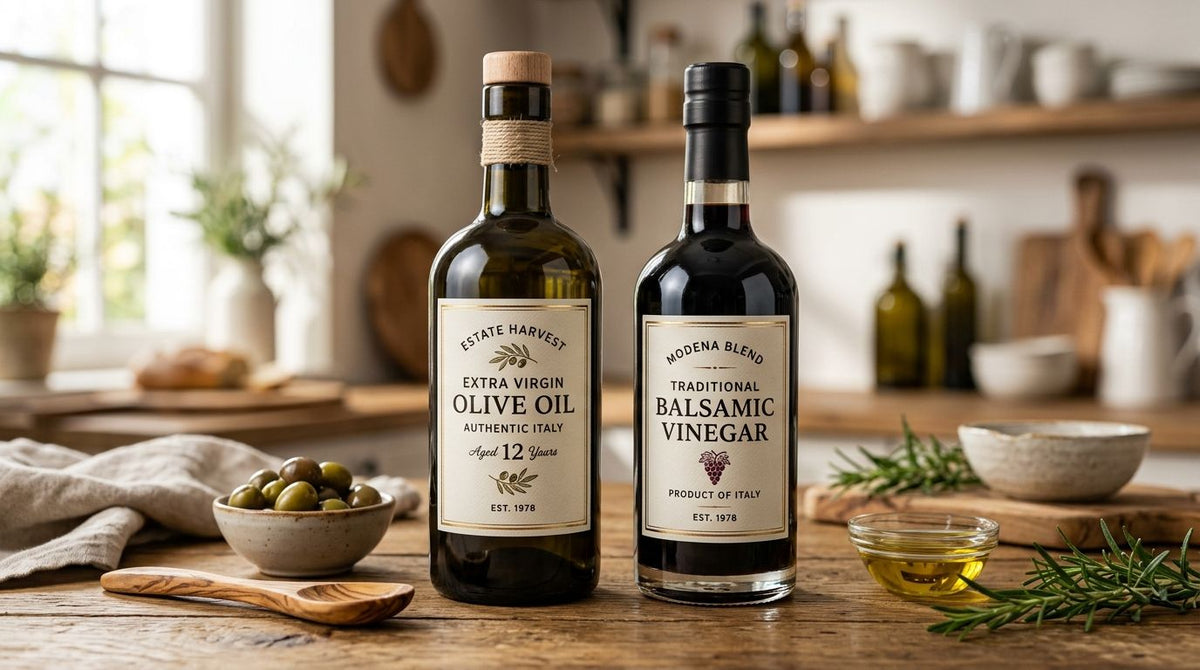
Custom labels for olive oil and vinegar bottles are printed labels engineered to survive oil migration, condensation, and repeated handling on glass or plastic bottles, with the goal of keeping brand, batch code, and best-by date legible for the full shelf life of the product. Standard paper labels absorb oil and turn translucent within weeks; standard adhesive lifts when a bottle sweats coming out of a cooler. This segment needs material and adhesive choices that most label buyers never have to think about.
- Custom labels for olive oil and vinegar bottles need oil-resistant film stock, not paper — paper yellows and goes translucent within weeks.
- Thermal transfer with white polyester film and resin ribbon is the standard combination for bottle labels that touch oil residue.
- McAuley Labels sells the direct thermal and thermal transfer polyester stock small-batch bottlers need, plus the GoDEX printers to run them.
- Test one label on an actual filled, capped bottle for 48 hours before committing to a print run of 500 or more.
Why custom labels matter for olive oil and vinegar bottle brands
A farmers market vendor or small-batch bottler doesn't sell on volume alone — the label is doing brand work on a shelf next to a dozen other bottles that look similar in size and color. A label that curls, smears a batch code, or peels at the neck seam undermines that shelf pitch instantly, and it's a returned-product problem, not just a cosmetic one.
The custom jar labels for food and beauty products guide covers the broader food-label category. Olive oil and vinegar bottles narrow that down to one specific failure mode: oil that seeps past the cap threads and gets onto the label surface itself, plus vinegar's acidity attacking weaker adhesives over time. Both liquids also condense on the outside of chilled or refrigerated bottles, which is the second common failure point in 2026 retail cold cases.
Choose a label material that resists oil and moisture
Start with material, not printer, because the wrong stock ruins even a perfect print.
- Skip uncoated paper labels entirely for bottles handled with oily fingers or wiped down after pouring
- Use a coated or laminated stock rated for oil contact if you're buying from a general print shop
- Choose polyester film over paper whenever the bottle will be refrigerated, since polyester doesn't absorb condensation
- Check that the adhesive is rated for glass — some general-purpose adhesives release at cold temperatures
- Wipe a sample swatch with olive oil for 24 hours before ordering a full batch
Match print method to your ribbon and label combination
Direct thermal printing uses heat alone and no ribbon, which works for short shelf-life runs, but the print itself fades with UV exposure or heat over months. Thermal transfer uses a wax, wax/resin, or resin ribbon to bond ink into the label surface, and it holds up far better against oil and rubbing.
For oil and vinegar bottles specifically, thermal transfer with resin ribbon on white polyester stock is the combination that survives handling, not direct thermal paper. The white polyester thermal transfer labels from McAuley Labels are built for this kind of oil and moisture exposure, and they run on any GoDEX thermal transfer printer already set up for barcode or asset-tag work.
- Run thermal transfer with resin ribbon for labels that see oil contact or repeated wiping
- Use wax/resin ribbon when cost matters more than maximum smudge resistance
- Reserve direct thermal for interior labels or short-run product testing, not the front-facing bottle label
- Confirm your printer supports the ribbon width and label width you're ordering — mismatched widths jam feed rollers
Design for oil-bottle real estate
Bottle labels are narrower and more curved than jar labels, and ingredient panels compete with brand space.
- Keep required text (net weight, ingredients, allergen statements) legible on curved glass, not squeezed below 6-point type
- Leave a 1/8-inch bleed margin so wrap-around labels don't cut off text at the seam
- Separate the front brand panel from the back compliance panel instead of cramming both onto one label
- Proof the label at actual bottle diameter — a design that looks fine flat can wrap awkwardly on a 375ml or 750ml bottle
Set batch codes and best-by dates correctly
Batch coding is the part most small producers get wrong first, usually by hand-writing or rubber-stamping codes after the label is already applied.
- Print variable batch codes and dates into the label file rather than stamping after application
- Use a monospaced font for date and batch fields so digits don't shift width and misalign
- Keep one code format across every run in 2026 so retailers and your own inventory records match
- Print a small run of proof labels with a test batch code before locking in the full order
Choose adhesive strength for glass vs. plastic
Glass and plastic bottles behave differently under heat, cold, and oil exposure, and one adhesive doesn't fit both.
- Use a permanent acrylic adhesive for glass bottles going into refrigeration or humid storage
- Confirm adhesive compatibility with plastic bottles if you're bottling vinegar in HDPE or PET
- Avoid low-tack adhesives meant for temporary labeling; oil and vinegar bottles need a permanent bond
- Ask your supplier directly whether the adhesive is rated for cold-chain or condensation exposure


Test label durability before a full run
A single failed proof label costs a few dollars. A 500-unit run that peels or smears costs a season of inventory.
- Apply a sample label to a filled, capped bottle and let it sit 48 hours before evaluating
- Wipe the label with a cloth dampened in olive oil or vinegar to simulate handling residue
- Refrigerate a sample bottle overnight and check for condensation lift the next morning
- Put a labeled bottle through a full day of warehouse temperature swings if it will be stored that way
Scale from hand-applied to bulk production
Once a design and material combination passes testing, the bottleneck shifts to print speed and consistency.
- Move batch coding and variable data into the label design file instead of applying it by hand per bottle
- Keep a spare ribbon and label roll on hand so a production run doesn't stall mid-batch
- Standardize on one printer and one label width across product lines to simplify reordering
- Track your ribbon-to-label ratio so reorder timing isn't guesswork
Label options compared for olive oil and vinegar bottles
| Option | Best for | Key limitation |
|---|---|---|
| Direct thermal paper labels | Short shelf-life batches, interior labels | Fades with heat and UV, absorbs oil over weeks |
| Thermal transfer white polyester with resin ribbon | Retail bottles exposed to oil handling and refrigeration | Requires a thermal transfer printer and ribbon stock |
| Custom printed logo stickers | Branding on packaging, cases, secondary surfaces | Not designed for direct oil-and-moisture bottle contact |
| General print-shop paper labels | One-off gift bottling, very short runs | Adhesive and coating quality vary by vendor |
Thermal transfer polyester with resin ribbon wins for any olive oil or vinegar bottle that gets handled, wiped, or refrigerated — direct thermal paper is fine only for short-lived or internal-use labels.
Common mistakes olive oil and vinegar bottlers make
- Using paper labels because they're cheaper upfront. The reprint and returned-inventory cost from smeared labels erases that savings within one or two runs.
- Skipping the oil-wipe test before a full print run. A label that looks fine dry can fail within days of contact with actual product residue.
- Hand-stamping batch codes after labeling. This introduces misalignment and makes recalls or inventory audits harder to trace.
- Ignoring bottle curvature during design. A label proofed flat on screen often prints text too close to the wrap seam.
- Buying adhesive that isn't rated for cold storage. Chilled retail display causes weak adhesives to release at the neck and shoulder of the bottle.
“If a label smears after one wipe with oil, it's a material problem, not a printer problem.”
FAQ
What's the best label material for olive oil bottles in 2026?
White polyester thermal transfer stock printed with resin ribbon is the best label material for olive oil bottles in 2026. It resists oil migration and doesn't absorb residue the way paper stock does.
Are direct thermal labels good enough for vinegar bottles?
Direct thermal labels work for short shelf-life vinegar bottles or interior labeling. The print fades with heat and UV exposure over months, so it is not the right choice for a front-facing retail label.
Do I need a special printer for oil-resistant bottle labels?
You need a thermal transfer printer that accepts a ribbon, since direct thermal printers cannot print onto polyester film. GoDEX thermal transfer printers handle this combination with the correct ribbon loaded.
How do I stop labels from peeling off refrigerated bottles?
Use a permanent acrylic adhesive rated for cold and condensation exposure. Test a labeled sample bottle overnight in a refrigerator before running a full batch in 2026.
Can I print batch codes and best-by dates directly on the label?
Yes. Build variable batch codes and dates into the label print file rather than stamping them by hand afterward, which keeps codes aligned and legible across the run.
What size label works best for a standard 750ml olive oil bottle?
Label size depends on bottle diameter and how much compliance text you carry. Leave an eighth-inch bleed margin and proof the label wrapped on the actual bottle rather than guessing at a standard size.
Is thermal transfer more expensive than direct thermal for bottle labels?
Thermal transfer costs more per label because it requires a ribbon in addition to the label stock. The oil and moisture resistance justifies it for any bottle that gets handled or refrigerated.
How many labels should I test before a full production run?
Test at least one label on a filled, capped bottle for 48 hours, including an oil wipe and a refrigeration check. Do this before committing to a run of 500 units or more.
One last thing
Most small bottlers lose labels to condensation, not oil. Oil residue is visible and gets tested for; the cold-storage moisture that lifts adhesive at the bottle neck is the failure nobody checks until a batch comes back from a retailer's cooler case in 2026. Run the refrigeration test even if your bottles aren't sold cold — distribution trucks and back-room storage swing temperature more than most producers expect.