
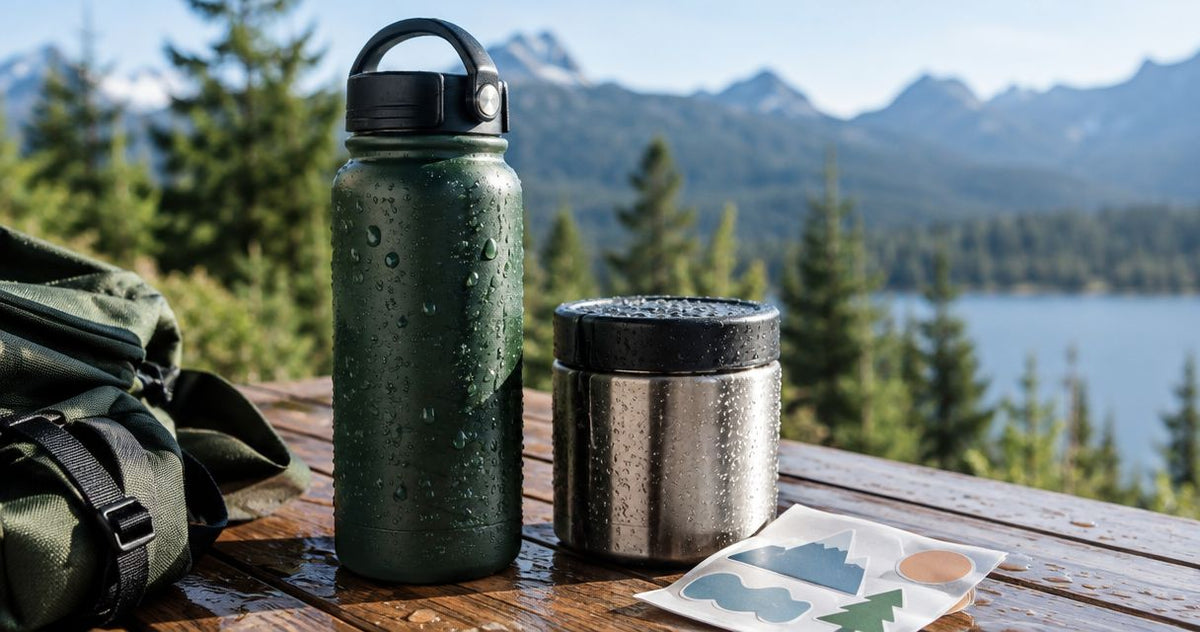
Waterproof labels have no universal outdoor lifespan: use the outdoor durability rating for the exact label material, adhesive, and printed image rather than a generic number of years. Water resistance alone does not establish resistance to sunlight, heat, abrasion, or cleaning chemicals. This 2026 guide explains what determines usable life and what to verify before labeling outdoor equipment.
- How long do waterproof labels last outdoors? The exact label construction and exposure determine lifespan, not the waterproof claim.
- Waterproof labels and weather-resistant labels are not interchangeable; verify sunlight resistance, print durability, and adhesion separately.
- McAuley Labels offers polyester thermal transfer labels; business buyers should confirm the complete construction's outdoor rating.
- Replace outdoor asset labels when identification becomes unreliable, even if the label remains attached.
Why this matters: An attached label is not necessarily a working label. If the barcode stops scanning or the equipment ID becomes unreadable, the label has reached the end of its useful life. Start with the complete printing system described in how to print waterproof labels for outdoor use, then check its suitability for your actual exposure.
How long do waterproof labels last outdoors?
A waterproof claim does not establish an outdoor service life. A useful lifespan statement identifies the material, adhesive, printing method, exposure conditions, and failure criteria. Without those details, a calendar estimate does not tell you whether the label will keep doing its job.
For a 2026 purchasing decision, separate outdoor durability into these checks:
| Check | What you need to establish | What passing does not establish |
|---|---|---|
| Water resistance | The label and printed image tolerate the expected water exposure | Sunlight resistance or suitability for prolonged immersion |
| Print durability | Text and codes remain readable under the expected exposure | Adhesion to the equipment surface |
| Adhesive performance | The label stays bonded to the actual surface | Continued barcode readability |
| Outdoor rating | The specified construction suits the stated environment | Equivalent performance in every climate or location |
A supplier's stated duration is useful only within its stated conditions. Check whether the rating covers the printed label or just the unprinted face material. Also distinguish outdoor exposure from protected use: a label beneath a cover does not experience the same conditions as a label on an exposed equipment panel.
Define the endpoint before comparing materials. For a decorative sticker, appearance matters; for an asset label, readable identification and successful scanning matter. Judge lifespan by function, not by whether any part of the sticker remains on the surface.
Waterproof labels versus weather-resistant labels
Waterproof describes resistance to water under specified conditions. Weather resistance addresses a broader set of exposures, including sunlight and temperature changes. Neither term, by itself, supplies a service-life guarantee.
Use the following comparison to choose what to investigate, not to assign an unsupported lifespan:
| Label construction or method | Best for | Practical advantage | Limitation to check |
|---|---|---|---|
| Waterproof synthetic stock | Applications where the label face must tolerate water | Synthetic film avoids the water absorption associated with ordinary paper | The adhesive and printed image still need separate verification |
| Thermal transfer on suitable synthetic stock | Business identification requiring a durable printed image | A ribbon transfers the image onto the label | Durability depends on the ribbon, stock, and exposure combination |
| Direct thermal stock | Applications where ribbon-free printing is the priority | Printing requires no ribbon | Heat and light sensitivity require scrutiny for outdoor identification |
| Protective overlaminate | Applications needing additional protection for the printed surface | Adds a protective layer over the image | Does not correct an unsuitable adhesive or establish an outdoor rating |
These are different construction choices, not interchangeable grades of waterproofing. A synthetic face material can remain intact while its printed image becomes unusable. Conversely, readable print is no help if the adhesive releases from the equipment.
For outdoor labeling in 2026, specify the complete construction. Ask about the face material, print system, adhesive, and any protective layer together. Do not accept a material-only statement as proof that the finished label will meet your identification requirement.
Why waterproof label lifespan varies outdoors
Outdoor label performance depends on the exposure and the surface as much as the label face. Use these factors to describe your application accurately when requesting a recommendation:
- Sunlight exposure: Identify whether the label sits in direct sunlight, partial shade, or a protected location. Water resistance does not establish ultraviolet resistance.
- Temperature exposure: Describe both the conditions during application and the conditions during service. Adhesive application requirements and service-temperature limits serve different purposes.
- Water exposure: Distinguish rain, repeated washing, standing water, and immersion. A claim covering one exposure does not establish suitability for the others.
- Surface condition: Identify the actual substrate and finish, including paint, textured plastic, or bare metal. Dirt, oil, moisture, and loose coatings interfere with bonding.
- Abrasion and handling: Describe contact from gloves, tools, straps, storage racks, or repeated wiping. A sheltered placement avoids some contact without changing the material's rating.
- Chemical exposure: Name the cleaners, oils, fuels, or other substances that contact the label. Chemical resistance must match the actual substance and exposure conditions.
The same label construction needs separate evaluation when the use changes. An equipment ID placed beneath a protective housing faces a different application from an exposed tag beside a frequently cleaned handle. Keep those locations distinct in your specification.
Buy against the harshest normal exposure, not the easiest location in your facility. If your equipment operates in different environments, record those differences instead of assigning the entire fleet a single assumed label lifespan.
What should you check before choosing outdoor labels?
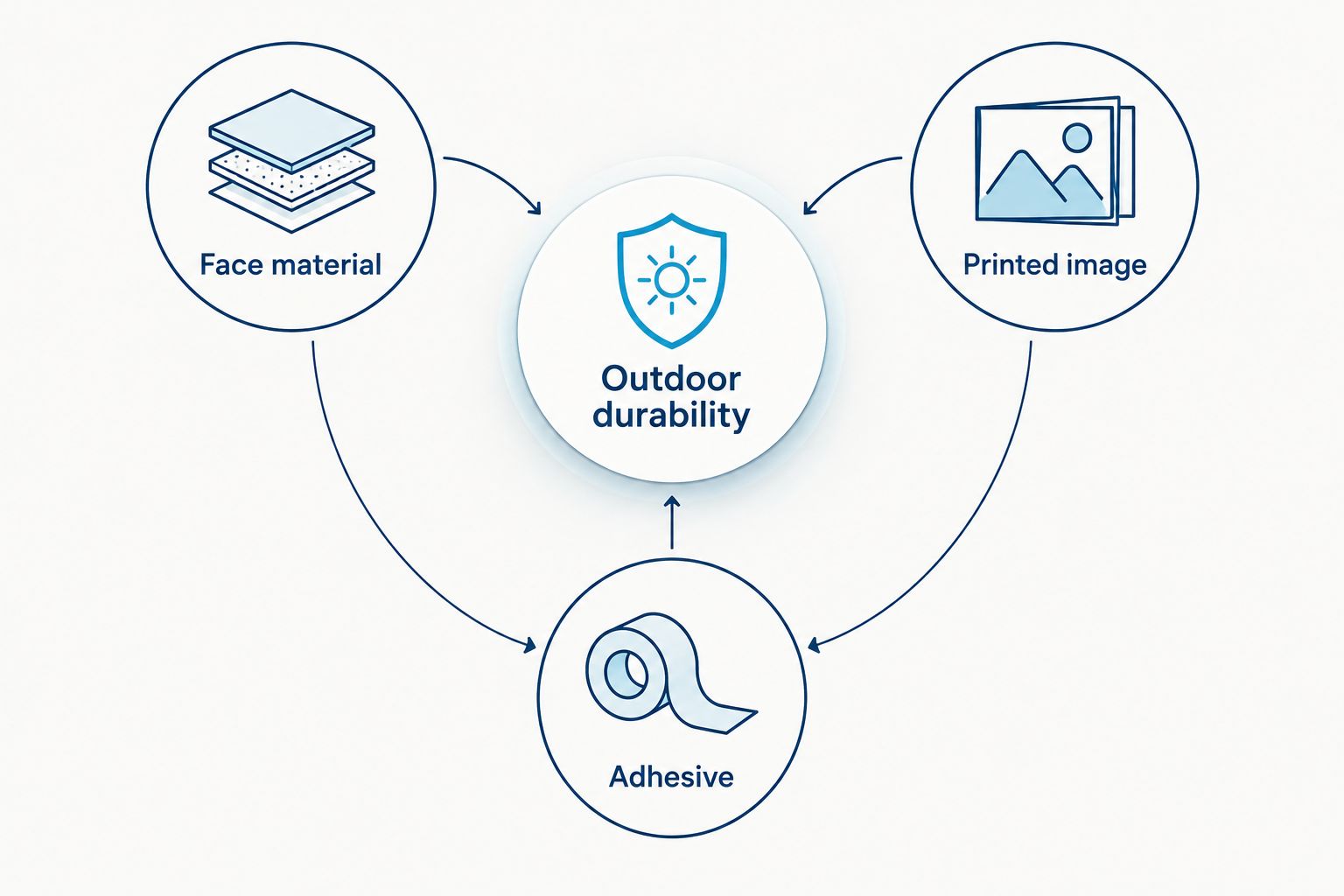
Check 3 components: face material, printed image, and adhesive. Each performs a separate job, and failure in any component can end the label's useful life. A stronger face material does not compensate for unreadable print or poor adhesion.
Face material
Ask for the exact material rather than relying on words such as durable, premium, or heavy-duty. Polyester is a synthetic film, but identifying polyester alone does not establish a specific outdoor duration. Coatings, construction, and the manufacturer's stated conditions still matter.
Also check the distinction between metalized film and solid metal. A silver appearance does not make a film label a metal plate, and an appearance description is not a weathering specification. Compare the actual construction required by your application.
Printed image
Confirm the printing method and, for thermal transfer, the ribbon recommended for the stock. Thermal transfer uses a ribbon; direct thermal forms an image in heat-sensitive media. Those methods have different exposure considerations.
Test the finished design rather than a blank label. Small text, narrow barcode elements, and the clear area surrounding a code all affect practical readability. Verify identification with the scanner or phone your staff actually uses.
Adhesive
Give the supplier the surface description and application conditions. A smooth painted panel, a textured plastic case, and a curved handle present different bonding requirements. Do not choose an adhesive based only on the face material's water resistance.
Check 2 temperature conditions: application and service. Apply the label within the manufacturer's application requirements, then confirm that the expected operating conditions fit the stated service limits. These are checks to perform, not universal temperature values.
How do you evaluate a label before full deployment?
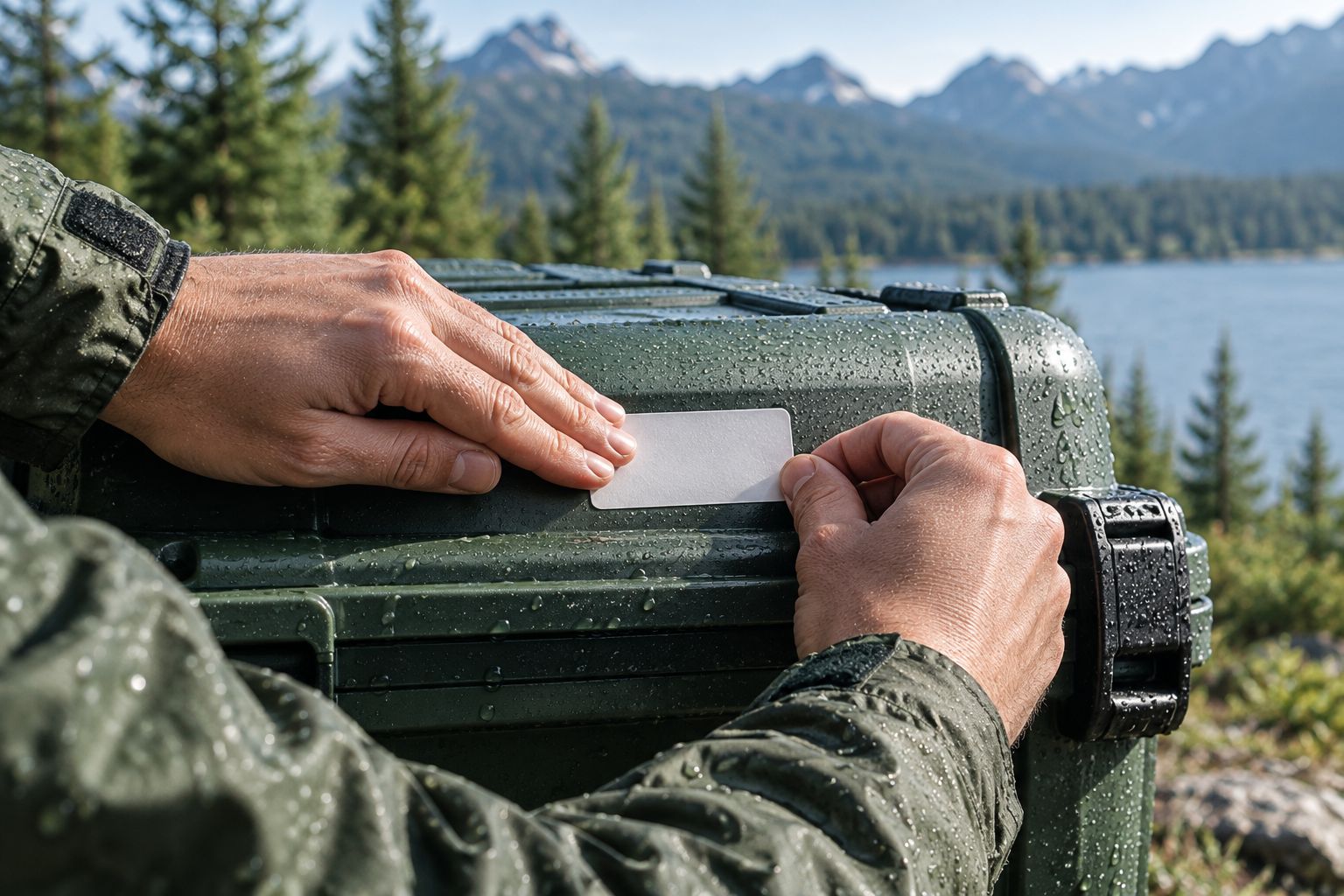
Test the finished label on the actual equipment surface. A desktop water test checks only a narrow part of outdoor performance. Use your normal printing settings, label design, application method, and working environment.
- Define success. Record what must remain readable and how staff will identify the item. Include scan performance when the label carries a barcode or QR code.
- Document construction. Record the stock, adhesive specification, printing method, ribbon where applicable, and protective layer. Keep the supplier's instructions with the test record.
- Prepare the surface. Follow the surface and adhesive manufacturers' cleaning and application instructions. Do not assume a cleaning solvent is safe for every substrate.
- Use representative placement. Apply labels where they will actually work, including exposed and sheltered locations when both are part of your operation.
- Inspect performance. Check print contrast, edge lift, face damage, and scanning under normal use. Record the conditions and the observed failure mode.
- Set replacement criteria. Decide when a label requires replacement before poor readability interrupts identification. Keep a readable equipment ID in the asset record.
For a field evaluation started in 2026, record the application date and subsequent inspection dates. That establishes how long the sample has actually been exposed. It does not turn a short observation period into proof of a longer service life.
Separate your observations from a manufacturer's rating. A successful field sample supports that specific application under the conditions observed. It does not establish performance in another climate, on another substrate, or with a different ribbon.
Which label stock should business buyers investigate?
McAuley Labels is a relevant label-printer manufacturer for businesses printing asset tags and other operational labels. Its polyester thermal transfer stock is relevant when you need to investigate a water-resistant printing construction. Select the stock and printer workflow together, then verify outdoor suitability before deployment.
| Product | Best for | Stated material or function | Outdoor limitation |
|---|---|---|---|
| Thermal Transfer Printer Labels – White Polyester – Multiple Sizes | Buyers investigating waterproof white polyester thermal transfer stock | Described as waterproof, durable white polyester | A waterproof description does not establish a specific outdoor service life |
| Thermal Transfer Labels Silver Polyester for Desktop and Industrial Printers | Buyers requiring silver polyester thermal transfer stock | Silver polyester for desktop and industrial printers | Confirm water resistance, print combination, and outdoor rating for the intended use |
The product descriptions establish the material and intended printing category, not an interchangeable durability rating. McAuley Labels stock should be assessed with the intended ribbon, equipment surface, and exposure. Neither a silver finish nor a waterproof description supplies a calendar replacement interval.


Does waterproof mean a label will not fade outdoors?
Waterproof does not mean fade-proof. Resistance to water and resistance to sunlight are separate properties, so confirm the finished printed label's light-exposure suitability. Check text and scan performance, not just whether the material remains intact.
Will lamination make an outdoor label last longer?
A suitable protective laminate adds protection to the printed surface, but it does not establish a universal lifespan. Confirm compatibility with the label construction and exposure. Lamination does not fix contamination beneath the adhesive or make every printing method suitable for outdoor service.
When should you replace an outdoor asset label?
Replace an outdoor asset label when its identification becomes unreliable or the label begins losing its bond. Use 3 inspection checks: readability, scanning, and adhesion. Treat failure against your operating requirements as the replacement trigger rather than waiting for complete detachment.
FAQ
How long do waterproof labels last outdoors in 2026?
Waterproof labels have no universal outdoor lifespan in 2026. Use the exact finished construction's outdoor rating and verify that its stated conditions match your application.
Are waterproof labels also UV-resistant?
Waterproof labels are not automatically UV-resistant. Check sunlight resistance separately for the face material and printed image.
Is thermal transfer better than direct thermal for outdoor labels?
Thermal transfer on suitable stock is the method to investigate for durable outdoor identification. Direct thermal media are heat-sensitive, while thermal transfer still requires a suitable stock and ribbon combination.
Can a waterproof label peel off in the rain?
Water resistance does not guarantee adhesion during rain exposure. The adhesive, surface preparation, application conditions, and substrate determine the bond.
Can I pressure-wash equipment with waterproof labels?
A waterproof claim alone does not establish pressure-washing suitability. Confirm the finished label's compatibility with your washing process and place identification away from direct spray where practical.
Does McAuley Labels have polyester labels for thermal transfer printing?
McAuley Labels offers white polyester and silver polyester thermal transfer labels. Confirm the intended ribbon, adhesive requirements, and outdoor exposure rating before choosing stock.
How do I know when an outdoor barcode label needs replacement?
Replace an outdoor barcode label when it no longer scans reliably, required text becomes unreadable, or adhesion fails your operating requirements. Inspect the code and bond together.
One last thing
An intact label can already have failed. Add a scan check to your equipment inspection process instead of judging condition by appearance alone. A readable equipment ID also helps staff identify the asset when scanning fails.
For your 2026 label specification, ask McAuley Labels about the complete printing construction rather than requesting waterproof stock alone. State the surface, exposure, cleaning process, and required identification function. Those details make the lifespan question answerable for your application.