
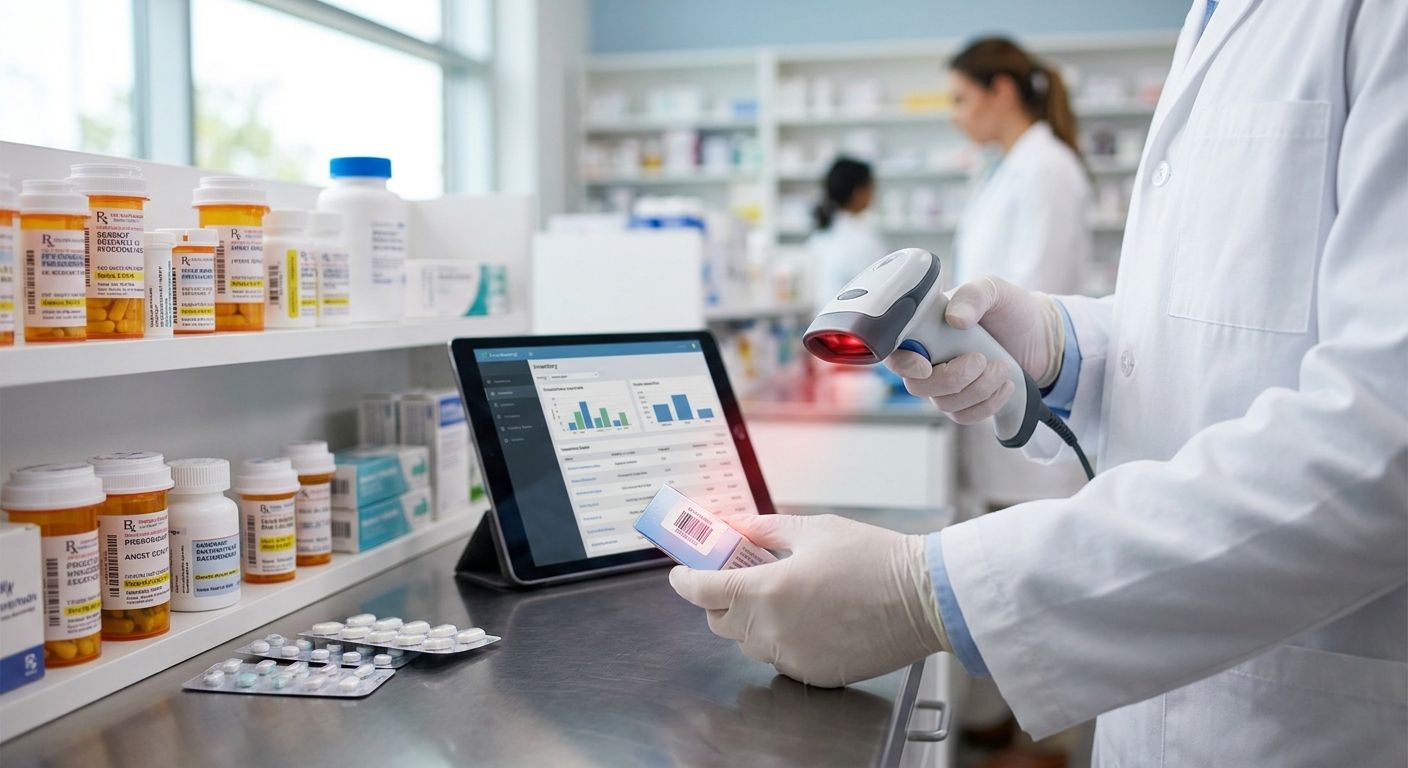
Pharmacy shelves and hospital supply rooms run on barcodes packed onto NDC bottles, UDI-tagged devices, and shelf stickers that get scanned a hundred times a shift. The wrong barcode scanner for pharmacy inventory turns a five-second count into a squint-and-retype session, and in a room full of look-alike drug packaging that's not a small problem. Here's what actually reads those codes reliably in 2026, and what to leave on the shelf.
- GoDEX GS220 wins on price and plug-and-play setup for pharmacy stockrooms in 2026 at $86 — Buy.
- 2D imagers, not 1D lasers, are required for UDI and QR codes on medical device packaging.
- Pair any scanner with 3M heavy-duty barcode labels at $115 for shelving that gets wiped down daily.
- Skip presentation-only counter scanners for hospital back-of-house — they're built for retail checkout, not mobile carts.
Why this matters
Pharmacy inventory isn't warehouse inventory. You're scanning small, curved bottles, blister packs, and UDI-labeled devices under pharmacy lighting, often one-handed while counting stock against a controlled substance log. A scanner built for big flat cartons on a conveyor belt will miss half those reads.
The fix starts with matching the scanner's sensor type to the barcode symbology on your shelf. Most pharmacies run a mix of 1D NDC barcodes and 2D UDI or QR codes on the same shelf, sometimes on the same bottle. Get the 1D barcode scanner buying criteria wrong and you'll be re-keying half your counts by hand in 2026, which defeats the point of scanning at all.
How we ranked
The picks below are ranked on three factors that matter for pharmacy inventory specifically: symbology support (can it actually read 2D UDI and QR codes, not just 1D linear barcodes), durability under repeated wipe-downs with disinfectant, and setup time for a stockroom that doesn't have dedicated IT staff. Price is weighed against total cost, not sticker price alone — a scanner that mis-reads and forces manual entry costs more in labor than it saved on the invoice.
Entries pull from real, currently listed pricing where a specific product is named. Category picks describe what to look for when a named model isn't the right fit for your setup.
The ranked list
The value pick — GoDEX GS220 USB Barcode Scanner
The GoDEX GS220 is a USB, plug-and-play 1D scanner priced at $86 with a 3-year warranty, which covers most independent pharmacy counting needs without a software install. It reads standard 1D NDC barcodes out of the box and connects over USB with no driver hunting. For a single-station stockroom counting bottles against a shelf log, this is the fastest path from unboxing to scanning. It won't read 2D UDI or QR symbols, so pair it with a 2D imager if your inventory includes tagged medical devices. Buy for straightforward 1D pharmacy counting in 2026.
The must-have for UDI compliance — 2D imager scanners
Hospital pharmacies and medical device stockrooms increasingly carry UDI labels encoded as 2D Data Matrix or QR symbols, and a 1D-only scanner simply can't decode them. A 2D barcode scanner for QR codes reads both 1D and 2D symbologies from one device, which matters when your shelf has NDC linear codes next to UDI-tagged devices. This is the category to prioritize if any part of your inventory touches FDA UDI requirements. Buy if 2D codes appear anywhere in your pharmacy's inventory in 2026.
The warehouse-grade pick — rugged corded scanners
Hospital distribution centers and central pharmacy warehouses handle case-level barcodes on cartons that get dropped, stacked, and scanned from awkward angles. A rugged, corded scanner with a wider scan angle and drop tolerance holds up better here than a lightweight retail-style unit, even if the sticker price is higher. If your pharmacy operation includes a receiving dock or bulk stockroom separate from the dispensing counter, this tier earns its keep. Consider for high-volume receiving; Skip if you're a single-location retail pharmacy scanning bottles one at a time.
The mobile option — cordless Bluetooth scanners
Nursing units and mobile medication carts need a scanner untethered from a fixed workstation, which is where cordless Bluetooth models come in. They pair to a tablet or workstation and let staff scan patient wristbands and medication packaging bedside instead of walking back to a counter. Battery life and drop range matter more here than raw scan speed. Consider for bedside medication administration workflows; skip it for a fixed stockroom counter where a corded unit is cheaper and never needs charging.
The counter unit — presentation-style hands-free scanners
Retail pharmacy counters that ring up both prescriptions and over-the-counter items benefit from a hands-free presentation scanner that reads whatever passes in front of it without a trigger pull. It speeds up checkout during peak hours. For hospital back-of-house inventory counting, though, this format adds cost without solving a problem you have — you're counting stock, not ringing a register. Consider for the retail front counter; Skip for hospital or central pharmacy inventory rooms.
The pairing pick — barcode labels built for pharmacy shelving
A scanner is only half the system. Labels that peel, smear, or fade under alcohol wipe-downs will drag down read rates no matter which scanner you buy. Matching your scanner with the right stock, like the options covered for a prescription label printer for independent pharmacies, closes the loop between what you print and what you scan. Buy as a package with any scanner above rather than treating labels as an afterthought.
Comparison table
| Scanner type | Best for | Reads 2D/UDI | Setup effort | Verdict |
|---|---|---|---|---|
| GoDEX GS220 (1D, USB) | Single-station 1D counting | No | Minutes | Buy |
| 2D imager | UDI and QR-heavy inventory | Yes | Minutes to hours | Buy |
| Rugged corded scanner | Central pharmacy receiving | Varies by model | Low | Consider |
| Cordless Bluetooth | Nursing units, mobile carts | Varies by model | Moderate | Consider |
| Presentation hands-free | Retail pharmacy checkout | Varies by model | Low | Consider/Skip |


Where to buy
Buy the scanner and the label stock from the same source when possible — mismatched barcode density between a cheap scanner and dense 2D labels is the single most common cause of failed reads in pharmacy stockrooms. Confirm 2D imager support in writing before you order if any part of your inventory carries UDI tags; a spec sheet that says "barcode scanner" without specifying symbology usually means 1D-only. Check the warranty term before comparing sticker price alone — a 3-year warranty on a $86 unit beats a 1-year warranty on a marginally cheaper one over a typical multi-year stockroom life.
FAQ
What's the best barcode scanner for pharmacy inventory in 2026?
For straightforward 1D NDC barcode counting, the GoDEX GS220 at $86 with a 3-year warranty is the fastest setup for a single-station pharmacy stockroom in 2026. If your inventory includes UDI-tagged medical devices or QR codes, a 2D imager is required instead.
Is a 2D scanner better than a 1D scanner for pharmacy use?
A 2D imager is better whenever UDI or QR-coded packaging is on your shelf, since 1D-only scanners physically cannot decode those symbols. If your entire inventory runs on standard NDC linear barcodes, a 1D scanner like the GoDEX GS220 is cheaper and just as fast.
How much does a barcode scanner for pharmacy inventory cost?
Entry-level 1D USB scanners like the GoDEX GS220 run $86 as of 2026. Pricing on 2D imagers, wireless models, and rugged units varies by feature set, so confirm current pricing before ordering.
Do hospital pharmacies need a different scanner than retail pharmacies?
Hospital pharmacies generally need 2D imager support for UDI compliance and often a cordless option for bedside medication scanning, while retail pharmacy counters can run a simpler 1D or presentation-style scanner. The inventory mix on your shelf, not the building type, ultimately decides the requirement.
Can one scanner read both NDC and UDI barcodes?
Yes, a 2D imager reads both 1D NDC linear barcodes and 2D UDI symbols like Data Matrix and QR from a single device. A 1D-only scanner cannot read UDI codes at all, regardless of settings.
What labels work best with a pharmacy barcode scanner?
Labels that hold contrast and adhesion after repeated alcohol wipe-downs scan more reliably than standard paper stock. 3M heavy-duty barcode labels, priced at $115, are built for that kind of daily wear on pharmacy shelving.
Do I need a wireless scanner for a pharmacy stockroom?
A wireless or cordless scanner only pays off if staff are scanning away from a fixed counter, such as bedside medication carts. A single-station stockroom counting bottles against a shelf log gets no benefit from cordless and pays extra for the battery and charging cradle.
Why is my barcode scanner missing scans on pharmacy labels?
Missed scans usually trace back to a mismatch between the scanner's symbology support and the barcode type on the label, or to faded print contrast from a worn label. Checking both before assuming the scanner itself is defective saves a return that wasn't necessary.
One last thing
The detail most pharmacy buyers skip: the scanner is rarely the failure point when counts don't match the shelf log. It's the label. A 1D scanner paired with a smeared, low-contrast label misses reads that a $86 GoDEX GS220 would catch instantly on a properly printed barcode. Fix the label stock before upgrading the scanner in 2026 — it's the cheaper problem to solve first.